From Concept to Reality: Advanced Packaging Powers Smarter AI Chips


Advanced packaging reshapes the future of artificial intelligence by driving rapid improvements in ai hardware. The latest market data shows that advanced packaging in AI hardware manufacturing reached $46 billion in 2024 and is expected to grow to $79.4 billion by 2030.
Year | Market Size (in Billion USD) | CAGR (%) | Fastest Growing Segment | CAGR of Fastest Segment (%) |
|---|---|---|---|---|
2024 | 46 | N/A | Telecom & Infrastructure | 14.9 |
2030 | 79.4 | 9.5 | N/A | N/A |
JUSDA and its JusLink platform support this growth by providing intelligent supply chain solutions, enabling efficient deployment and integration of advanced packaging for technology-driven industries.
Key Takeaways
Advanced packaging is crucial for enhancing AI hardware performance and efficiency, allowing for the integration of multiple components into a single unit.
Traditional chip design faces significant challenges, including long development times and high power consumption, highlighting the need for innovative solutions.
Technologies like 2.5D and 3D integration, along with chiplets, enable faster data transfer and improved energy efficiency in AI systems.
JUSDA's JusLink platform optimizes supply chain management for AI hardware, helping companies reduce lead times and improve inventory accuracy.
The future of AI hardware will focus on modular designs and advanced packaging technologies, driving innovation and efficiency in various industries.
Limits of Traditional Chip Design
Performance and Scaling Barriers
Traditional chip design faces significant obstacles as the demand for advanced AI hardware grows. The process of developing these chips often requires extensive time and resources. Companies encounter several limitations:
The design process can take months or even years, slowing innovation.
Increased complexity leads to higher costs for research, tools, and labor.
Small mistakes in design may result in delays or reduced performance.
Scaling barriers also restrict the capabilities of AI hardware. As data volumes increase, conventional architectures struggle to keep up. Several technical challenges emerge:
CPU bottlenecks, especially in the PCIe interface, limit data transfer rates between CPUs and GPUs. This directly impacts performance in AI applications.
High memory bandwidth requirements, sometimes reaching 1 TB/s per node, challenge traditional DRAM architectures.
Latency-sensitive tasks require high single-core CPU performance, often needing base frequencies above 4 GHz. This demand can hinder the overall computational power available for AI workloads.
These barriers highlight the need for new approaches in ai semiconductor design to deliver the computational power required for next-generation AI systems.
Power and Data Challenges
Power consumption presents another major challenge for traditional chip architectures. As AI systems scale, energy demands rise sharply. Key issues include:
Massive power consumption, which strains existing infrastructure.
Concerns about energy efficiency, as traditional designs struggle to optimize power use.
Limitations in interconnect technologies, which affect both data transfer and energy use.
The rapid growth of AI-related electricity demand, projected to reach 16% of total U.S. electricity by 2030.
A fivefold increase in electricity demand for AI expected over two years.
These challenges underscore the urgent need for innovations in energy efficiency and hardware optimization. Without new solutions, the computational power required for advanced AI will remain out of reach, and performance gains will stall.
Advanced Packaging in AI Hardware
Why Advanced Packaging Matters
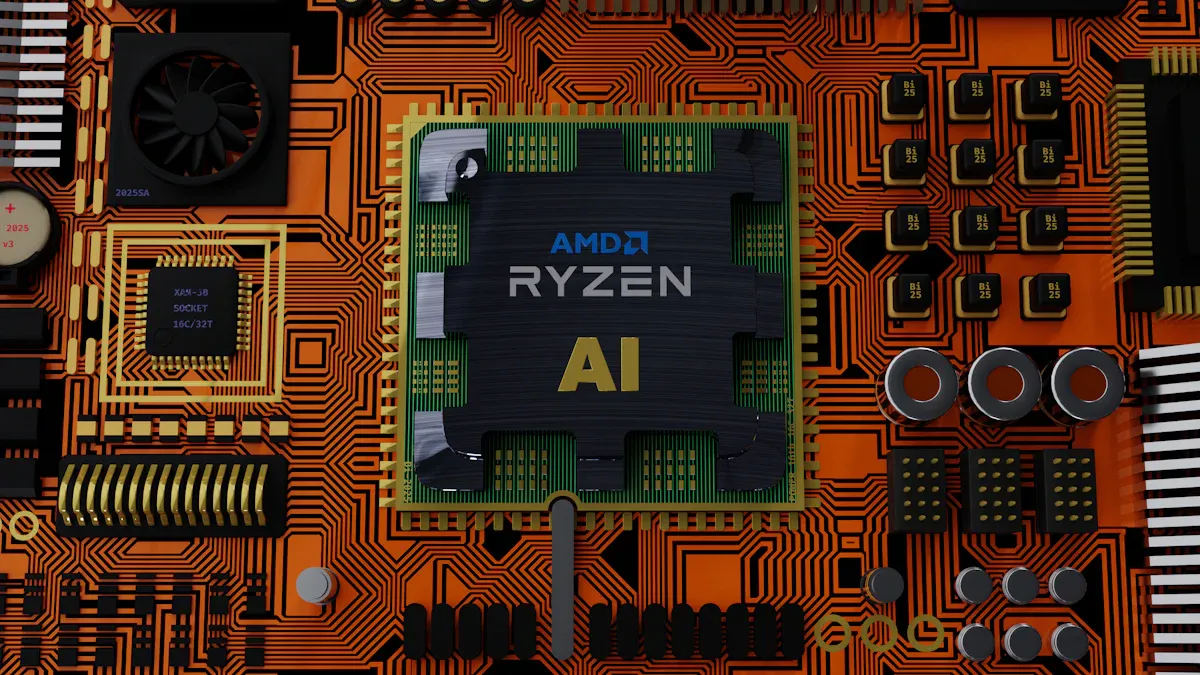
Advanced packaging has become a cornerstone for the next generation of ai hardware. As traditional chip designs reach their limits, engineers turn to new methods that improve performance and efficiency. Advanced packaging allows for the integration of multiple components, such as processors and memory, into a single unit. This approach leads to higher bandwidth and lower power consumption, which are critical for modern ai semiconductor applications.
Note: The expansion of advanced packaging capacity by leading manufacturers highlights its importance. Technologies like CoWoS and SoIC enable the integration of complex components, boosting both performance and energy efficiency in AI accelerators.
The following table compares advanced packaging with traditional methods in key areas:
Aspect | Advanced Packaging | Traditional Methods |
|---|---|---|
Functional Density | Limited to 2D designs | |
Modularity | Enables modular designs | Monolithic structures |
Memory Management | Improved, addresses the 'memory wall' | Less efficient memory handling |
Energy Efficiency | Enhanced through specialized integration | Less optimized |
Customization | Greater flexibility for specific tasks | Limited customization |
Yield | Higher due to smaller chiplets | Lower, defects impact whole chip |
Industry Reception | Critical for AI development | Lacks innovation |
These advantages make advanced packaging essential for supporting larger and more complex AI models.
Overcoming Moore’s Law Limits
Moore’s Law once drove rapid progress in chip technology, but physical and economic barriers now slow this pace. Advanced packaging offers a solution by enabling higher integration density and improved power efficiency. Engineers use 2.5D and 3D packaging, along with chiplets, to increase data transfer speeds and reduce latency. This approach helps overcome the 'memory wall' that limits traditional designs.
Advanced packaging also supports heterogeneous integration, combining different types of components in one package. This flexibility extends performance scaling beyond the limits of traditional silicon manufacturing. As a result, ai hardware can handle larger data volumes and more complex tasks, meeting the demands of modern applications.
Advanced Packaging Technologies
Advanced packaging technologies have transformed the landscape of AI hardware. These methods enable engineers to combine multiple chips and components in new ways, driving higher performance and efficiency. The most important technologies include 2.5D and 3D integration, chiplets and modular design, and advanced solutions like CoWoS and CPO.
2.5D and 3D Integration
2.5D and 3D packaging represent two leading approaches in advanced packaging technologies. In 2.5D integration, chips sit side by side on an interposer, which connects them efficiently. 3D integration stacks chips vertically, using through-silicon vias (TSVs) for direct communication. The table below highlights their differences:
Feature | 2.5D Integration | 3D Integration |
|---|---|---|
Structure | Chips placed side-by-side on an interposer | Chips stacked vertically |
Interconnect Density | High die-to-die interconnect density | Maximizes transistor density |
Footprint | Larger due to side-by-side placement | Smaller due to vertical stacking |
Communication | Efficient via interposer | Direct via TSVs |
Performance | Improved over traditional 2D designs | Enhanced due to shorter interconnects |
Energy Efficiency | Moderate | High due to reduced power loss |
Cost | More affordable | More complex and potentially costly |
Thermal management becomes more complex with these methods. 2.5D integration requires careful cooling, while 3D packaging can trap heat inside the stack.
Chiplets and Modular Design
Chiplet technology and modular design have become essential in advanced packaging technologies. These approaches allow engineers to build AI chips from smaller, specialized pieces. Key benefits include:
Integration of specialized components for better performance.
Faster time-to-market with reusable designs.
Scalability by adding more compute cores or accelerators.
Process node optimization, using advanced nodes for critical parts.
Improved yield rates, since smaller chiplets are easier to manufacture and replace.
Major companies like AMD, Intel, and TSMC use these methods to create flexible and powerful AI hardware.
CoWoS and CPO
CoWoS (Chip-on-Wafer-on-Substrate) and CPO (Co-Packaged Optics) stand out among advanced packaging technologies. CoWoS delivers high bandwidth, low latency, and strong energy efficiency, making it ideal for AI and supercomputing. CPO enables high-speed data transmission with minimal signal loss, supporting data centers and AI systems. These solutions allow for greater integration and performance, powering the next generation of AI hardware.
Advanced packaging technologies provide the foundation for integrating complex AI models, supporting rapid growth in high-performance computing and data centers.
Impact on AI Hardware
Performance and Efficiency Gains
Advanced packaging has transformed the landscape of ai hardware by delivering significant improvements in both performance and efficiency. Engineers now design ai accelerators that achieve higher computational power without increasing device size. This shift allows manufacturers to create specialized ai hardware that meets the growing demands of artificial intelligence and high-performance computing.
The integration of 3D chip stacking and chiplet architectures enables the development of advanced neural processing units. These units offer measurable gains in performance-per-watt, which means they deliver more computational power for every unit of energy consumed. As a result, system-level efficiency improves across data centers and edge devices. Companies can deploy high-density ai solutions that maximize performance while minimizing energy costs.
The impact of these innovations extends to ai accelerators used in various industries. For example, ai semiconductor designs now support more accelerators within a single package, increasing the overall computational power available for complex tasks. This approach also enhances performance-per-watt, making it possible to run demanding workloads with lower energy consumption. The result is a new generation of specialized ai hardware that delivers both high performance and efficiency.
Note: The combination of advanced packaging and modular design allows for rapid scaling of ai accelerators, supporting the needs of high-performance computing and artificial intelligence applications.
Supporting Complex AI Models
The impact of advanced packaging on ai hardware goes beyond raw performance. It plays a crucial role in supporting increasingly complex AI models that require massive computational power and low latency. Engineers use advanced packaging to integrate memory and processors efficiently, which is essential for handling large datasets and real-time inference.
Key benefits include:
Optimized performance: By placing memory and processors close together, ai accelerators achieve faster data transfer and lower latency.
Power efficiency: The optimized layout of components leads to better performance-per-watt, reducing energy costs for high-density ai deployments.
Smaller form factors: Vertical stacking enables compact ai hardware, making it easier to deploy accelerators in edge devices and data centers.
Cost savings: Chiplet-based designs allow manufacturers to use cost-effective processes for each component, improving system-level efficiency.
Specialized ai hardware now supports more accelerators per system, enabling the deployment of advanced models in fields like high-performance computing and artificial intelligence. These systems deliver high computational power and performance-per-watt, ensuring that even the most demanding applications run smoothly. The impact of these advances is clear: organizations can now build scalable, efficient, and powerful ai accelerators that drive innovation across industries.
Industry Adoption and JUSDA’s Role
Leading Companies and Trends
Many global companies have adopted advanced packaging to improve AI hardware performance and efficiency. These organizations focus on digital transformation, industrial automation, and AI-driven optimization. The table below highlights several leaders and their focus areas:
Company Name | Focus Areas |
|---|---|
Sealed Air Corporation | Sustainable packaging and digital transformation |
Amcor plc | Sustainable packaging and digital transformation |
Siemens AG | Industrial automation and AI for operational excellence in packaging |
ABB Ltd. | Industrial automation and AI for operational excellence in packaging |
DS Smith plc | AI-driven packaging optimization solutions |
International Paper Company | AI-driven packaging optimization solutions |
Smurfit Kappa Group | AI-driven packaging optimization solutions |
Rockwell Automation | AI-driven packaging optimization solutions |
Honeywell International Inc. | AI-driven packaging optimization solutions |
Syntegon Technology GmbH | AI-driven packaging optimization solutions |
Industry leaders measure success by tracking demand for inspection AI solutions, integrating hardware and software for quality assurance, and ensuring seamless system interoperability. Companies that achieve these goals see faster product cycles and improved operational outcomes.
Note: The market for advanced packaging continues to grow. Localized supply chains and accelerated product cycles have become essential, as customers now expect new AI hardware every year.
JUSDA and JusLink in AI Supply Chains
JUSDA plays a key role in supporting the deployment of advanced AI hardware. The company delivers intelligent supply chain solutions tailored to the needs of electronic manufacturing, automotive, and other technology-driven industries. JusLink, JUSDA’s digital supply chain platform, uses AI-driven forecasting, smart replenishment, and real-time risk management to optimize logistics for advanced packaging.
JusLink’s features help companies manage condensed development processes and meet the demand for rapid product upgrades. The platform enables real-time collaboration, inventory monitoring, and automated risk alerts. These capabilities reduce time-to-market for AI hardware and support seamless integration across global supply chains.
JUSDA’s commitment to innovation and efficiency ensures that clients can respond quickly to changing market needs. By leveraging JusLink, businesses gain greater visibility, control, and agility in their supply chain operations, which is vital for the success of advanced packaging in AI hardware.
AI and Supply Chain Innovation
JusLink’s AI-Driven Solutions
JusLink delivers a suite of AI-driven solutions that redefine supply chain management for advanced packaging in AI hardware. The platform uses intelligent algorithms to streamline operations, reduce costs, and enhance customer service. JusLink empowers companies to make proactive decisions and optimize logistics processes. The following table summarizes the key features of JusLink’s AI-driven supply chain solutions:
Solution Description | Key Features |
|---|---|
Streamlines operations, reduces costs, enhances customer service | |
Predictive Analytics | Enables proactive decision-making, optimizes logistics, boosts efficiency |
Real-time Data Analytics | Provides visibility, enables swift response to disruptions, drives performance |
Predictive Maintenance | Minimizes downtime, extends machinery lifespan, reduces operational costs |
Data-driven Insights | Offers comprehensive view, informs decisions on trends and preferences |
JusLink’s predictive analytics and real-time data capabilities allow supply chain managers to respond quickly to market changes. The platform’s data-driven insights help companies understand customer preferences and market trends, supporting better decision-making.
Enhancing Efficiency and Risk Management
AI integration in JusLink transforms supply chain efficiency and risk management for advanced packaging. The platform evaluates supplier performance and reliability by processing large volumes of structured and unstructured data. Advanced algorithms predict potential disruptions and recommend alternative sourcing strategies. JusLink analyzes historical data and market trends to forecast product demand, enabling precise inventory management.
JusLink optimizes inventory with real-time tracking and intelligent decision-making.
The platform enhances logistics through advanced route optimization and predictive maintenance.
AI systems continuously monitor supplier performance and potential disruptions, enabling proactive risk mitigation.
Supply chain managers face risks such as geopolitical tensions, natural disasters, and the complexities of advanced packaging technologies. JusLink’s AI-driven intelligence helps companies respond faster to disruptions and maintain continuity. Strategic reshoring and resilient partnerships further strengthen supply chain flexibility. JusLink enables organizations to adapt quickly, ensuring reliable delivery of advanced AI hardware.
Future of Advanced Packaging
Trends in AI Hardware
The future of advanced packaging in AI hardware shows rapid evolution. Engineers continue to refine 2.5D and 3D packaging, expanding interposer areas to support larger and more complex chips. Silicon bridge solutions emerge, allowing better connections between chiplets. Hybrid bonding, especially copper-to-copper (Cu-Cu), plays a critical role in achieving ultra-fine pitch vertical interconnects. Panel-Level Packaging (PLP) grows in popularity, offering cost-effective production for high-volume applications. AI integration in packaging design automates processes and optimizes layouts, increasing overall efficiency.
Timeframe | Trends and Developments |
|---|---|
Near-Term (1-5 years) | - Larger interposer areas in 2.5D/3D packaging |
Long-Term (beyond 5 years) | - Fully modular semiconductor designs |
In the long term, modular semiconductor designs will allow custom chiplets for specific AI workloads. Vertical stacking of components will become common, and Co-Packaged Optics (CPO) will enhance bandwidth while reducing energy consumption. Active interposers will improve in-package functionality, supporting new technologies such as quantum and neuromorphic computing.
Challenges and Opportunities
Advanced packaging for AI chips faces several challenges. Engineers must manage extreme density on printed circuit boards and maintain signal integrity at high data rates. Heat generation increases with power demands, making thermal management a top priority. These issues require innovative solutions.
Extreme density on printed circuit boards complicates design and manufacturing.
Signal integrity must be preserved as data rates rise.
Heat generation reaches unprecedented levels, demanding advanced thermal management.
Opportunities arise from these challenges. New materials and processes can improve performance and reliability. Novel engineered materials for high-bandwidth memory (HBM) chips and advanced thermal interface materials (TIMs) help manage heat more effectively. AI-driven supply chain solutions also create new possibilities. Predictive maintenance and quality control become more efficient, and automation of repetitive tasks increases productivity. Real-time monitoring improves food safety and traceability, while intelligent packaging systems support sustainability in the supply chain.
The integration of AI with advanced packaging technologies enhances operational efficiency and enables smarter, more resilient supply chains.
Advanced packaging drives the evolution of AI hardware, enabling smarter and more efficient systems. JUSDA and JusLink shape the future of technology by streamlining logistics and optimizing supply chains.
Company A reduced lead times by 30% and improved inventory accuracy with JusLink.
Company B achieved a 25% reduction in transportation costs using real-time analytics.
JUSDA enhanced collaboration and production scheduling worldwide.
Industry leaders recognize advanced packaging as the foundation for ongoing transformation. The future promises continued innovation in AI hardware and supply chain solutions.
FAQ
What industries benefit most from JUSDA’s supply chain solutions?
JUSDA serves electronic manufacturing, 3C home appliances, FMCG, automotive, new energy, medical health, heavy equipment, and bulk materials. Each industry receives tailored supply chain management solutions designed to improve efficiency and reliability.
How does JusLink improve supply chain efficiency for AI hardware?
JusLink uses AI-driven forecasting, smart replenishment, and real-time risk management. These features help companies optimize inventory, reduce lead times, and respond quickly to market changes.
JusLink’s intelligent agents provide real-time data and automated decision support for supply chain managers.
What are the main features of JusLink’s AI solution?
Supply chain trend analysis
Freight rate prediction
Sales demand forecasting
Automated replenishment strategies
Risk control tower
Intelligent supply chain assistant (JusElsa)
These features enhance visibility, decision-making, and operational efficiency.
How does JUSDA support global supply chain operations?
JUSDA operates over 155 service points worldwide and manages more than 2,500,000 square meters of warehouse space. The company provides air, land, sea, and rail transport, along with cloud warehousing and comprehensive foreign trade services.
See Also
Enhancing Supply Chain Efficiency Through AI Innovations
Exploring AI Integration for Tomorrow's Supply Chain
Transforming Our World: The AI Technology Revolution
Automation's Role in Advancing High-Tech Manufacturing Warehouses
Collaborating for Success: Strengthening Supplier Ties in Manufacturing