AI navigation transforms warehouse automation in 2025 with AI-augmented Visual SLAM technology enabling guide-free navigation systems

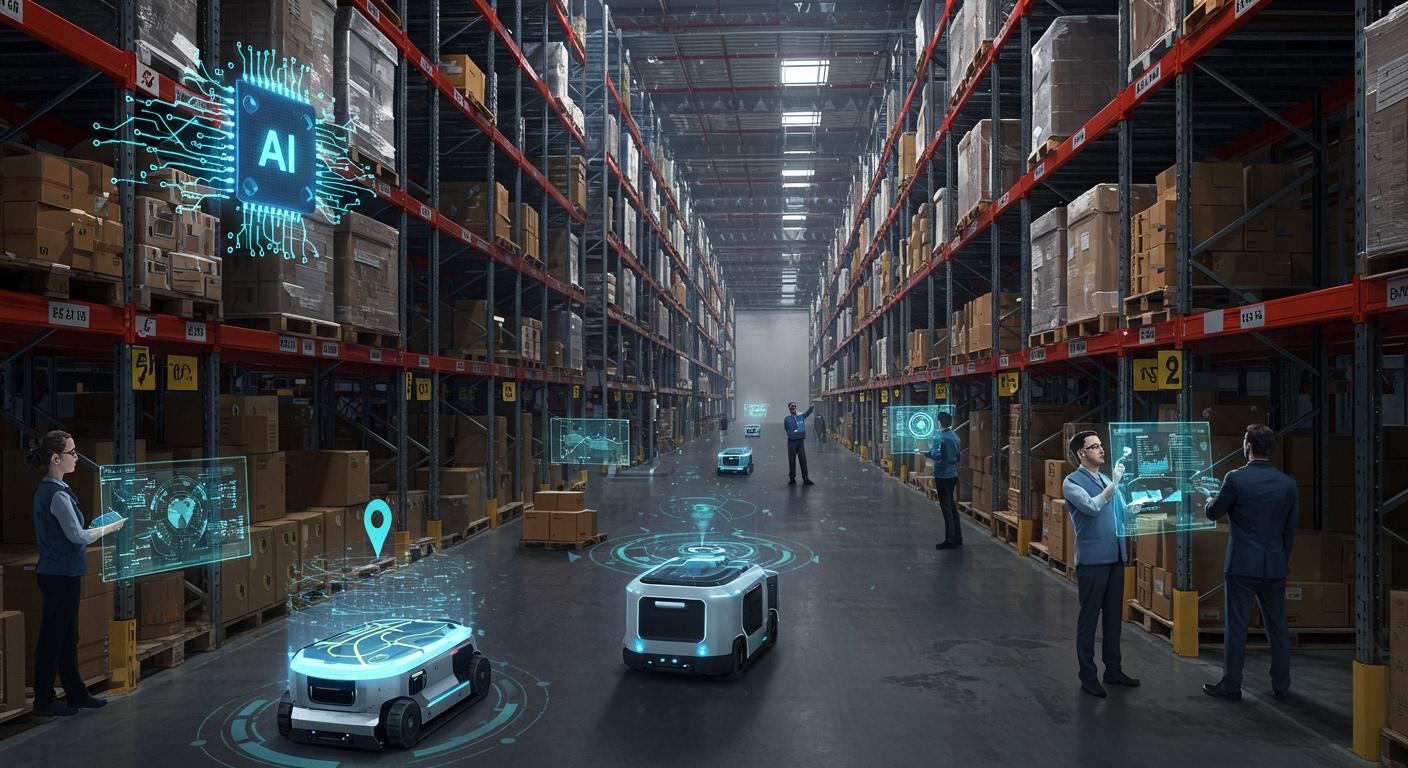
AI navigation powered by Visual SLAM is transforming warehouse operations in 2025. JUSDA deploys advanced warehouse and JusLink solutions to boost efficiency, flexibility, and cost reduction. Guide-free navigation systems allow machines to learn environmental patterns, raising obstacle detection efficiency by 30% over traditional methods. The shift to automation drives demand for high-accuracy systems, impacting warehouse operations and global supply chains.
Evidence Description | Key Insights |
|---|---|
AI-powered SLAM solutions | Enable machines to learn environmental patterns and enhance obstacle detection with up to 30% higher efficiency than traditional systems. |
Market Growth | The Global SLAM Market is projected to witness strong growth through 2033, driven by rising adoption across industries. |
Key Takeaways
AI navigation with Visual SLAM technology enhances warehouse efficiency by allowing machines to learn and adapt to their environment without physical guides.
JUSDA's JusLink platform provides real-time inventory tracking, automating replenishment and improving supply chain transparency.
Guide-free navigation systems reduce operational bottlenecks, improving travel time by up to 40% and increasing throughput by 35%.
Automation in warehouses leads to higher accuracy in order fulfillment, reducing picking errors by up to 70% and improving customer satisfaction.
AI-driven solutions support workforce transformation, allowing employees to focus on higher-value tasks while improving job satisfaction and safety.
AI Navigation and Visual SLAM
Technology Overview
AI-driven warehouse automation relies on advanced navigation systems that use Visual SLAM technology. Visual SLAM, or Simultaneous Localization and Mapping, enables robots and automated vehicles to map their surroundings and determine their position in real time. This technology forms the backbone of modern warehouse automation, allowing machines to operate without physical guides or markers.
Visual SLAM systems in warehouses combine several core technical components:
Real-time SLAM supports adaptive localization and path planning. Robots can adjust their routes instantly as the environment changes.
Advanced algorithms, such as hybrid SLAM-navigation systems like IA-DWA, optimize global paths and help avoid obstacles locally.
Multimodal sensor fusion integrates data from cameras, LiDAR, and other sensors. This fusion improves spatial awareness and navigation accuracy.
Deep reinforcement learning (DRL) enables predictive obstacle avoidance. Robots learn from experience, which increases safety and efficiency.
Visual SLAM technology automates repetitive tasks and adapts to dynamic warehouse environments with minimal management. Robots use sensors and AI to navigate changing conditions, reducing human error in processes like barcode scanning and packaging. Automation ensures accuracy in shipping and inventory management.
Note: Visual SLAM systems allow warehouses to achieve higher levels of efficiency and reliability. Automation reduces manual intervention and supports real-time adaptation, which is essential for large-scale warehouse operations.
JUSDA’s Role in AI Warehouse Automation
JUSDA leads the industry in deploying ai-driven warehouse automation solutions powered by Visual SLAM. The company integrates advanced navigation systems into its global warehouse network, supporting efficient and flexible operations. JUSDA’s warehouses use intelligent automation to streamline inventory management, order fulfillment, and logistics planning.
JUSDA’s JusLink platform enhances AI warehouse automation by providing real-time inventory tracking and control. The platform leverages IoT, cloud computing, and big data to enable seamless collaboration across the supply chain. JusLink’s AI-driven tools, such as sales forecasting and replenishment management, optimize inventory levels and reduce operational risks.
JUSDA’s approach to warehouse automation includes:
Automated guided vehicles (AGVs) and autonomous mobile robots (AMRs) equipped with Visual SLAM for guide-free navigation.
Real-time data sharing between suppliers and buyers, improving transparency and decision-making.
Integration of multimodal sensors and AI algorithms to support dynamic inventory management and accurate order processing.
JUSDA Warehouse Automation Features | Description |
|---|---|
Guide-free navigation | Robots move independently, adapting to warehouse layouts. |
JusLink provides instant updates on stock levels and locations. | |
AI-powered risk management | The system detects and responds to supply chain disruptions. |
Flexible automation solutions | JUSDA customizes automation for industries like electronics and automotive. |
JUSDA’s AI-driven warehouse automation transforms supply chain operations. The company’s solutions reduce costs, improve accuracy, and support scalability for global clients. Automation in JUSDA’s warehouses ensures reliable performance, even in complex and fast-changing environments.
Guide-Free Navigation Systems
How It Works
Guide-free navigation systems use advanced AI and Visual SLAM technology to transform warehouse operations. These systems allow autonomous mobile robots (AMRs) to map their environment and move without physical guides. AMRs rely on sensors, cameras, and LiDAR to detect obstacles and adjust their routes instantly. This dynamic approach enables robots to operate efficiently in changing warehouse layouts.
JUSDA integrates guide-free navigation into its automated warehouse solutions. Robots equipped with Visual SLAM analyze their surroundings, reroute around obstacles, and optimize travel paths. The Tree Method, used in high-traffic environments, demonstrated a 40% reduction in average travel time and a 35% improvement in throughput. These improvements help resolve bottlenecks and enhance operational efficiency. Faster and more reliable transport becomes possible when robots address obstacles without human intervention.
Note: Guide-free navigation systems support real-time adaptation, which is essential for modern warehouse operations. Robots can deploy quickly and require minimal setup, making them ideal for dynamic environments.
Comparison to Traditional Warehouse Operations
Traditional warehouse operations often depend on automated guided vehicles (AGVs) that follow fixed paths marked by wires or tapes. These systems require significant infrastructure changes for route updates and stop when encountering obstacles, waiting for operator instructions. In contrast, AMRs in guide-free navigation systems use AI and real-time mapping to maneuver through spaces dynamically.
FEATURE | AUTOMATED GUIDED VEHICLE (AGV) | AUTONOMOUS MOBILE ROBOT (AMR) |
|---|---|---|
Navigation | Follows fixed paths | Moves dynamically with AI and LiDAR |
Flexibility | Limited, needs infrastructure changes | Highly flexible, adjusts routes in real time |
Obstacle Handling | Stops and waits for instructions | Reroutes around obstacles independently |
Deployment | Requires predefined paths | Quick deployment, minimal setup |
Use Case | Repetitive, structured tasks | Dynamic environments, frequent layout changes |
AMRs maneuver through spaces dynamically, avoiding obstacles in real time.
AMRs resemble self-driving cars, plotting their own routes and making real-time adjustments. AGVs operate like trains, restricted to fixed tracks.
Warehouse Efficiency Benefits
Speed and Accuracy
Warehouse automation powered by AI navigation systems delivers significant improvements in speed and accuracy.
AI navigation systems process large volumes of data quickly, which increases order processing speed. They automate data entry and inventory tracking, minimizing human mistakes. Machine learning algorithms provide precise demand forecasts, preventing inventory mismanagement. Tools like barcode scanners ensure accurate stock levels, reducing miscounts. These improvements result in fewer picking errors and higher first-pass accuracy, which boosts overall warehouse efficiency.
Note: AI-powered warehouse automation reduces human errors in order fulfillment, such as incorrect data entry and missed information. AI tools validate data against predefined rules, ensuring accuracy and flagging discrepancies.
Flexibility and Scalability
Warehouse automation enables flexible and scalable operations across facilities of all sizes. AI navigation systems simplify the adoption of modular solutions, allowing easy integration of new components. The following table demonstrates how automation supports scalability and adaptability:
Evidence | Description |
|---|---|
Labor Cost Reduction | Labor accounts for up to 65% of total warehouse operating costs, driving automation demand. Automation helps reduce reliance on labor-intensive tasks, improving productivity without eliminating jobs. |
Picking Error Reduction | Automated picking systems can reduce picking errors by up to 70%, leading to fewer returns and increased customer satisfaction. |
Throughput Improvement | Robotics can improve throughput by 2–3x, allowing for more orders processed continuously without breaks. |
AGV Adoption Growth | Automated guided vehicles (AGVs) are growing at over 13% CAGR, indicating their increasing accessibility and value in scaling operations. |
AI-driven adaptability allows businesses to respond to changing demands and scale operations seamlessly. AI can reconfigure warehouse storage layouts in real time based on demand fluctuations, inventory patterns, and product characteristics. Algorithms generate optimal picking routes by analyzing product placement, order priorities, and aisle congestion. Smarter slotting strategies maximize available space and reduce travel time.
AI-powered systems work continuously, enhancing efficiency and safety.
Modular automation solutions allow warehouses to expand or contract operations as needed.
Dynamic storage layout optimization ensures efficient use of space and faster picking times.
Warehouse efficiency improves as automation enables rapid adaptation to new product flows and layout changes. JUSDA’s warehouse automation solutions support flexible operations, helping clients achieve scalable growth and consistent performance.
JUSDA Warehouse Solutions
JusLink and Real-Time Inventory
JUSDA delivers advanced warehouse solutions through its JusLink platform. JusLink uses IoT, cloud computing, and big data to provide real-time inventory tracking. The platform enables businesses to monitor stock levels and locations instantly. JusLink supports automated replenishment and demand forecasting. Companies gain full visibility into their supply chains.
JUSDA integrates eVMI and JusLink systems across its global warehouse network. These systems allow clients to track inventory in real time. The platform sends alerts for shortages and triggers replenishment processes automatically. JusLink improves transparency and control for warehouse managers.
JusLink’s AI-powered agents help users query inventory data, generate business reports, and assess transportation risks. The system supports conversational interaction, making data access simple and efficient.
JUSDA’s warehouses use advanced management systems to optimize operations. Facilities in China, Vietnam, the United States, and other regions rely on JusLink for inventory control. The platform ensures accurate stock counts and reduces manual errors. JUSDA’s clean room facilities meet strict environmental standards, supporting industries with high quality requirements.
Feature | Benefit |
|---|---|
Real-time tracking | Immediate updates on inventory status |
Automated replenishment | Reduced risk of stockouts |
Data transparency | Improved decision-making |
AI agents | Fast access to reports and risk analysis |
JUSDA’s AI solutions for warehouse management help clients reduce costs and improve efficiency. The company’s technology supports dynamic inventory management and rapid response to market changes.
Industry-Specific Applications
JUSDA tailors its warehouse solutions to meet the needs of different industries. The company serves electronics, automotive, FMCG, medical health, new energy, heavy equipment, and bulk materials sectors. Each industry receives customized services based on its requirements.
Electronics manufacturers benefit from JUSDA’s clean room storage and precise inventory tracking. Automotive clients use finished goods distribution centers and VMI hubs for raw materials. JUSDA’s warehouses in Hong Kong and Vietnam support B2C e-commerce and sorting services. The company’s multilingual staff and close relationships with customs authorities ensure smooth operations.
JUSDA’s value-added services include picking, packing, labeling, kitting, and repacking. These services help clients streamline logistics and improve product quality.
JUSDA’s global warehouse network covers China, Japan, the United States, Mexico, India, and other regions. The company provides bonded warehouses, distribution centers, and finished goods storage. Clients receive tailored solutions that match their industry’s supply chain needs.
Electronics: Clean room facilities, real-time tracking, and software upgrades.
Automotive: VMI hubs, finished goods centers, and cross-border logistics support.
FMCG: Efficient consolidation and distribution services.
Medical health: Compliance with environmental health and safety standards.
JUSDA’s industry-specific applications ensure that each client receives the right solution for their business. The company’s expertise in supply chain management helps clients achieve operational excellence and global competitiveness.
AI Warehouse Automation Impact
Workforce Transformation
AI warehouse automation is reshaping workforce roles in logistics. Employees now work alongside advanced robotics and AI-powered autonomous solutions, which handle repetitive and physically demanding tasks. This shift allows workers to focus on higher-value activities, such as quality control and process optimization. Many companies report that workers exposed to automation experience improved physical health and higher job satisfaction. They do not face increased anxiety or job insecurity. Instead, automation reduces working hours without affecting wages.
Training programs have evolved to support employees in these new environments. Companies use augmented reality (AR) to simulate complex warehouse tasks, improving preparedness and learning retention. Logistics firms have seen a 25% increase in picking efficiency and fewer errors after adopting AR-based training. Organizations like Walmart and Boeing use AR to guide workers, which helps them adapt quickly to AI-powered automation. Training now emphasizes AI literacy, practical application, workflow integration, and innovation.
Evidence Type | Description |
|---|---|
Labor Optimization | AI optimizes labor allocation, making roles more efficient |
Task Automation | Reduces physically demanding tasks, enhancing satisfaction |
Upskilling Opportunities | Provides chances for workers to engage in fulfilling roles |
Employee Retention | Higher retention rates due to reduced burnout |
Workers gain opportunities for upskilling and career advancement.
Employee retention improves as motivation increases.
Safety and Collaboration
AI warehouse automation enhances safety and collaboration in warehouse operations. Robots equipped with high-definition cameras and AI monitoring systems identify hazards, such as spills or overheating machinery, faster than humans. AI can predict congestion by analyzing movement patterns, allowing robots to adjust paths and prevent collisions. These features minimize slip and fall risks and prevent fire hazards.
Evidence Description | Impact on Warehouse Safety |
|---|---|
AI predicts congestion and reroutes robots | Reduces accidents by managing traffic proactively |
Robots detect hazards with cameras | Faster response to risks |
AI monitors spills and machinery | Prevents slips and fire hazards |
Cobots avoid collisions with humans | Ensures safe collaboration |
AI-powered automation supports continuous monitoring of warehouse conditions. Machine learning algorithms detect unusual machinery operation and near misses, helping prevent accidents. Collaborative robots, or cobots, work safely alongside human employees. AMRs reroute around obstacles and handle repetitive tasks, allowing workers to focus on decision-making and problem-solving. This mix of humans and robots increases efficiency and flexibility in operations.
AI and machine learning optimize inventory management and order fulfillment.
Collaboration between humans and robots leads to safer, more productive warehouses.
Overcoming Challenges
Integration and Training
Warehouses face several challenges when integrating AI navigation systems into daily operations. Many facilities rely on outdated systems, which can cause data quality issues and missing information. Change management presents another hurdle, as both frontline workers and managers may resist new technologies due to unfamiliarity and lack of training. Vendor lock-in can limit flexibility, making it difficult to adapt to evolving needs. Cybersecurity threats also increase with the adoption of AI, exposing operations to potential risks. Warehouses often struggle to find professionals with expertise in AI for logistics, which slows down implementation. Ethical concerns arise when AI makes errors, leading to compliance challenges. Scalability and maintenance become complex because each warehouse has unique characteristics.
Effective training strategies help overcome these obstacles. Hands-on training allows staff to practice with real tools and scenarios, building confidence. Gradual introduction of digital tools fosters familiarity. A culture of continuous learning encourages ongoing skill development. Mentor-apprentice arrangements guide less experienced staff through complex tasks. The following table summarizes proven training strategies:
Strategy | Description |
|---|---|
Hands-on training | Practice with actual tools and situations |
Gradual digital integration | Introduce simple tools to build confidence |
Continuous learning culture | Dedicated time for skill development and certification |
Tip: Start small by introducing user-friendly digital tools and create a safe space for practice before full implementation.
Solutions for Global Operations
Global warehouse networks require robust solutions to maintain efficient operations. JUSDA addresses these needs by integrating advanced AI and digital platforms across its facilities. The JusLink platform enables real-time inventory tracking and automated replenishment, supporting seamless operations in diverse regions. JUSDA’s supply chain management collaboration platform streamlines demand forecasting, delivery scheduling, and transport coordination. These systems reduce manual handling and improve data accuracy.
Industry leaders have demonstrated the benefits of AI integration. JD Logistics expanded storage capacity by 300% through AI-driven goods placement. Ocado uses AI-powered robotic arms to pack orders quickly, allowing staff to focus on strategic roles. Companies like DHL and Walmart leverage AI for predictive maintenance and demand forecasting, reducing costs and improving efficiency. JUSDA’s global network, supported by advanced technology, ensures reliable operations and enables clients to adapt to changing market demands.
Case Studies and Success Stories
JUSDA Customer Stories
JUSDA has helped leading manufacturers optimize global supply chains through advanced automation and digital platforms. The collaboration with Sharp stands out as a prime example. Sharp faced challenges in managing complex supply chains and high inventory costs. JUSDA implemented its Supply Chain Management Collaboration Platform, integrating AI and real-time tracking. This solution improved lifecycle management and reduced manual handling.
The following table highlights key metrics from JUSDA customer case studies:
Metric | Improvement |
|---|---|
Cost Reduction | |
Inventory Optimization | 35% |
Order Processing Speed | Significant Increase |
Inventory Accuracy | Significant Increase |
Customer Satisfaction | Significant Increase |
JUSDA’s platform enabled Sharp and other manufacturers to achieve faster order processing and higher inventory accuracy. Customer satisfaction rose as supply chain transparency improved. These results demonstrate the impact of JUSDA’s technology on global operations.
JUSDA’s approach supports efficient expansion and helps clients adapt to changing market demands.
AGV and AMR Market Trends
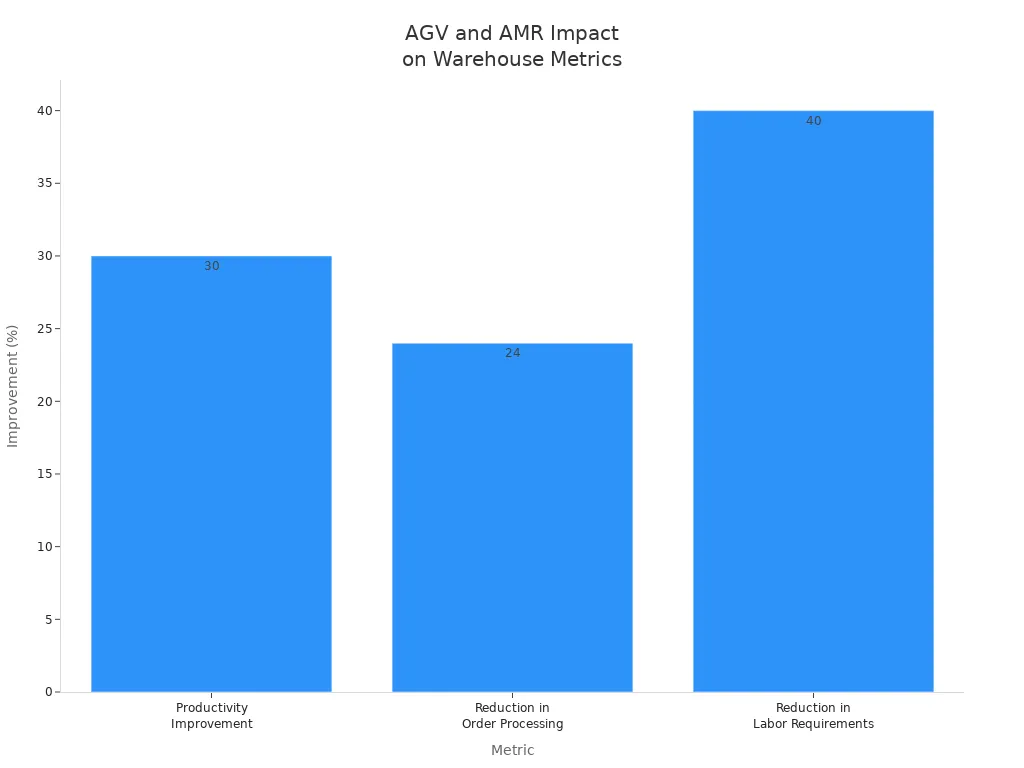
The market for automated warehouse equipment continues to grow rapidly. In 2024, the market reached $29.6 billion and is projected to hit $60.04 billion by 2031. The global autonomous robots segment, which includes AGVs and autonomous mobile robots, generated $5,523.7 million in revenue in 2023. Experts expect this figure to reach $14,018.4 million by 2030, with a CAGR of 14.6% from 2024 to 2030.
Metric | Improvement (%) | Source |
|---|---|---|
Productivity Improvement | Warehouse Operators (2023) | |
Reduction in Order Processing | 24% | E-commerce Businesses |
Reduction in Labor Requirements | 40% | General Findings |
The AGV market focuses on flexibility and efficiency.
The AMR market expands due to e-commerce growth and labor shortages.
Technological advancements drive exponential growth in the AMR market.
Operational efficiency and shifting business needs fuel adoption across industries.
JUSDA leverages these trends to deliver solutions that improve productivity and reduce operational costs. Clients benefit from faster throughput and lower labor requirements, making warehouse automation a key driver of success.
Future of Warehouse Automation
Innovation and Competitiveness
Warehouse automation continues to drive innovation and competitiveness in global logistics. Companies invest in advanced AI-powered management systems to stay ahead. Gartner reports that by 2026, 75% of organizations will adopt AI-driven warehouse management. This trend highlights the urgency for businesses to innovate and adapt.
JUSDA leads the way by integrating intelligent platforms like JusLink and eVMI across its global network. These systems provide real-time inventory tracking and automated replenishment, helping clients maintain a competitive edge. Businesses focus on three key areas to future-proof their operations:
Investing in robust infrastructure to support automation.
Developing the workforce to implement and manage AI technologies.
Refining data strategies to maximize the benefits of automation.
JUSDA’s commitment to innovation ensures that clients receive tailored solutions for electronics, automotive, and other industries. The company’s approach enables rapid adaptation to market changes and supports scalable growth.
Focus Area | Impact on Competitiveness |
|---|---|
Infrastructure | Enables seamless automation |
Workforce Skills | Improves technology adoption |
Data Strategy | Enhances decision-making |
Note: Companies that prioritize these areas position themselves for long-term success in warehouse automation.
AI-Driven Supply Chain Evolution
AI-driven supply chain evolution transforms logistics and warehouse management. JUSDA’s platforms use predictive analytics and dynamic routing to manage complex supply chains. These tools optimize workflows and enable real-time decision-making.
AI tools like predictive analytics and dynamic routing help companies manage supply chains efficiently.
Integration of AI improves resilience and decision-making in logistics.
AI-driven insights become as valuable as physical products, changing how supply chains are perceived.
Companies implementing AI-driven planning experience improved forecast accuracy and reduced freight costs. Machine learning models optimize routing decisions, leading to cost-effective and sustainable shipping. Big data analytics provide actionable insights for workflow optimization and maintenance prediction.
AI enhances warehouse productivity by enabling real-time decisions.
Companies see improved forecast accuracy and lower freight costs.
Integration of AI revolutionizes warehouse operations, making them more efficient and responsive.
JUSDA’s solutions empower clients to navigate disruptions and maintain operational excellence. Businesses that embrace AI and automation secure their place in the competitive logistics landscape.
FAQ
What is Visual SLAM technology in JUSDA’s warehouse automation?
Visual SLAM enables robots to map and navigate warehouse environments in real time. JUSDA uses this technology to support guide-free navigation, improving obstacle detection and operational efficiency across its global warehouse network.
How does JusLink improve inventory management?
JusLink provides real-time inventory tracking using IoT, cloud computing, and big data. The platform sends instant updates, automates replenishment, and offers AI-powered agents for fast data queries and risk analysis.
Which industries benefit from JUSDA’s warehouse solutions?
JUSDA serves electronics, automotive, FMCG, medical health, new energy, heavy equipment, and bulk materials sectors. Each industry receives tailored solutions, including clean room storage, VMI hubs, and compliance with strict environmental standards.
What value-added services does JUSDA offer in its warehouses?
JUSDA provides picking, packing, labeling, kitting, repacking, software upgrades, and rework services. These services help clients streamline logistics, improve product quality, and optimize warehouse operations.
How does JUSDA support global supply chain collaboration?
JUSDA’s Supply Chain Management Collaboration Platform integrates AI, cloud computing, and blockchain. The platform enables real-time transparency, demand forecasting, delivery scheduling, and transport coordination for efficient global operations.
See Also
Exploring AI Integration For Tomorrow's Supply Chain Efficiency
Understanding Robotic Automation's Role In Warehouse Efficiency
Advantages Of High-Tech Automation In Modern Manufacturing Warehouses