From High Costs to Smart Savings How AI Route Optimization Improves Logistics

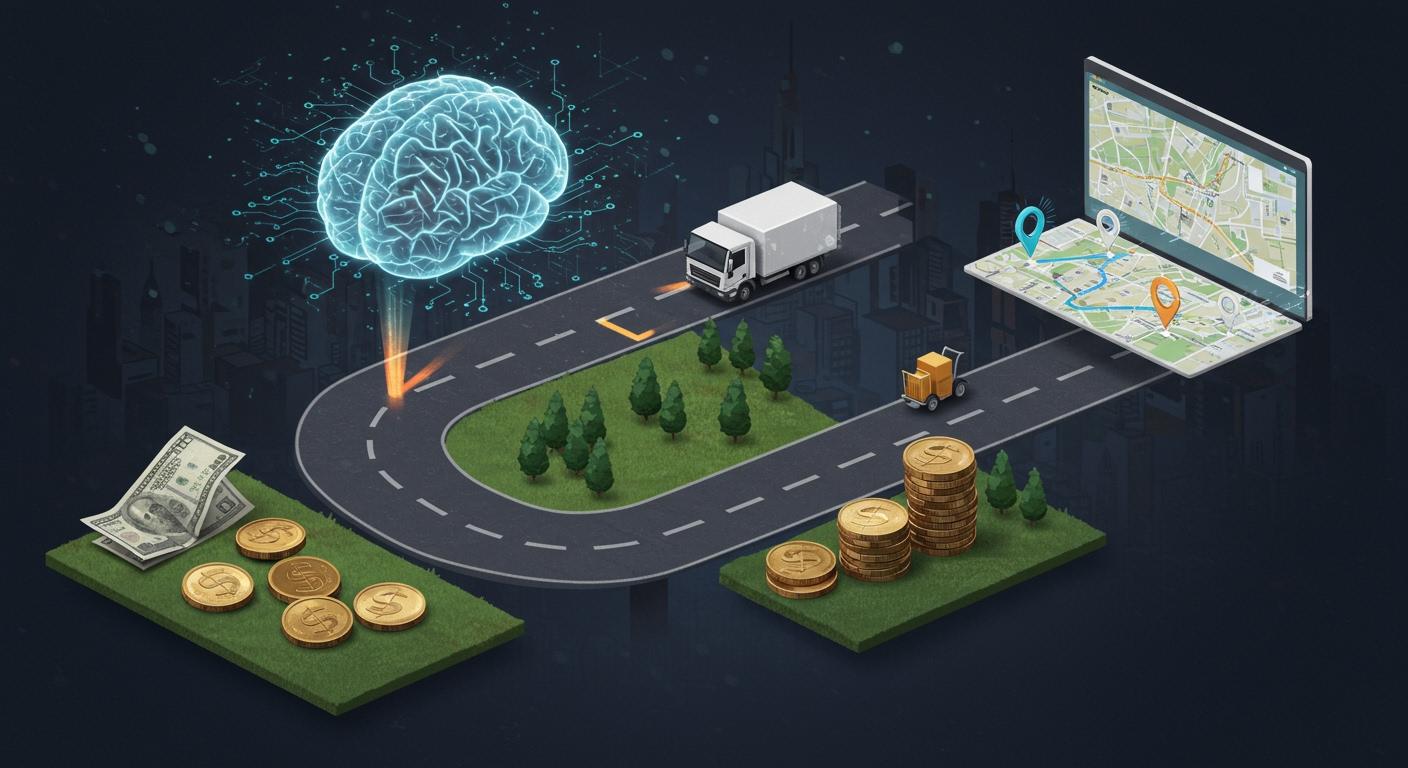
AI route optimization transforms logistics by reducing costs and improving delivery accuracy. Modern logistics companies face several obstacles:
Challenge | Description |
|---|---|
Rising Fuel Costs | Diesel prices in India have surged over 30% in the last two years, increasing transportation costs. |
Traffic Unpredictability | In cities like Bengaluru, drivers spend an extra 260 hours annually in traffic, leading to delays. |
Rapid Delivery Demands | Last-mile delivery is complicated by congested streets, increasing delivery times by 15-20%. |
JUSDA and its JusLink platform leverage advanced AI to address these issues. Companies using these solutions streamline delivery schedules, identify efficient routes, and reduce fuel consumption. Many large enterprises now adopt AI-powered tools for better operational efficiency. Businesses seeking a competitive edge should consider integrating intelligent route optimization into their logistics strategy.
Key Takeaways
AI route optimization can reduce transportation costs by 15-25% and fuel savings by 10-20%. Implementing this technology leads to significant financial benefits.
Real-time data analysis allows logistics companies to adapt routes instantly, improving delivery accuracy and reducing delays caused by traffic or weather.
Integrating AI tools like JusLink enhances operational efficiency, enabling companies to achieve higher customer satisfaction through timely deliveries.
Companies should assess their logistics needs and ensure data quality before implementing AI solutions to maximize effectiveness and avoid common pitfalls.
Adopting best practices, such as investing in employee training and maintaining human oversight, ensures successful implementation of AI route optimization.
AI Route Optimization in Logistics
Cost Reduction
AI route optimization transforms logistics by integrating real-time data from multiple sources. This technology analyzes traffic, weather, and delivery schedules to create the most efficient routes for every shipment. Companies using JusLink benefit from advanced algorithms that adapt to changing conditions, ensuring that vehicles avoid delays and minimize unnecessary mileage.
JusLink’s platform stands out by offering features such as intelligent risk management and automated application management. These tools help logistics teams respond quickly to disruptions and keep operations running smoothly. As a result, businesses see significant reductions in operational costs.
Companies that implement AI route optimization often report a 15-25% reduction in transportation costs and 10-20% savings on fuel compared to traditional planning methods.
The following table highlights the main benefits:
Benefit | Description |
|---|---|
Cost Savings | AI algorithms identify the most efficient routes, leading to reduced fuel usage and lower operational costs. |
Improved Efficiency | Streamlined logistics operations through optimized routes and resource allocation, enhancing productivity. |
Enhanced Customer Satisfaction | Quicker routes ensure on-time deliveries, improving customer satisfaction and retention. |
JUSDA, as a leader in intelligent supply chain solutions, leverages JusLink to deliver these measurable savings to clients across industries. The platform’s microservices architecture allows businesses to customize features, ensuring that each operation achieves maximum efficiency.
Delivery Precision
Precise delivery is critical in today’s logistics environment. AI route optimization enables companies to meet tight delivery windows and maintain high service levels. JusLink’s intelligent agents monitor shipments in real time, adjusting routes as needed to avoid delays and ensure on-time arrivals.
Reduced fuel costs: AI calculates the shortest and fastest routes, lowering fuel consumption.
Improved delivery accuracy: Real-time analysis minimizes human errors in route planning.
Enhanced productivity: Optimized routes allow more deliveries per shift, reducing labor costs.
Logistics companies measure the return on investment from AI route optimization through several key metrics:
Metric | Impact |
|---|---|
Operational Savings | |
Service Quality Improvement | Enhanced customer satisfaction |
ROI Timeline | Initial gains in 1-3 months |
Full benefits realized | 3-6 months |
Operational excellence | 6-12 months |
"The AI optimization system paid for itself in under 5 months. What surprised us most wasn't just the cost savings, but how much it improved our service quality and customer satisfaction scores." — Operations Director, Regional Delivery Company
JUSDA’s commitment to innovation and efficiency ensures that clients not only save money but also deliver a superior customer experience. JusLink’s AI-powered features help businesses achieve operational excellence and maintain a competitive edge in the global market.
JusLink vs. Traditional Methods
What Sets JusLink Apart
JusLink redefines logistics management by leveraging AI route optimization. Unlike conventional route planning, which relies on static maps and historical data, JusLink adapts to real-time conditions. The platform uses machine learning to analyze traffic, weather, and delivery schedules, ensuring each shipment follows the most efficient path. JusLink’s intelligent agents continuously learn from every trip, improving future route recommendations.
The following table highlights the main differences between JusLink’s AI-powered approach and traditional methods:
Feature | JusLink's AI-Powered Approach | Conventional Route Planning |
|---|---|---|
Adaptability | Adapts to real-time conditions | Static directions |
Learning Capability | Uses ML to improve routes | No learning from past trips |
Efficiency | Cuts fuel use and boosts on-time rates | Less efficient due to static nature |
JusLink’s adaptability and learning capabilities set it apart in a rapidly changing logistics environment. Companies using JusLink experience improved delivery accuracy and reduced operational costs.
Key Differences
JusLink integrates real-time data and automated decision-making to enhance logistics outcomes. The platform’s AI-powered demand forecasting and control-tower visibility utilize live data streams and supplier scoring. JusLink’s system reduces logistics costs by approximately 15%. Service levels improve by about 65%. Forecasting errors decrease by up to 50%. Practical implementations show an 11% improvement in delivery accuracy and an 8.5% reduction in over-stock.
AI-powered demand forecasting and control-tower visibility utilize real-time data and supplier scoring.
AI can reduce logistics costs by approximately 15%.
Service levels can improve by about 65%.
Forecasting errors can be reduced by up to 50%.
Practical implementations have shown an 11% improvement in delivery accuracy and an 8.5% reduction in over-stock.
JusLink’s automated decision-making ensures that logistics teams respond quickly to disruptions. The platform’s real-time monitoring and intelligent risk management help companies maintain supply chain stability. JusLink’s advanced features deliver measurable improvements in efficiency and customer satisfaction.
Benefits for Logistics
Efficiency Gains
JusLink delivers measurable improvements in operational efficiency for logistics companies. The platform integrates with corporate ERP systems, providing one-stop clearance capabilities and extensive customs solutions. Companies gain real-time visibility into customs processes, which ensures compliance and minimizes risks. Enhanced visibility across the supply chain leads to better decision-making and higher customer satisfaction. JusLink’s predictive analytics help anticipate market demands, allowing swift responses to changing conditions.
Improvement Type | Description |
|---|---|
Companies benefit from one-stop clearance capabilities and extensive customs solutions. | |
Cost Savings | Integration with corporate ERP systems enhances operational efficiency. |
Enhanced Visibility | Real-time visibility into customs processes ensures compliance and minimizes risks. |
Better Decision-Making | Enhanced visibility across the supply chain leads to better decision-making. |
Customer Satisfaction | Companies achieve higher customer satisfaction through reliable service. |
Predictive Analytics | The platform's predictive analytics help anticipate market demands, allowing swift responses. |
JusLink’s impact on delivery times and cost savings is clear. Companies have increased their on-time delivery rate from 92% to 99%. Delivery errors have dropped by 40%. Total credit and refund costs have decreased by 61%, while the cost of refunds related to delivery issues has fallen by 71%.
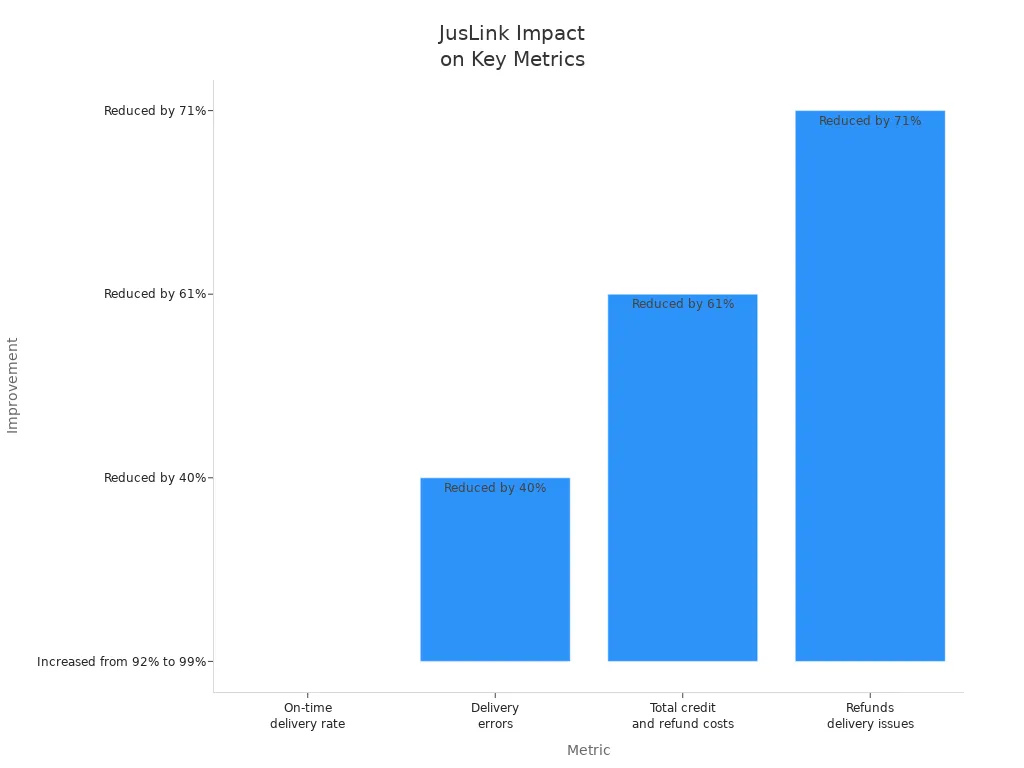
Companies report that optimizing last mile delivery leads to significant operational cost savings.
Sustainability
JusLink supports sustainable logistics through advanced energy management and AI route optimization. The platform’s Energy Solutions program manages utilities to lower operating costs by reducing energy use. The program uses a three-step approach: Measure, Reduce, and Offset, which systematically improves energy efficiency. Customers have seen an average savings of 12% on their utility bills.
The ANOVA test results show a significant relationship between fuel costs and vehicle loading weight, confirming economic savings from optimization.
Tukey’s HSD test demonstrates the impact of vehicle combinations on fuel consumption.
The average fuel consumption of 29 L/100 km translates to an average cost of 40.89 EUR for 100 km.
Optimized vehicle sets reduce the number of transits, lowering fuel consumption and emissions.
Fewer transportation cycles directly decrease fossil fuel use and CO2 emissions.
AI-powered route optimization minimizes fuel consumption and reduces the carbon footprint of supply chains.
Adaptive vehicle routing and automated fuel monitoring have helped companies reduce idle time and CO2 emissions, with some achieving reductions of approximately 500 kg of CO2 monthly.
JusLink’s commitment to sustainability ensures that logistics operations remain efficient and environmentally responsible.
AI in Action with JUSDA
Real-Time Data
JUSDA uses real-time data to drive smarter logistics decisions. The company integrates AI-driven tools, cloud computing, and big data analytics to optimize every step of the supply chain. These technologies help forecast demand, schedule predictive maintenance, and improve route planning. As a result, logistics operations become faster and more cost-effective.
Technology | Impact on Logistics Operations |
|---|---|
AI-driven tools | Enhanced demand forecasting, predictive maintenance, and route optimization, leading to lower costs and faster delivery. |
Cloud Computing | Enabled real-time data access and operational flexibility, improving supply chain management and reducing bottlenecks. |
Big Data Analytics | Provided insights into supplier performance and inventory management, minimizing disruptions and enhancing collaboration. |
Many logistics providers now track orders and inventory in real time. About 78% of them use this approach. Around 74% have integrated ERP systems for smoother operations. Predictive analytics can cut logistics costs by up to 30% and improve delivery times by 20%. JUSDA’s use of real-time data ensures that companies stay ahead in a competitive market.
Customer Success
Chinese manufacturers have seen major benefits from JUSDA’s AI-powered logistics solutions. These companies now enjoy stronger supply chain resilience and better synchronization between logistics and production. JUSDA supports localized production strategies, which helps reduce lead times and improve responsiveness to market demands.
Benefit | Description |
|---|---|
Supply Chain Resilience | Enhanced ability to adapt to disruptions, ensuring continuity in manufacturing processes. |
Real-time Logistics Synchronization | Improved coordination between logistics and production schedules, leading to efficiency gains. |
Localized Production Strategies | Support for manufacturers to produce goods closer to their markets, reducing lead times. |
Better Inventory Management | Advanced technologies allow for optimized stock levels and reduced waste. |
Responsiveness to Market Demands | Ability to quickly adjust to changing consumer needs and preferences. |
JusLink’s AI agents and the DeepSeek-powered assistant JusElsa play a key role in these improvements. These tools enable enhanced decision-making, autonomous operations, and better natural language understanding. Multiple AI agents work together, coordinating tasks efficiently across the supply chain.
Capability | Description |
|---|---|
Enhanced Decision-Making | Utilizes advanced reasoning models to reduce errors and improve accuracy in logistics operations. |
Autonomous Operations | Enables self-optimizing agents that learn and adapt in real time, crucial for dynamic logistics. |
Improved Natural Language Understanding | Superior NLU allows for better interpretation of customer queries, enhancing user experience in logistics. |
Multi-Agent Collaboration | Facilitates swarm intelligence, where multiple AI agents coordinate tasks efficiently in logistics. |
Customers report that JUSDA’s tools have transformed their supply chains. Companies using modern tools and smart strategies achieve similar results. AI-driven solutions like JusLink help create resilient, efficient supply chains. Businesses that adopt these technologies gain a strong competitive advantage in a changing world. AI route optimization stands at the core of these advancements, driving both efficiency and customer satisfaction.
Implementation Steps
Choosing JusLink
Selecting JusLink for AI route optimization begins with a clear assessment of business needs. Companies should evaluate their logistics processes and identify areas where efficiency gains are most needed. A strong data foundation is essential. Disconnected systems or poor data quality can hinder the effectiveness of AI solutions. JusLink integrates seamlessly with existing ERP and logistics management systems, making it suitable for organizations seeking end-to-end visibility and control.
Decision-makers should anchor their selection in business goals. Predictive analytics and route optimization must align with objectives such as reducing operational costs and improving customer experience. Collaboration with partners who specialize in AI-driven logistics accelerates implementation and helps avoid common pitfalls. JusLink’s microservices architecture allows customization, ensuring that each business can tailor the platform to its unique requirements.
Step | Action |
|---|---|
Identify inefficiencies and set clear goals for improvement. | |
Evaluate Data Readiness | Ensure data quality and system connectivity before implementation. |
Align with Business Goals | Match AI capabilities to cost reduction and customer satisfaction targets. |
Choose Expert Partners | Work with AI specialists for smooth integration and scaling. |
Customize JusLink Features | Adapt platform modules to fit specific operational scenarios. |
Best Practices
Successful adoption of JusLink’s AI route optimization tools relies on several best practices:
Start with readiness, not just tools. Companies must establish clean data and connected processes before deploying AI.
Anchor AI initiatives in business goals. Every implementation should focus on measurable outcomes like cost savings and improved customer experience.
Build strategic clarity. Develop adoption roadmaps that link AI opportunities directly to business objectives.
Foster cross-functional alignment. Leadership, IT, and operations teams should share responsibility for AI adoption.
Scale sustainably. Use frameworks that adapt to industry specifics, making AI repeatable across different logistics functions.
Invest in employee training. Specialized knowledge ensures effective use and maximizes benefits.
Maintain human oversight. Balance AI efficiency with personalized customer service to meet client expectations.
Tip: Companies that follow these practices often report fuel savings, faster deliveries, and reduced driver fatigue.
Challenge | Solution(s) |
|---|---|
Strategic planning, budgeting, and training | |
Overreliance on technology | Contingency plans and backup systems |
Privacy and security concerns | Robust data protection measures |
Human element and customer preferences | Maintain human oversight |
AI route optimization, powered by JusLink and JUSDA, drives measurable cost savings and delivery improvements for logistics companies. The following table highlights key benefits:
Benefit | Description |
|---|---|
Optimized routes lower fuel usage and operational costs. | |
Enhanced Delivery Efficiency | Faster deliveries through dynamic route adjustments. |
Decreased Carbon Footprint | Efficient planning supports sustainability goals. |
Industry trends show rapid adoption of AI solutions. Companies reduce expenses and improve efficiency by acting now. Route planning tools minimize stops and lower CO2 emissions, while live GPS insights help avoid congestion. Businesses gain a long-term competitive edge and support sustainable logistics by implementing JusLink’s intelligent platform.
FAQ
What is JusLink’s main advantage over traditional route planning?
JusLink uses AI to analyze real-time data, including traffic and weather. The platform adapts routes instantly, improving delivery speed and reducing costs. Traditional methods rely on static maps and cannot respond to changing conditions.
JusLink’s intelligent agents learn from each delivery, making future routes even more efficient.
How does JusLink help companies reduce fuel consumption?
JusLink’s AI algorithms select the shortest and fastest routes. The system monitors vehicle loading and traffic patterns. Companies report lower fuel usage and fewer transportation cycles, which leads to reduced operational costs and carbon emissions.
Benefit | Impact |
|---|---|
Lower fuel use | Reduced expenses |
Fewer cycles | Less CO2 emissions |
Can JusLink integrate with existing ERP systems?
JusLink offers seamless integration with corporate ERP and logistics management systems. This feature provides end-to-end visibility and control. Companies gain real-time access to customs processes, inventory, and shipment status.
Integration supports compliance and minimizes risks in global logistics operations.
What role do JusLink’s AI agents play in logistics management?
JusLink’s AI agents automate tasks such as material preparation, delivery stocking, and risk management. These agents provide real-time insights, monitor shipments, and identify potential disruptions. Companies benefit from improved decision-making and supply chain stability.
Enhanced transparency
Faster response to risks
How does JusLink support sustainability in logistics?
JusLink’s Energy Solutions program manages utilities and optimizes vehicle routing. The platform reduces energy use and fuel consumption. Companies achieve lower operating costs and decrease their carbon footprint.
Some companies report monthly reductions of approximately 500 kg of CO2 emissions.
See Also
Exploring AI's Hidden Capabilities In Logistics Management
Enhancing Supply Chain Performance Through AI Innovations
Transforming Future Logistics With AI Supply Chain Solutions
Maximizing Savings: Expert Tips For Supply Chain Optimization