Air cargo heats up on pre-tariff shipping and ecommerce promos

Air cargo heats up as you race to ship goods before tariffs hit and grab ecommerce deals. You see global demand jump 11.3% in 2024, with Asia-Pacific leading at 14.5%.
Full-year demand beat 2021 records.
International operations soared 12.2%.
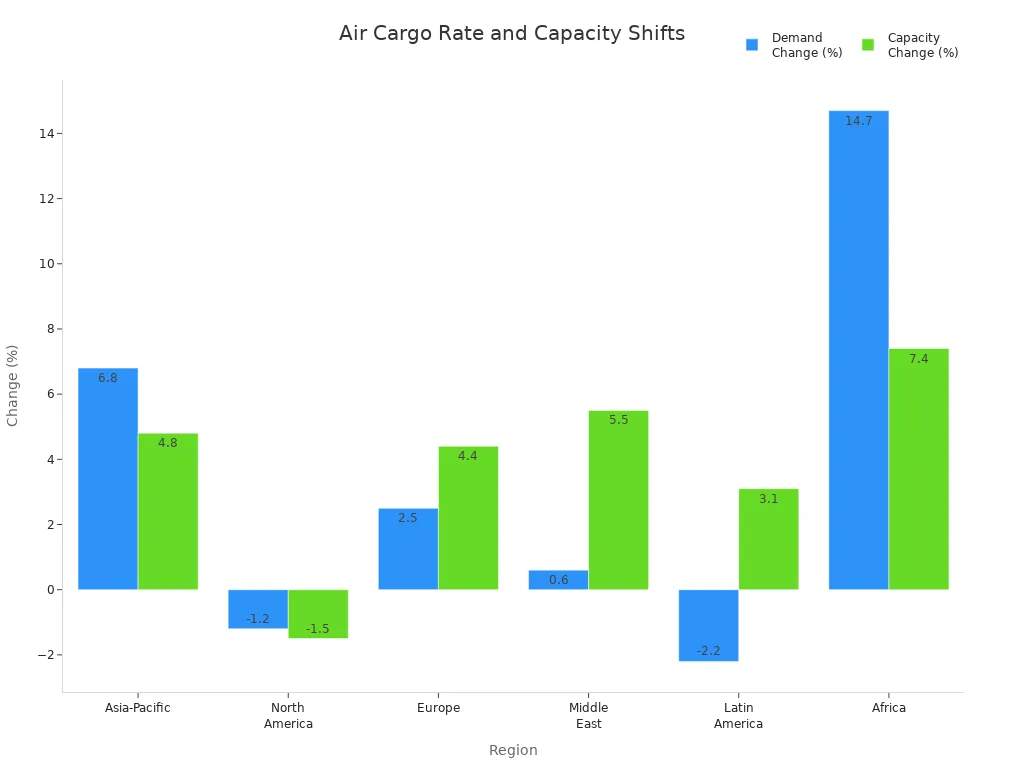
You need quick insights to stay ahead as rates and capacity shift fast.
Key Takeaways
Air cargo demand is rising due to pre-tariff shipping and ecommerce promotions. Companies should act quickly to secure shipping space and avoid higher costs.
JUSDA offers solutions like scenario modeling and contingency contracts to help businesses navigate tariff challenges and maintain supply chain efficiency.
Stay informed about global trade trends and tariff changes. This knowledge allows you to adapt your shipping strategies and minimize disruptions.
Air cargo heats up: Demand Drivers
Pre-tariff Shipping Surge
You see air cargo heats up every time new tariffs loom on the horizon. Shippers rush to move goods before higher duties take effect. This year, the China–U.S. air freight market has seen a big spike in demand. Airlines report full bookings, and rates have jumped as everyone tries to beat the clock.
Many companies want to avoid a 100% tariff increase on Chinese imports, so they ship early.
Pre-shipment activity rises sharply, filling up planes and pushing rates higher.
JUSDA’s global network gives you a front-row seat to these shifts. With service points across Asia, Europe, and North America, you can spot these surges early and plan your shipments to avoid delays or extra costs.
Ecommerce Promotions Boost Volumes
Ecommerce events make air cargo heats up even more. Big online sales, like those on Alibaba, Amazon, and Shein, send a flood of packages across borders. You notice this every time there’s a major promotion or shopping festival.
Global e-commerce revenues are set to grow 9% each year through 2029.
In September 2024, air cargo demand jumped 9.4% over the previous year.
International operations rose 10.5%, marking the 14th straight month of growth.
Air cargo volumes from Asia-Pacific to Europe soared 47% compared to late 2019.
Shipments to the US climbed 37% in the same period, mostly low-value items like electronics and fashion.
JUSDA’s expertise in ecommerce logistics helps you ride these waves. You get tailored solutions for fast-moving consumer goods, electronics, and more, so you never miss out on peak season opportunities.
Asia-Pacific and US Market Trends
The Asia-Pacific region leads the charge as air cargo heats up, but the story is changing fast. You see strong growth in shipments from Taiwan, Vietnam, Thailand, and Malaysia to the US, especially for tech and machinery. Still, the market faces some bumps. Freighter redeployments and route changes limit capacity, especially for passenger flights.
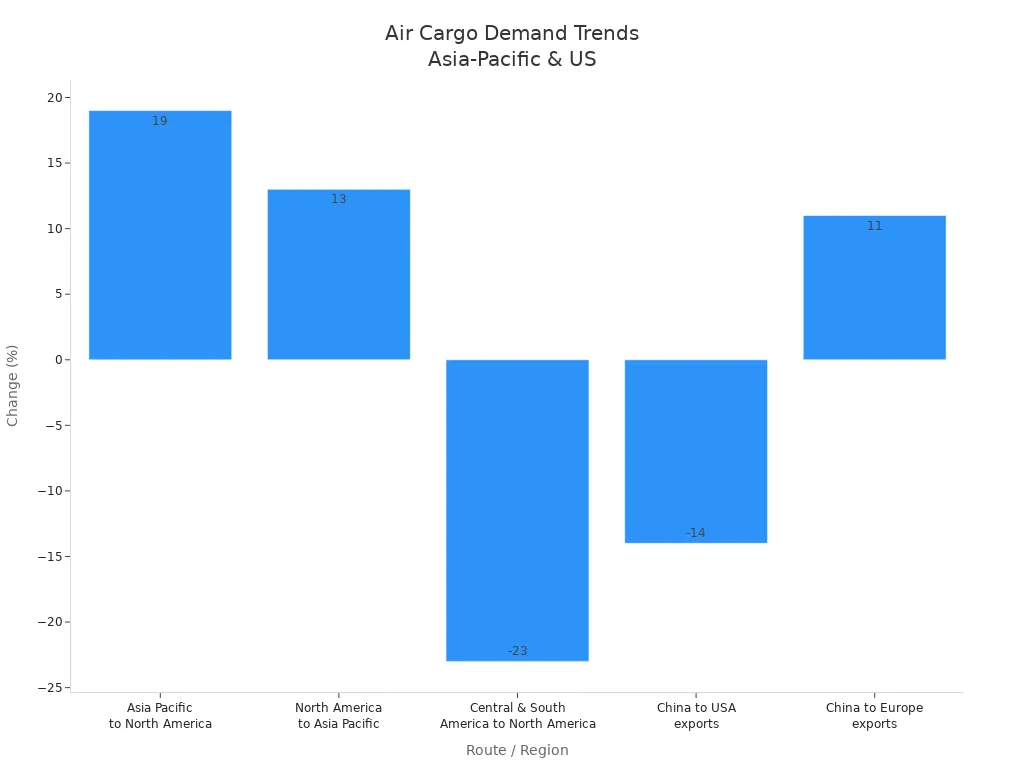
Here’s a quick look at recent trends:
Trend Description | Value |
|---|---|
Growth in Asia Pacific to North America | +19% |
Growth in North America to Asia Pacific | +13% |
Decline from Central & South America to N. Am. | -23% |
Drop in China to USA exports | -14% |
Increase in China to Europe exports | +11% |
You also notice a shift in trade routes. While China to USA exports dropped 14%, China to Europe exports rose 11%. E-commerce keeps driving trade from Asia-Pacific to Europe, and you can see this in the numbers.
JUSDA’s industry knowledge and global reach help you adapt to these changes. You get real-time insights and flexible options, so you can shift your strategy as the market moves.
Tip: Stay alert to tariff news and ecommerce cycles. Quick action helps you secure space and better rates when air cargo heats up.
Tariff Impact on Air Cargo

Shifting Shipping Patterns
You see shipping patterns change fast when new tariffs hit. Companies scramble to adjust their supply chains. Some move goods earlier to avoid extra costs. Others look for new suppliers or switch trade lanes. You notice big drops in cargo volumes between China and the U.S.—up to 60% since the tariffs were announced. E-commerce bookings fell by half in May. The end of the de minimis exemption for imports from China and Hong Kong made things even tougher. De minimis items used to make up half of air freight volumes, but now you see fewer of these shipments.
Cargo volumes between China and the U.S. dropped by 60%.
E-commerce bookings fell by 50% in May.
Fewer de minimis shipments after rule changes.
Shippers don’t just wait and hope. You see them change freight flows and sourcing origins. Some companies restructure their shipping patterns in just a week after a tariff announcement. Carriers notice these shifts too. You see more businesses using integrated logistics solutions to stay flexible and respond quickly.
Tip: If you want to keep your supply chain strong, consider diversifying your sourcing and shipping routes. Quick changes help you avoid surprises when air cargo heats up.
Rate and Capacity Fluctuations
Tariffs shake up air cargo rates and capacity. When a new policy comes out, you see a rush to ship goods before the deadline. This surge pushes rates higher and fills up planes. After the rush, demand drops sharply. Carriers end up with extra space, and rates fall. Over three months, average prices dropped by 4.5%. You see market volatility everywhere.
Here’s a table showing how tariffs affect pricing and space:
Evidence Description | Source |
|---|---|
50% drop in air cargo bookings from China to the US | Easyway Air Freight |
Softer demand between China and the US expected | Lavinia Lau, Cathay Pacific |
Fewer price quotation requests for air cargo shipments | Wang Xin, Shenzhen Cross-Border E-Commerce Association |
Trucking companies worry about lower volumes | Adam Miller, Knight-Swift Transportation |
Prices rise while consumer spending falls | John Shea, Momentum Commerce |
You see carriers use dynamic pricing models. They adjust rates based on real-time market conditions. Performance metrics help stabilize pricing. When demand falls, you get more choices and better deals. When demand spikes, you need to act fast to secure space.
JUSDA’s Solutions for Tariff Challenges
You don’t have to face tariff challenges alone. JUSDA gives you smart strategies to keep your supply chain moving. You get scenario modeling to balance price and service. This helps you plan the best routes and avoid costly surprises. JUSDA diversifies capacity sources, so you don’t rely on just one trade lane. You get contingency capacity contracts to handle sudden demand surges.
Strategy | Description |
|---|---|
Scenario Modeling | Balances price and service requirements to optimize route planning. |
Diversifying Capacity Sources | Maintains a mix of carriers to avoid over-reliance on a single trade lane. |
Contingency Capacity Contracts | Secures backup commitments to handle unexpected demand surges. |
You can build strong relationships with multiple carriers. This gives you more negotiation power. Transportation management systems (TMS) help you benchmark rates and make smart shipping decisions. Sharing data and performance metrics with carriers aligns goals and improves service levels.
Build strong relationships with multiple carriers.
Use TMS to compare rates and optimize shipping.
Share data to improve service and align goals.
JUSDA also helps you explore alternative markets and suppliers. This reduces your risk when tariffs change. You get customs and compliance support, so your shipments clear faster and avoid delays. With JUSDA, you stay ahead when air cargo heats up.
Note: JUSDA’s global network and technology give you the tools to adapt quickly. You can keep your supply chain resilient, even when tariffs and policies change.
Ecommerce Drives Air Cargo Growth
Online Sales Events and De Minimis Rule
You notice big changes every time there is a major online sales event. Global air cargo volumes jumped 5% year-on-year in August. E-commerce shipments played a big part in this growth. Even with more packages flying, the average spot rate dropped by 3% to $2.55 per kg. This means you might see lower prices now, but it could signal challenges ahead.
The de minimis rule used to let you ship goods worth $800 or less into the U.S. without paying duties. Now, with this rule ending, every parcel needs formal customs clearance. You will see:
Higher shipping costs for e-commerce orders.
Slower delivery times because of extra customs checks.
More complex paperwork for each shipment.
These changes make it harder for you to get fast, cheap deliveries from overseas.
Cross-Border Ecommerce Trends
Cross-border e-commerce keeps growing fast. You see air cargo heats up as more people shop online from other countries. Here are some trends shaping the market:
Trend | What’s Happening |
|---|---|
Growing 6-7% each year, faster than regular freight. | |
Digitalization | Over 75% of shipments now use e-AWB, making tracking easier. |
Blockchain technology | Adds security and transparency to your shipments. |
You benefit from faster, safer, and more reliable deliveries as these trends continue.

JUSDA Solutions
To provide you with professional solutions and quotations.
JUSDA’s Support for Ecommerce Logistics
JUSDA helps you handle these changes with smart solutions:
Special air freight channels for electronics, so your gadgets arrive quickly and safely.
Easy integration with Shopify for smooth order management and tracking.
Strong focus on compliance and safety, so your shipments clear customs without trouble.
You get tailored support for your e-commerce business, whether you ship fashion, electronics, or other goods. JUSDA keeps your supply chain moving, even when rules and demand shift.
Alternatives to Air: China-Europe Express Rail by JUSDA
Rail vs. Air and Sea Freight
You might wonder if there’s a better way to move goods when air cargo gets too expensive or unpredictable. JUSDA’s China-Europe Express Rail gives you a smart option. This rail service connects China and Europe with reliable, scheduled trains. You get more predictability and less risk of delays. The trains now run faster, reaching speeds up to 120 km/h. The rail network keeps growing, so you have more choices for your shipments.
Rail freight creates much less CO2 than air. In 2020, the Eurasian railway route produced only 36.5 thousand tonnes of CO2, while air transport would have created over 19 million tonnes.
Dedicated container trains between China and Europe make rail service more reliable and predictable.
Upgrades to tracks and longer trains help move more goods at once.
Cost and Speed Advantages
You want to save money and time. Rail freight costs more than sea but much less than air. It gives you a balance between price and speed. Sea freight from China to Europe can take 30 to 40 days. Rail cuts that down to about 12 to 18 days. Sometimes, rail shipments arrive in less than 10 days. This helps you keep your supply chain moving without breaking the bank.
Rail is cheaper than air and faster than sea.
Rail rates can be up to 59% lower than average sea rates for China-Europe routes.
You get your goods weeks sooner compared to ocean shipping.
Use Cases for Electronics and Medical Goods
You need fast, safe delivery for high-value products like electronics and medical supplies. Many companies now use China-Europe Express Rail for these shipments. For example, an automotive parts supplier switched from ocean to rail during the Red Sea crisis. They cut transit time by 45 days and saved 10% on freight costs. This kind of result shows how rail can help you deliver electronics and medical goods quickly and reliably, even when other routes face delays.
Tip: If you want to avoid air cargo price spikes and sea freight delays, try JUSDA’s China-Europe Express Rail for your next shipment.
Smart Supply Chains: JusLink AI by JUSDA
Predictive Analytics for Freight Rates
You want to know what’s coming next in the air cargo market. JusLink AI helps you do just that. With its predictive analytics, you can see freight rate trends before they happen. The system looks at huge amounts of data—like past rates, shipping volumes, and even weather patterns. Then, it gives you forecasts that help you plan your shipments and budget smarter. You don’t have to guess when rates will spike or drop. JusLink AI gives you the power to make decisions with confidence.
Real-Time Risk Monitoring
You face risks every day in your supply chain. Delays, lost shipments, or sudden changes can cost you time and money. JusLink AI’s real-time risk monitoring keeps you ahead of problems. The platform tracks your shipments as they move, giving you updates and alerts if something goes wrong. You get dynamic inventory management and risk management tools that let you react fast. With end-to-end visibility and control, you can fix issues before they become big headaches. This makes your supply chain stronger and more reliable.
Enhancing Supply Chain Visibility
You need to see everything that happens in your supply chain. JusLink AI gives you that clear view. The platform connects all your data in one place, from orders to deliveries. You can check on your goods at any time, spot trends, and find ways to improve. This kind of visibility helps you work better with your partners and keep your customers happy. When you use JusLink AI, you turn your supply chain into a smart, connected system that’s ready for anything.
Market Outlook and Actionable Insights
Short-Term Forecasts
You might notice the air cargo market is still busy, but things are changing. Here’s what you can expect in the next few months:
Global air cargo demand grew by 3% in the first half of 2025, but growth slowed to just 1% in June.
The second half of the year looks less certain because of new tariff deadlines and changes to de minimis rules for shipments from China and Hong Kong.
Average rates have stayed mostly flat, with a small 0.5% increase compared to last year.
Spot rates have dropped for two months in a row as more planes are available than needed.
Strategies for Shippers and Manufacturers
You can stay ahead by using smart strategies:
Sort your products by urgency and profit margin to decide what needs fast shipping.
Combine shipments to save money and get better rates.
Book space on planes early so you don’t miss out during busy times.
Use real-time tracking to spot delays and fix problems quickly.
Watch freight rates closely and use data to negotiate better deals.
Diversify your suppliers and shipping routes to avoid surprises.
Make backup plans for sudden changes or disruptions.
Use digital tools and predictive analytics to plan for the future.
What to Watch in Global Trade
You should keep an eye on these global trends:
Trade tensions between the US and China continue to affect air cargo volumes.
New tariffs on goods from China and Hong Kong could slow down e-commerce shipments.
The IMF predicts slower global economic growth, which may lower demand.
Political events, like airspace closures or military drills, can disrupt supply chains.
Changes to de minimis rules mean more shipments need customs checks, slowing deliveries.
Tip: Stay flexible and keep learning about new rules and routes. This helps you adapt when air cargo heats up or cools down.
You see air cargo heats up from pre-tariff shipping and ecommerce promos. JUSDA’s China-Europe Express Rail and JusLink AI help you adapt with speed, cost savings, and smart risk management.
Feature | Benefit |
|---|---|
JusLink AI | Predicts rates, tracks risks |
Express Rail |
Stay proactive. Use technology for visibility and efficiency. Watch for new rules and innovations in logistics.
FAQ
How can you save money on air cargo during peak times?
Book early, combine shipments, and use JUSDA’s scenario modeling. You get better rates and avoid last-minute price spikes.
What makes JUSDA’s China-Europe Express Rail a good choice?
You get faster delivery than sea freight and lower costs than air. Rail works well for electronics, medical goods, and urgent shipments.
How does JusLink AI help your supply chain?
Predicts freight rates
Monitors risks in real time
Gives you clear supply chain visibility
You make smarter, faster decisions.
See Also
Exploring 2024's Innovations in Sea Freight Logistics
Understanding Current Trends in Logistics Risk Management
Maximizing Supply Chain Efficiency: Expert Tips for Savings
Discovering JUSDA's Latest Warehousing Solutions for Efficiency