Amazon’s 2025 peak season fulfillment fees and their comparison to last year’s rates


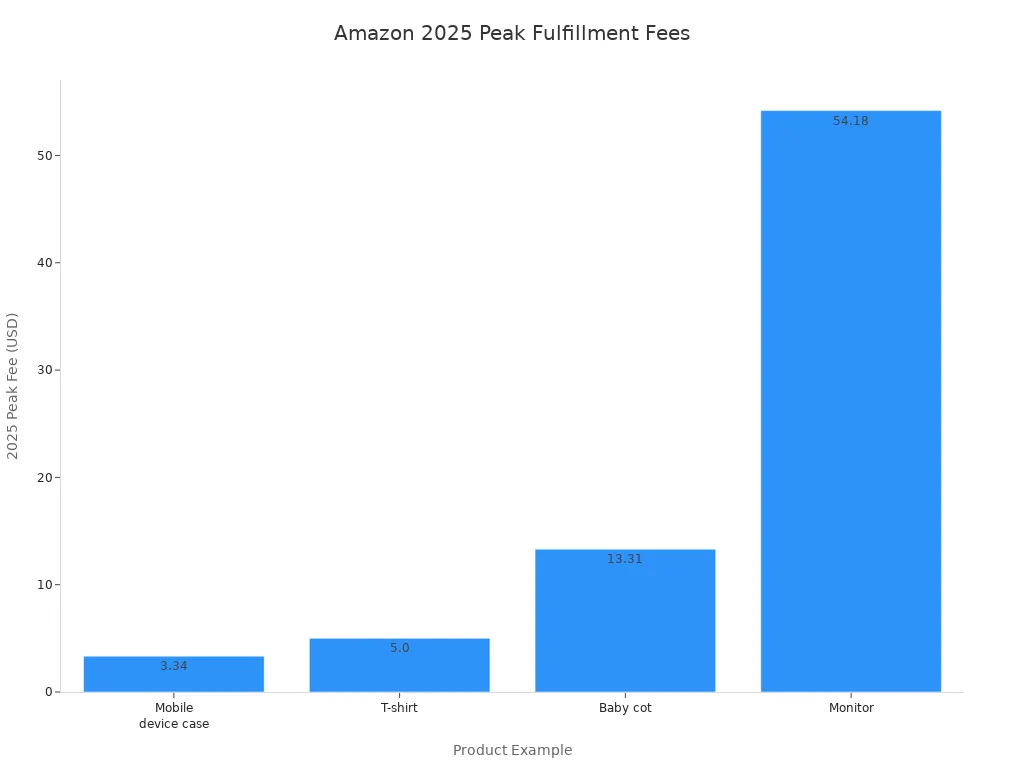
Amazon’s 2025 peak season fulfillment fees remain unchanged from last year. Sellers see stability in costs, which helps with planning for the busy holiday months. Careful attention to these fees supports better cost management and stronger profit margins. The table below shows examples of 2025 peak fees for different product sizes, matching the rates set in 2024.
Product Example | Size Tier | 2025 Non-Peak Fee | 2025 Peak Fee | Fee Increase Compared to 2024 Peak |
|---|---|---|---|---|
Mobile device case | Small standard | $3.15 | $3.34 | Increase equivalent to 2024 |
T-shirt | Large standard | $4.67 | $5.00 | Increase equivalent to 2024 |
Baby cot | Large bulky | $12.27 | $13.31 | Increase equivalent to 2024 |
Monitor | Extra large 50-70 lbs | $51.37 | $54.18 | Increase equivalent to 2024 |
Key Takeaways
Amazon’s 2025 peak season fulfillment fees stay the same as in 2024, giving sellers stable costs to plan for the busy holiday months.
Fees depend on product size, weight, and category, with higher charges for bulky, heavy, or special items like apparel and dangerous goods.
Amazon improved operations in 2025, using AI tools and better inventory placement to keep fees steady and speed up deliveries.
Sellers should plan inventory early, monitor stock levels, and use smart logistics partners like JUSDA to reduce costs and avoid delays.
Using advanced tools and flexible fulfillment methods helps sellers stay competitive and manage costs during Amazon’s peak season.
Amazon’s 2025 peak season fee comparison
2025 vs. 2024 rates overview
Amazon’s 2025 peak season fulfillment fees continue the trend set in 2024, offering sellers a stable cost structure during the busiest months of the year. The official fee period runs from October 15, 2025, to January 14, 2026. This window covers all major fulfillment programs, including Fulfillment by Amazon (FBA), Remote Fulfillment with FBA for Canada and Mexico, Multi-Channel Fulfillment, and Buy with Prime.
Note: Amazon’s 2025 peak season fees remain unchanged from last year. No new fee types have been introduced, and the peak season surcharge structure is consistent with 2024.
The table below summarizes the main fulfillment fee tiers for both years, highlighting the stability in rates:
Product Size & Category | 2024 Non-Peak Fee | 2024 Peak Fee | 2025 Non-Peak Fee | 2025 Peak Fee | Fee Change 2024→2025 |
|---|---|---|---|---|---|
Small Standard (4-8 oz) | $3.40 | $3.60 | $3.40 | $3.60 | None |
Large Standard (1-2 lb) | $5.12 | $5.37 | $5.12 | $5.37 | None |
Large Standard (3-20 lb) | $6.92 + $0.08/4oz | $6.92 + $0.08/4oz | $7.17 + $0.16/0.5lb | None | |
Small Oversize (2-3 lb) | $8.84 | $9.22 | $8.84 | $9.22 | None |
Medium Oversize (5-10 lb) | $13.07 | $13.65 | $13.07 | $13.65 | None |
Apparel (Large Standard, 1-2 lb) | $5.52 | $5.77 | $5.52 | $5.77 | None |
Dangerous Goods (Small Std, 4-8 oz) | $3.31 | $3.43 | $3.31 | $3.43 | None |
Amazon’s 2025 peak season fee comparison shows that sellers can plan with confidence, knowing that fulfillment costs will not increase unexpectedly during the holiday rush.
Product size and category breakdown
Amazon’s 2025 peak season fees use a tiered structure based on product size, weight, and category. The main categories include standard-size, oversize, apparel, and dangerous goods. Each category has its own fee schedule, reflecting the handling and shipping requirements.
Standard-Size Products:
Small standard items (up to 16 oz) have fees ranging from $3.06 to $3.98, depending on weight and category. Large standard items (4 oz to 3 lb) range from $3.68 to $6.81. Items over 3 lb incur additional surcharges per half-pound.Oversize Products:
Oversize items, such as furniture or large electronics, have higher base fees. For example, a small oversize item (2-3 lb) is charged $9.22 during the peak season. Large bulky and extra-large items can see fees starting at $13.31 and rising with weight.Apparel:
Apparel products carry slightly higher fees than non-apparel items of the same size and weight. This difference, usually about $0.40 per unit, covers extra handling and packaging.Dangerous Goods:
Dangerous goods require special handling. Fees for these items are higher, with a small standard dangerous goods item charged $3.43 during the peak season.Dimensional Weight:
Amazon applies dimensional weight pricing for bulky but lightweight items. For example, a pillow weighing 2 lb but with a dimensional weight of 31 lb will be charged at the higher dimensional weight, placing it in a more expensive fee bracket.Storage Fees:
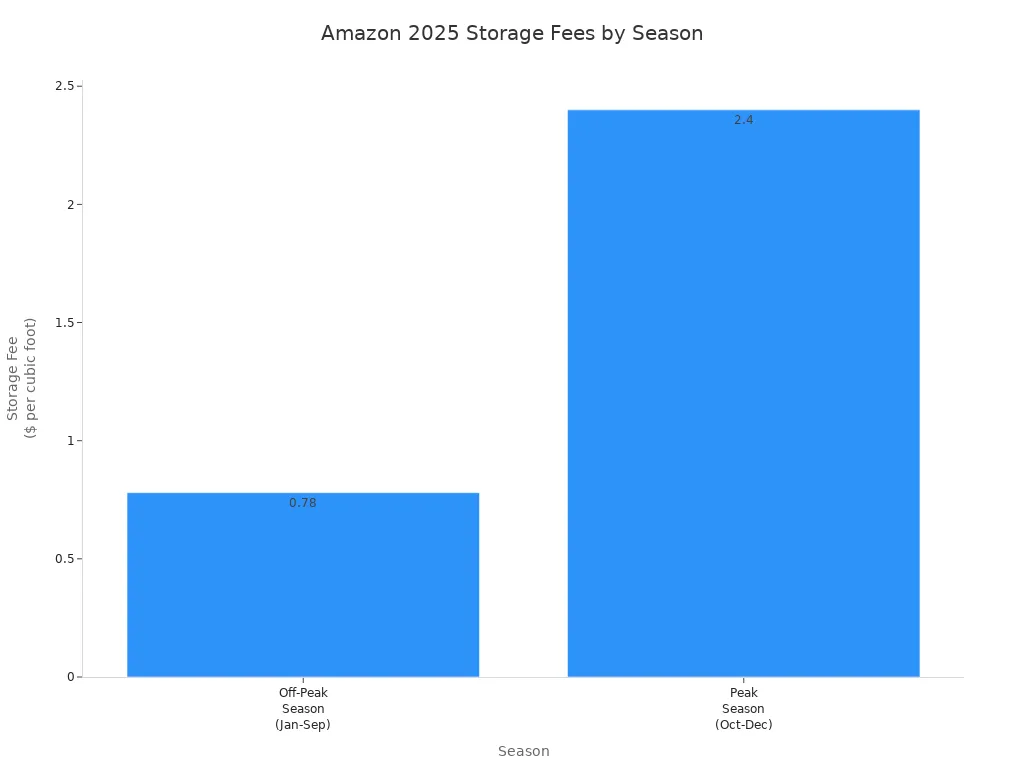
Monthly inventory storage fees also increase during the peak season. Standard-size items are charged $2.40 per cubic foot from October to December, compared to $0.78 off-peak. Dangerous goods storage fees are higher due to safety requirements.
Tip: Sellers should review their product dimensions and weights carefully. Bulky items may incur higher fees due to dimensional weight calculations.
Amazon’s 2025 peak season fee structure remains consistent with 2024, with no new surcharges or fee types introduced. The end of peak pricing for Low-Price FBA items, starting January 15, 2025, brings more predictability for sellers of low-cost products. The introduction of targeted fees, such as the Inbound Placement Service Fee and Low-Inventory Level Fee, continues from 2024, but these do not affect the main peak season fulfillment rates.
Sellers can expect Amazon’s 2025 peak season to bring high shipping volumes, with daily package counts nearly doubling during the holidays. The stable fee structure helps sellers manage costs and plan inventory strategies with greater certainty.
Key changes and industry context
No fee increases or new types
Amazon has chosen to keep its 2025 peak season fulfillment fees unchanged from 2024. This decision brings stability for sellers during the busiest shopping months. The company has not introduced any new fee types for 2025. The fee structure remains simple and predictable, which helps sellers plan their costs with confidence.
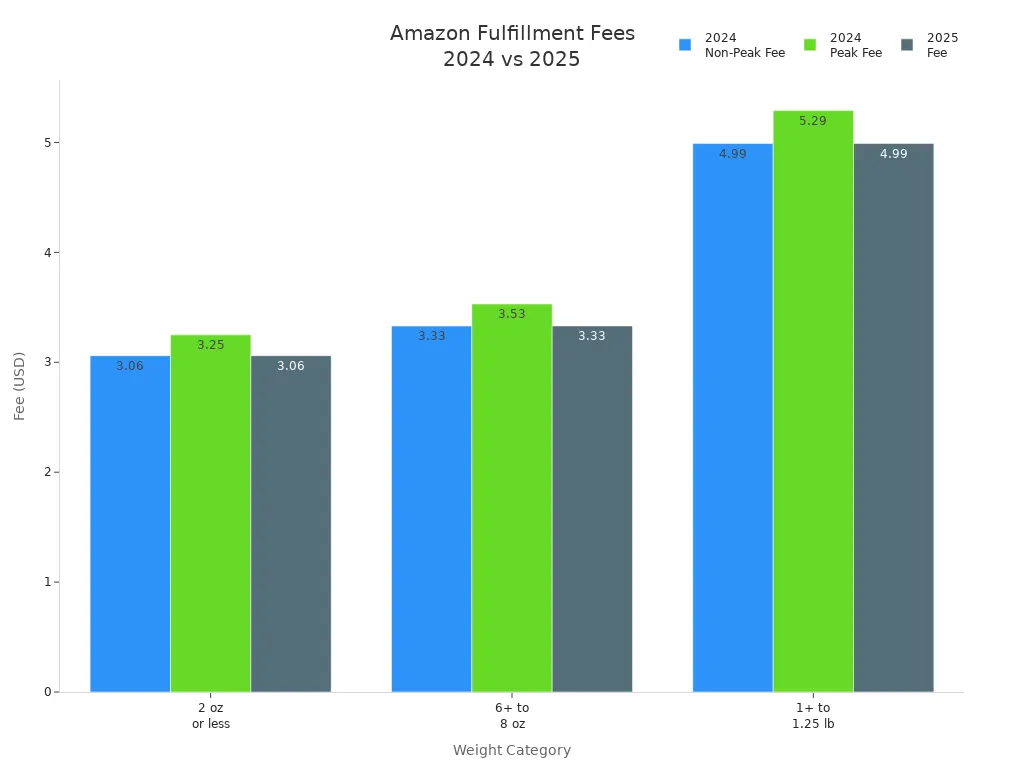
The following table highlights the consistency in Amazon’s fulfillment fees across key weight categories:
Weight Category | 2024 Non-Peak Fee | 2024 Peak Fee | 2025 Fee (from Jan 15, 2025) | Change |
|---|---|---|---|---|
2 oz or less | $3.06 | $3.25 | $3.06 | No change |
6+ to 8 oz | $3.33 | $3.53 | $3.33 | No change |
1+ to 1.25 lb | $4.99 | $5.29 | $4.99 | No change |
Amazon’s approach stands out in the industry. While Walmart has offered incentives like waived peak season storage fees and discounts on fulfillment services, Amazon has focused on fee stability and operational efficiency. This strategy supports sellers by reducing uncertainty and helping them manage costs more effectively.
Amazon’s operational improvements
Amazon has made several operational improvements in 2025 that allow it to freeze fulfillment fees. The company has introduced Low-Price FBA Rates for products under $10, reducing fees by $0.77 per unit. It has also lowered inbound placement service fees for large bulky products, making it easier for sellers to use Amazon’s network.
Key improvements include:
Enhanced AI-driven tools, such as an upgraded FBA Inventory Dashboard, help sellers forecast demand and manage inventory more efficiently.
Strategic inventory placement across fulfillment centers shortens delivery distances and speeds up order processing.
Automated low-stock alerts and real-time inventory synchronization prevent overselling and reduce order cancellations.
Amazon’s focus on efficiency has led to faster shipments and higher customer satisfaction. CEO Andy Jassy has highlighted that more orders now move directly from fulfillment centers to delivery, and items are consolidated into fewer boxes. These changes make the network faster and more reliable.
JUSDA recognizes the importance of these operational improvements. Stable fees and efficient logistics support supply chain stability, which is crucial for sellers during peak season. By leveraging intelligent supply chain solutions, sellers can further optimize their operations and maintain a competitive edge in a dynamic market.
Impact on sellers and cost management
Profitability and cost examples
Sellers on Amazon face a range of fulfillment costs during the holiday rush. These costs depend on product size, weight, and category. For example:
An oversize Home & Garden item with a selling price of $89.99 incurs a referral fee of $13.50.
The FBA fulfillment fee totals $22.41, calculated as $19.05 plus $0.42 for each of the 8 pounds.
Monthly storage fees reach $6.72 for four months, while the peak season surcharge adds $8.40 for two months.
Returns processing, at a 3% return rate, costs $0.67 per unit.
The total FBA costs for this item add up to $51.70, which is 57.5% of the sale price.
Size Tier | Weight Range | Fulfillment Fee (Non-Peak) | Peak Season Surcharge | Approx. Peak Fee |
|---|---|---|---|---|
Small Standard | 0–2 oz | $3.06 | $0.19–$0.29 | ~$3.25 |
Large Standard | ≤4 oz | $3.68 | $0.19–$0.29 | ~$3.87 |
Oversize/Bulky | Up to 50 lb | Typically $10+ | Included in base fee | $12–$15 approx. |
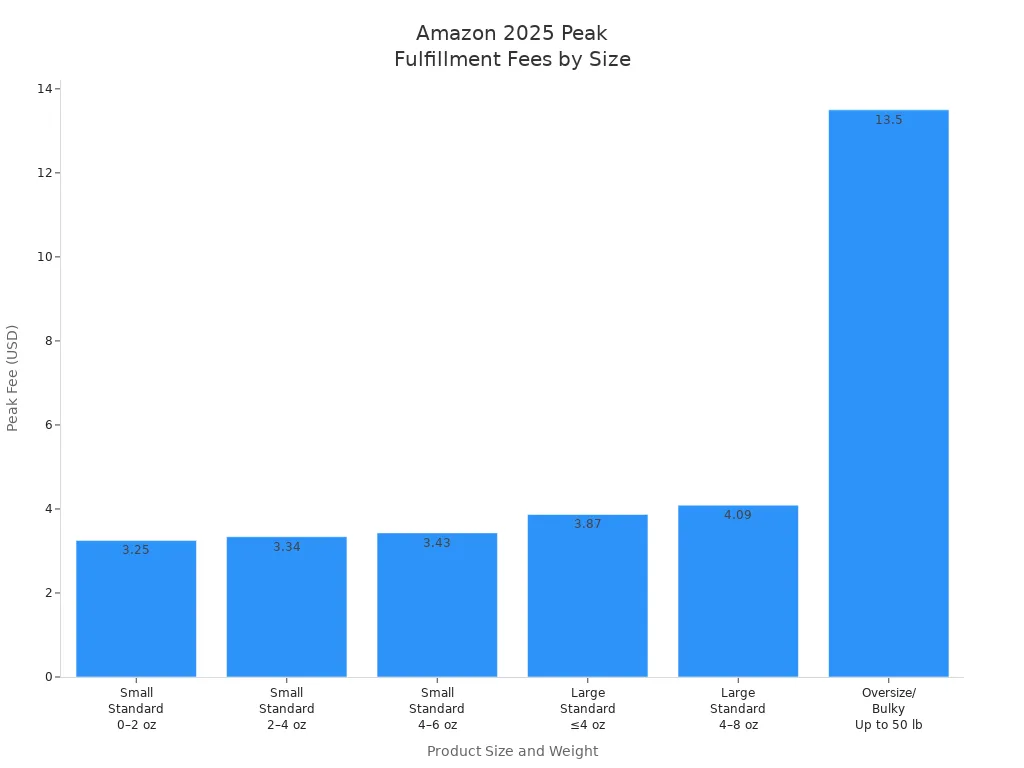
These examples show how fulfillment fees can take a large share of revenue, especially for bulky or heavy products. Sellers must track these costs to protect their profit margins during Amazon’s 2025 peak season.
Strategies for peak season
Stable fulfillment fees in Amazon’s 2025 peak season help sellers plan ahead. Profitability remains more predictable, as there are no new fee increases. However, sellers still need to manage storage, referral, and targeted fees. To optimize costs and performance, many sellers turn to advanced logistics partners.
JUSDA and JUSDASR offer solutions for cross-border logistics and peak season management. Their services include:
Strategic warehouse locations in the US for faster delivery and lower costs.
Dropshipping and specialized support for high-power products.
Integration with major carriers for reliable last-mile delivery.
For inventory planning, sellers can:
Monitor inventory health metrics like the Inventory Performance Index.
Focus on high-performing products to maximize revenue.
Use both FBA and Merchant Fulfilled Network to keep products available.
Communicate with suppliers to adjust orders quickly.
JUSDA’s JusLink AI Solution helps sellers forecast demand, manage risks, and optimize replenishment. These strategies support better cash flow and reduce the risk of stockouts or excess inventory during the busiest months.
Optimizing fulfillment with JUSDA and JUSDASR
Cross-border logistics advantages
JUSDA and JUSDASR provide sellers with strong cross-border logistics support during Amazon’s 2025 peak season. Their network of warehouses in the United States, located near major ports and airports, allows for quick and cost-effective distribution. Sellers can use dropshipping services to manage inventory more flexibly and respond to market changes. JUSDASR partners with major carriers like FedEx and UPS, which ensures reliable last-mile delivery even when order volumes surge.
Sellers can follow several best practices to maximize efficiency:
Align shipments with Amazon’s official Prime Day and holiday calendars.
Replenish low-stock items early to avoid extra fees and keep products close to customers.
Use inventory management tools to secure extra storage and prevent overload.
Plan inbound shipments ahead of time and use combined freight models for faster delivery.
Upload tracking numbers to improve shipment visibility.
Batch stock to warehouses for automatic replenishment and lower costs.
Use express courier services to speed up check-ins and avoid delays.
By following these steps, sellers can reduce logistics costs and improve delivery speed during the busiest months.
Intelligent supply chain solutions
JUSDA’s JusLink AI Solution gives sellers advanced tools for demand forecasting and risk management. The platform analyzes sales trends, predicts inventory needs, and provides early warnings for potential disruptions. Sellers can use these insights to plan inventory, avoid stockouts, and manage costs more effectively.
Many sellers also choose a hybrid fulfillment approach. They balance FBA and FBM models to stay flexible and avoid storage limits. JUSDA supports this strategy by offering overflow storage and flexible fulfillment options.
A real-world example comes from Sharp, a global home appliance brand. After partnering with JUSDA, Sharp reduced logistics costs by 20% and improved order delivery times by 30%. The company used JUSDA’s intelligent supply chain solutions to streamline operations and respond quickly to market demands.
Note: JUSDA and JUSDASR help sellers stay agile and competitive during Amazon’s 2025 peak season by combining advanced technology with a robust logistics network.
Amazon’s 2025 peak season brings stable fulfillment fees, giving sellers predictability for planning. The table below shows that while fulfillment fees remain steady, storage fees nearly triple during peak months, highlighting the need for careful inventory management.
Fee Type | Off-Peak Season (Jan-Sep) | Peak Season (Oct-Dec) |
|---|---|---|
Fulfillment Fees | Stable, no increase noted | Stable, no increase noted |
Storage Fees (Standard & Oversize) | $0.78 per cubic foot | $2.40 per cubic foot (nearly triple) |
Sellers should take these steps to optimize fulfillment strategies:
Use forecasting tools and monitor Amazon’s FBA deadlines.
Consider JUSDA and JUSDASR for efficient cross-border logistics and global reach.
Proactive cost management and advanced logistics solutions help sellers stay competitive throughout Amazon’s 2025 peak season.
FAQ
What are Amazon’s 2025 peak season fulfillment fee dates?
Amazon applies peak season fulfillment fees from October 15, 2025, through January 14, 2026. Sellers should plan inventory shipments before this period to avoid delays and ensure products remain available during high-demand months.
Do Amazon’s 2025 peak season fees differ from 2024?
No, Amazon’s 2025 peak season fulfillment fees remain unchanged from 2024. Sellers benefit from this stability, which allows for better cost planning and inventory management during the holiday season.
How can sellers reduce fulfillment costs during peak season?
Sellers can optimize inventory levels, use JUSDA’s cross-border logistics, and leverage JusLink’s AI tools for demand forecasting. Early inventory planning and efficient warehouse selection help lower storage and shipping expenses.
What advantages do JUSDA and JUSDASR offer for Amazon sellers?
JUSDA and JUSDASR provide strategic warehouse locations, dropshipping, and reliable last-mile delivery. These services help sellers speed up shipments, reduce logistics costs, and maintain high customer satisfaction during peak periods.
Why is inventory planning important for Amazon’s peak season?
Proper inventory planning prevents stockouts and excess storage fees. Sellers who forecast demand and replenish stock early can meet customer needs and avoid costly delays during the busiest shopping months.
See Also
How To Cut Costs And Save On Supply Chain Spending
Exploring The Latest Trends In Sea Freight Logistics 2024
Understanding Emerging Trends In Logistics Risk Management