From Ice Blocks to AI The Changing Face of Cold Chain


The journey of cold chain logistics began with ice blocks and now features AI-driven systems.
In today’s world, cold chain solutions span industries such as food, pharmaceuticals, and electronics.
AI and IoT enable real-time monitoring, reducing temperature errors and wastage.
The global cold chain market reached $234.5 billion in 2023.
JUSDA leads in intelligent logistics innovation.
Key Takeaways
Cold chain logistics has evolved from using ice blocks to advanced AI systems, improving the preservation of perishable goods.
Real-time monitoring through IoT devices reduces spoilage and waste, ensuring better quality and safety for food and pharmaceuticals.
AI enhances decision-making in cold chain logistics, optimizing routes and storage, which leads to cost savings and improved delivery times.
History of Cold Chain Logistics

Early Preservation Methods
Long before modern refrigeration, people relied on creative ways to keep food and medicine safe. Ancient civilizations used a variety of techniques to slow spoilage and extend shelf life:
Ice houses stored blocks of ice and snow, providing cool storage for months.
Dry salting and brining preserved meats and fish by drawing out moisture and creating an environment hostile to bacteria.
Drying removed water from food, making it less likely to spoil.
Fermentation transformed milk into cheese and grapes into wine, both preserving and enhancing flavor.
Natural ice and snow, especially in colder regions, kept food fresh for longer periods.
Smoking combined drying with chemical preservation, especially for meats and fish.
Pickling used acidic solutions to prevent bacterial growth.
Honey, with its natural antimicrobial properties, preserved fruits and even played a role in embalming.
These early methods formed the foundation for the temperature controlled supply chain. They allowed communities to store perishable goods and survive harsh seasons.
In the late 1700s, British fishermen began using natural ice and salt to keep fish fresh at sea. By the 1800s, large blocks of ice were transported to cities and used in cooling systems for buildings. The ice trade flourished, with ice harvested from ponds and stored in icehouses. This practice enabled the distribution of perishable products like dairy and fruit from rural areas to urban markets. The history of the cold chain began with these labor-intensive but effective solutions.
Key Innovations in Cold Chain
The cold chain industry advanced rapidly with the invention of mechanical refrigeration in the 1880s. This breakthrough changed how people stored and transported perishable goods. Several milestones marked this era:
The introduction of reefer ships in the mid-19th century allowed global trade in fruits, meat, and other perishables. Bananas, mangoes, and other produce could now reach distant markets, regardless of local growing seasons.
The first effective cold store opened in London in 1882, providing reliable storage for temperature sensitive products.
The late 1930s saw the patenting of mobile refrigeration vehicles, making it possible to move perishable goods over long distances.
The 1950s brought the rise of refrigerated trucks and freight trains, which expanded the reach of the temperature controlled supply chain.
These innovations improved temperature control during transportation, which enhanced the preservation of perishable goods. Refrigerated trucks and portable cooling units reduced energy consumption and minimized greenhouse gas emissions. The cold chain became more efficient and sustainable, supporting the growth of international trade in food, medicine, and other sensitive products.
Regulatory and Infrastructure Advances
As the cold chain industry grew, governments and organizations introduced regulations to ensure safety and quality. These rules shaped how companies managed temperature controlled supply chains and handled perishable goods.
Description | |
|---|---|
Drug Supply Chain Security Act (DSCSA) | Mandates electronic data exchange, standardized data formats, unique product serialization, and track and trace requirements for drug products. |
Environmental Storage Regulations | Requires proper storage conditions for drugs, including humidity and light exposure controls. |
Compliance Standards | Enforces mandatory compliance with cold chain standards for patient safety. |
Regulatory bodies such as the FDA, EMA, and WHO set strict requirements for temperature control and documentation. Each country has unique rules for imports and exports. Non-compliance can result in fines, product recalls, or loss of goods. Companies must stay updated on destination country regulations to avoid disruptions.
The expansion of global cold chain infrastructure has played a crucial role in supporting international trade. Efficient systems maintain product integrity across long distances. Countries that rely on food imports depend on these systems for food security. The perishable logistics market now supports agriculture, food and beverage, and healthcare sectors worldwide.
JUSDA’s global warehousing network demonstrates the importance of modern infrastructure in cold chain logistics. In Vietnam, JUSDA operates facilities with a total capacity of 130,000 m², located in Bac Ninh, Hai Phong, and Bac Giang. These refrigerated warehouses meet international standards and feature advanced infrastructure. Dual-layer security, a multilingual professional team, and strict management processes enhance operational efficiency. JUSDA’s network supports the safe and reliable movement of temperature sensitive goods, helping clients meet regulatory requirements and market demands.
Modern Cold Chain and AI Integration
Real-Time Monitoring and Data
Modern cold chain logistics rely on real-time data to ensure the safety and quality of perishable goods. IoT devices now play a central role in monitoring the cold chain, providing continuous updates on temperature, humidity, and location. This technology gives logistics providers unprecedented visibility and control over temperature sensitive cargo. The integration of IoT and advanced temperature monitoring systems has transformed how companies manage storage and transportation for pharmaceutical products, food, and vaccines.
Evidence Description | Source Link |
|---|---|
IoT technology enhances real-time visibility and data analytics in temperature monitoring, improving product safety and compliance. | How IoT is Revolutionizing Temperature Monitoring in Cold Chain Logistic |
Integration of IoT devices leads to unprecedented visibility, control, and responsiveness in cold chain management. | How IoT Transforms Cold Chain Logistics & Temperature Control |
IoT technology allows for better visibility and data-driven decisions, addressing previously invisible errors in cold chain logistics. |
Companies use real-time data to maintain optimal conditions for perishable and temperature sensitive goods. This approach reduces spoilage and waste, ensuring improved product quality and safer food for consumers. The ability to detect deviations immediately allows for quick responses, preventing damage to pharmaceutical products and medications. Historical data analysis also helps identify trends and assess risks for future shipments, supporting increased shelf life and better planning.
Approximately 40 percent of global food is wasted each year due to inadequate cold chain monitoring. IoT-based predictive analysis now enables early detection of critical factors like temperature and humidity, preventing spoilage before it occurs.
AI in Cold Chain Logistics
Artificial intelligence has become a game changer for the cold chain industry. AI-driven systems continuously track temperature and humidity, sending alerts for any deviations. These systems ensure that temperature sensitive cargo, such as pharmaceutical products and vaccines, remain within required ranges. Automated decision-making allows AI to reroute shipments or adjust temperatures in real time, reducing human error and enhancing safety.
Real-time monitoring: AI tracks environmental conditions and prevents spoilage.
Temperature control: Sensors adjust storage and transport settings for perishable goods.
Automated decision-making: AI reroutes shipments and manages exceptions.
Enhanced load optimization: AI recommends optimal loading configurations for refrigerated vehicles, maximizing space and energy efficiency.
AI also improves risk management through predictive analytics. By analyzing current and historical data, AI can forecast potential threats and provide early warnings. This proactive approach allows logistics providers to address risks before they impact operations. Large language models analyze temperature excursion data, detecting subtle changes that may signal equipment failures. This shift from reactive to proactive management saves millions in prevented product losses.
AI enhances predictive analytics by automating data processing and providing real-time risk alerts.
Continuous risk monitoring and early warning signals help organizations mitigate risks proactively.
Predictive analytics allows organizations to foresee risks and address them before they impact operations.
The adoption of AI and digital solutions has led to measurable benefits in cold chain logistics:
Labor costs decrease as automation reduces manual work.
Storage costs drop as AI optimizes warehouse space and inventory.
Transportation costs fall due to AI-enhanced route optimization.
Order fulfillment rates improve by up to 20 percent.
Delivery lead times decrease by 15 to 30 percent.
Inventory turnover rates increase by 25 percent or more.
While the initial investment in AI technologies may be high, businesses often see a return on investment within one to three years. AI also supports predictive maintenance, analyzing historical data to forecast equipment failures and reduce unexpected breakdowns.
JUSDA’s Digital Solutions
JUSDA stands at the forefront of efficient cold chain technologies, offering advanced digital solutions that address the most pressing logistical challenges. The company’s JusLink platform integrates IoT, cloud computing, and big data to provide real-time visibility and collaboration across the supply chain. JUSDA’s AI-powered tools, such as JusAI, deliver predictive analytics, risk management, and automation for cold chain logistics.
Example | Description |
|---|---|
Automated Storage and Retrieval Systems (AS/RS) | Utilizes robotic technology to efficiently store and retrieve products in temperature-controlled environments, minimizing human error and optimizing space utilization, leading to improved inventory management and reduced spoilage. |
Kenya's Horticulture Industry | Implemented a robust cold chain logistics system with pre-cooling facilities, refrigerated trucks, and training programs, enabling high-quality produce exports and maximizing profitability. |
Maersk Line's Remote Container Management (RCM) | Uses IoT-enabled devices in refrigerated containers to monitor and control conditions remotely, significantly reducing cargo losses and enhancing customer service. |
JUSDA’s global warehousing network supports the safe and reliable movement of temperature sensitive goods. The company operates advanced storage facilities in key regions, using automation and digital platforms to optimize inventory and reduce spoilage. JUSDA’s solutions help clients meet strict pharmaceutical regulations and maintain the quality of perishable products during refrigerated movement.
The company addresses common challenges in cold chain logistics, such as compliance, product handling, distributed storage, transit delays, packaging, and data management. Real-time monitoring systems track temperature and humidity, while GPS tracking identifies delays during transit. Energy-efficient equipment reduces environmental impact, and digital tools ensure effective data management.
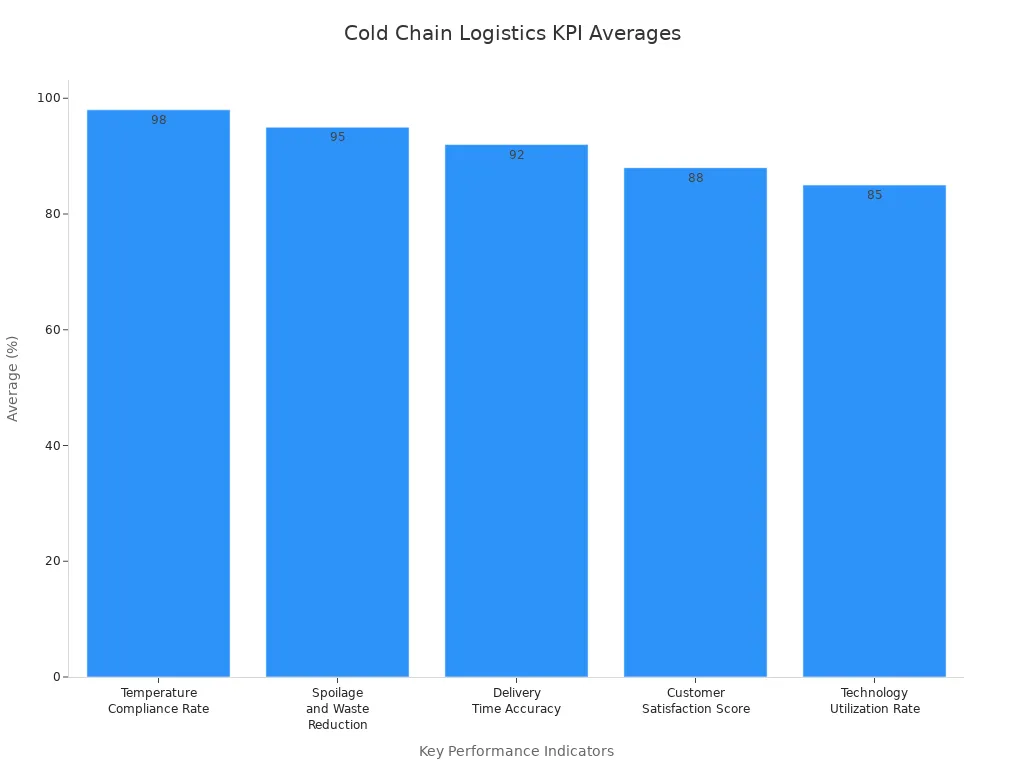
Key performance indicators (KPIs) measure the success of modern cold chain logistics systems. These include temperature compliance rate, spoilage and waste reduction, delivery time accuracy, customer satisfaction score, and technology utilization rate.
KPI | Description | Average |
|---|---|---|
Temperature Compliance Rate | Monitors real-time temperature data to ensure consistency within regulatory thresholds and to trigger immediate alerts on deviations. | 98% |
Spoilage and Waste Reduction | Tracks incidents of spoilage and implements strategies to reduce waste, reflecting cost savings and environmental impact. | 95% |
Delivery Time Accuracy | Measures on-time delivery performance to optimize routes and schedules, thereby enhancing customer satisfaction. | 92% |
Customer Satisfaction Score | Collects and analyzes customer feedback to drive continuous improvements and boost repeat business. | 88% |
Technology Utilization Rate | Assesses the effective use of IoT devices and analytics tools to enhance operational efficiency and return on investment. | 85% |
JUSDA’s approach aligns with industry trends in digital transformation and sustainability. The company builds evidence-backed hypotheses for low-risk pilots, focuses on workflow efficiency, and trials AI-driven demand forecasting. Digital transformation and sustainability now go hand in hand, helping businesses achieve both environmental and competitive goals.
Looking ahead, the cold chain industry will continue to adopt AI and digital solutions to enhance operational efficiency. Blockchain technology will enable secure and transparent tracking of products, including temperature data and handling conditions. AI-driven analytics will help identify potential risks before they escalate, allowing for predictive modeling of delays or equipment failures. Digital transformation will increase the resilience and responsiveness of cold chain logistics providers, ensuring the safety and quality of perishable and pharmaceutical products worldwide.

JUSDA Solutions
To provide you with professional solutions and quotations.
The cold chain has evolved from ice blocks to AI-powered systems, transforming global supply chains. JUSDA’s advanced warehouses and digital platforms set new standards for efficiency and reliability. Innovations in AI and IoT now protect perishable products, reduce spoilage, and ensure safe delivery, benefiting industries and consumers worldwide.
See Also
Transforming Logistics: The Impact of AI on Supply Chains
Enhancing Productivity: Innovations in AI for Supply Chains
Embracing Change: Adapting Supply Chains to Technology Advances
Exploring AI's Hidden Opportunities in Logistics Management
Discovering Tomorrow's Supply Chain: Insights on AI Integration