Comparing Logistics Requirements in Southeast Asian Cross-Border E-Commerce

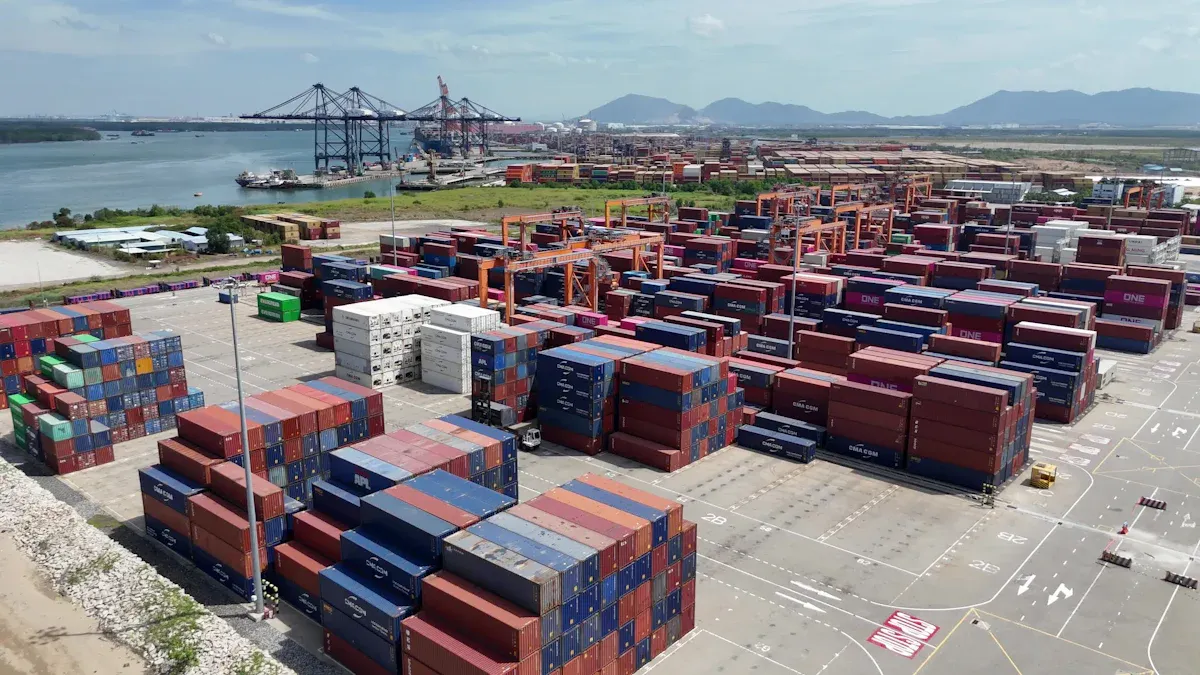
A recent report released by Amazon Global Selling indicates that the B2C e-commerce export revenue for six ASEAN countries (Singapore, Malaysia, Thailand, Vietnam, Indonesia, and the Philippines) is projected to reach 304 billion US dollars by 2028.
Shipping costs and delivery speed matter most in Vietnam, where logistics expenses reach 30% of e-commerce revenue.
Infrastructure varies by country, affecting shipping times and costs everywhere.
Each nation uses different customs, laws, and payment methods, making Comparing Logistics Requirements complex. Advanced providers like JUSDA use technology to help you overcome these challenges.
Key Takeaways
Southeast Asia's e-commerce is booming, expected to grow from $139 billion in 2023 to $186 billion by 2025. Businesses should adapt to this growth by improving logistics strategies.
Logistics efficiency is crucial for customer satisfaction. Fast and accurate deliveries build trust and encourage repeat purchases, benefiting both customers and businesses.
Each Southeast Asian country has unique logistics challenges. Understanding customs, shipping, and payment systems in each market is essential for successful cross-border e-commerce.
Technology plays a key role in overcoming logistics challenges. Solutions like JUSDA offer tools for better inventory management, faster shipping, and improved customs processes.
Building strong partnerships with logistics providers can enhance your supply chain. Collaborating with companies that leverage technology can help you stay competitive in the evolving market.
Southeast Asia E-Commerce Logistics Overview
Market Growth and Trends
You see e-commerce in Southeast Asia growing at a fast pace. The region reached a gross merchandise value of $139 billion in 2023. Experts expect this number to rise to $186 billion by 2025. Many changes shape how you experience online shopping and delivery. Here are some of the most important trends:
Companies use AI, big data, and automation to improve logistics and make your shopping experience better.
Social commerce is becoming more popular. You can now shop directly through social media platforms.
There is a strong need for both low-cost and premium delivery options.
Governments and businesses invest in better roads, railways, and ports, especially in rural areas.
Automated warehouses and smart delivery solutions help orders reach you faster.
Cross-border e-commerce is growing, so companies work together to make customs and logistics easier.
These trends show why Comparing Logistics Requirements across countries is important for your business success.
Importance of Logistics Efficiency
Logistics efficiency plays a big role in your e-commerce experience. When companies deliver your orders quickly and accurately, you feel more satisfied and trust the brand. The table below shows how logistics efficiency affects e-commerce success and customer satisfaction:
Aspect | Impact on E-commerce Success and Customer Satisfaction |
|---|---|
Delivery Speed | |
Delivery Accuracy | Accurate deliveries enhance trust and brand reputation. |
Overall Customer Experience | A positive experience encourages repeat purchases. |
You benefit from efficient logistics because you get your orders on time and in good condition. Businesses also gain because happy customers are more likely to buy again.
Country Logistics Comparison

Singapore Logistics Profile
You find Singapore’s logistics system highly efficient. Customs clearance is fast and transparent. Shipping benefits from world-class ports and airports. Last-mile delivery is reliable, with many options for tracking. Warehousing uses advanced technology for inventory control. Payment and returns are smooth, with strong support for digital payments.
Malaysia Logistics Profile
Malaysia offers a growing logistics sector. Customs processes are improving, but you may face some delays. Shipping is cost-effective due to good road and port networks. Last-mile delivery covers most urban and rural areas. Warehousing is modern in major cities. Payment systems support both cash and digital methods, making returns easier for you.
Indonesia Logistics Profile
You face several challenges in Indonesia’s cross-border e-commerce logistics:
Compliance requirements can slow your business.
Logistics systems are fragmented, causing inefficiencies.
Infrastructure gaps affect payment and delivery, especially in rural areas.
Last-mile delivery is difficult outside big cities.
Many small digital middlemen add to the complexity and can affect quality.
Thailand Logistics Profile
Thailand is working to become a logistics hub in Southeast Asia. You benefit from:
Major investments in infrastructure, such as the Eastern Economic Corridor and high-speed rail.
Airport expansions that boost trade.
A growing e-commerce market, expected to reach USD 60 billion by 2030.
Strong consumer demand for online shopping, which drives logistics innovation.
Vietnam Logistics Profile
Vietnam's logistics sector is experiencing significant growth, driven by economic expansion, a booming e-commerce market, and a strategic shift to become a regional manufacturing hub. Key aspects include the dominance of road transport for domestic goods, maritime transport for international trade, and a growing focus on e-commerce-driven express and last-mile delivery services. Despite strong growth, the sector faces challenges like high logistics costs (at 20.9% of GDP), infrastructure gaps, and a need for qualified labor, though the government is investing in technology and infrastructure upgrades to address these issues.
Philippines Logistics Profile
You may find high logistics costs in the Philippines. Many small businesses cannot export without e-commerce. Most report that they do not understand foreign export rules. You need more education about import regulations, especially for the U.S. Payment and returns can be slow, and shipping costs remain a challenge.
When comparing logistics requirements across these countries, you see that each market has unique strengths and challenges. You need to adapt your strategy for customs, shipping, last-mile delivery, warehousing, and payments in each country.
Comparing Logistics Requirements Across Countries
When you look at cross-border e-commerce in Southeast Asia, you see many differences and similarities in logistics. Comparing logistics requirements helps you understand how customs, shipping, delivery, warehousing, and payment systems work in each country. This section gives you a side-by-side view so you can make better decisions for your business.
Customs and Compliance
Customs rules and compliance standards change from country to country. You need to know how trade agreements like CPTPP and RCEP affect your shipments. Some countries have strict customs duties, while others offer easier online consumer protection. The table below shows key differences:
Aspect | CPTPP | RCEP |
|---|---|---|
Customs Duties on Electronic Transmissions | Permanent prohibition | Tied to current practice, less certainty |
Dispute Settlement Mechanism | Applicable to e-commerce chapter | Excluded from e-commerce chapter |
Online Consumer Protection | Requires interoperability | Focuses on domestic frameworks |
You must check each country’s customs process before shipping. Some countries use digital customs clearance, which makes your work faster. Others still rely on manual paperwork. JusTrade, a JUSDA solution, helps you manage customs with smart technology, making compliance easier.
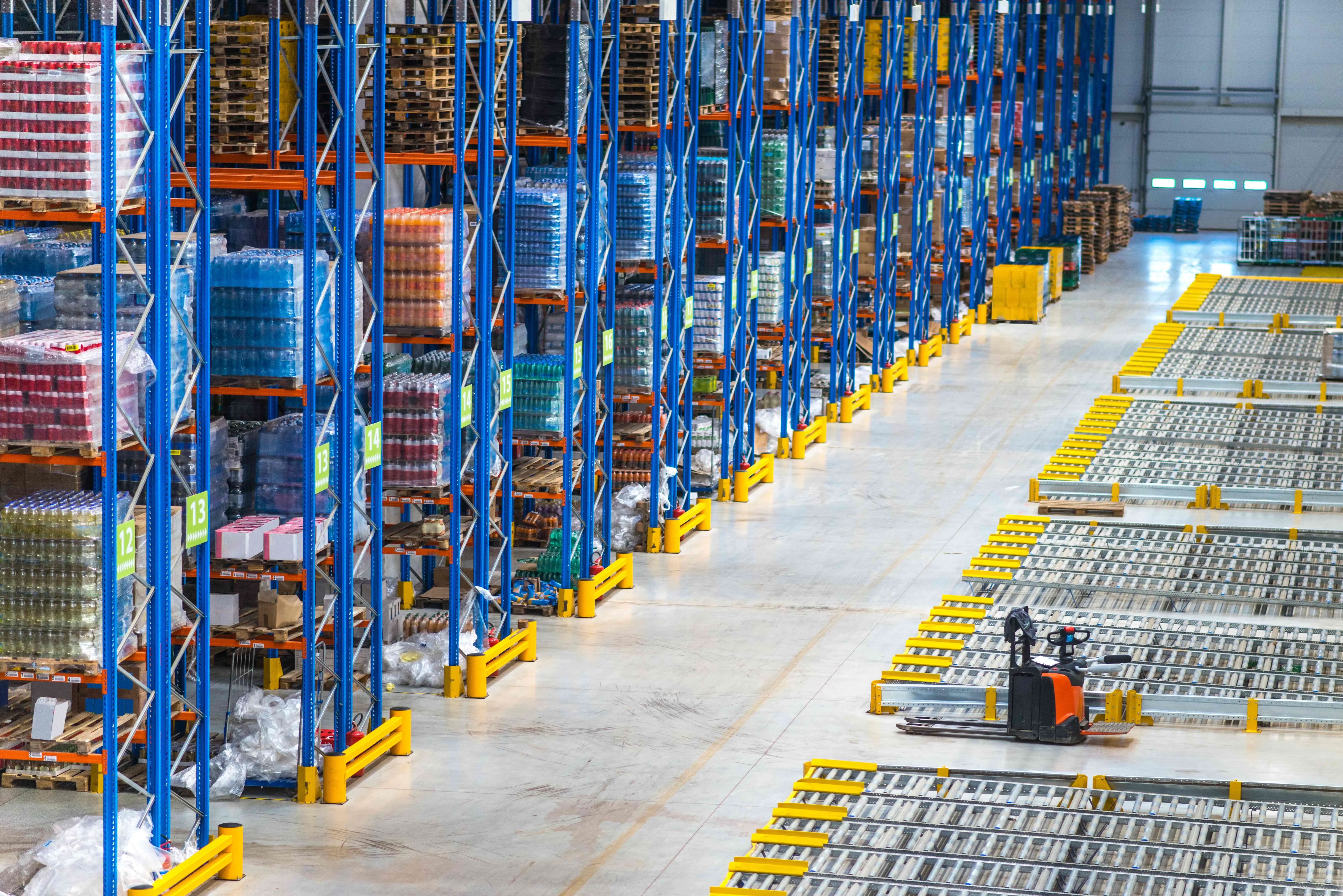
JUSDA Solutions
To provide you with professional solutions and quotations.
Shipping and Infrastructure
Shipping and transport infrastructure play a big role in Comparing Logistics Requirements. Road transport is important in Vietnam, Thailand, and Laos. Vietnam is building more highways, and Thailand has new transport hubs. Laos now has a rail link to China. These changes help goods move faster.
You see shipping costs and delivery times vary by country:
Shipping costs from China to Vietnam are low. You pay less for cross-border goods than for local products.
Delivery times for cross-border goods are usually 7 to 10 days.
Low-value products are popular in cross-border e-commerce. High-value items need extra logistics steps.
Countries work together to improve shipping. Vietnam led the ASEAN Online Sale Day, where 216 companies joined to make cross-border shopping safer and better. You benefit from these efforts because your orders arrive faster and with better quality.
Last-Mile Delivery and Warehousing
Last-mile delivery and warehousing are big challenges in Southeast Asia. You face high logistics costs and tough regulations. Urban areas have traffic jams and warehouse shortages. Rural areas have unpaved roads and limited courier networks.
Here are some common issues:
Urban congestion slows down deliveries.
Warehouses are hard to find in busy cities.
Rural deliveries take longer and cost more.
Cash-on-delivery is common in rural areas.
Failed deliveries happen when customers are not home or addresses are wrong.
Comparing logistics requirements shows that Vietnam prefers small warehouses because of urban density and e-commerce growth. Other countries use larger warehouses. The table below highlights these differences:
Aspect | Vietnam | Other Southeast Asian Countries |
|---|---|---|
Warehousing Solutions | Small warehouses in cities | Larger warehouses in suburbs or industrial zones |
Last-Mile Delivery | Fierce competition, weak infrastructure | Varies by country, some have better networks |
E-commerce Growth | Growth rates differ, some slower |
You see fast delivery options in Vietnam, like two-hour or one-hour services. The ASEAN land transportation market is growing quickly, with more companies joining the race to deliver faster.
Payment and Returns
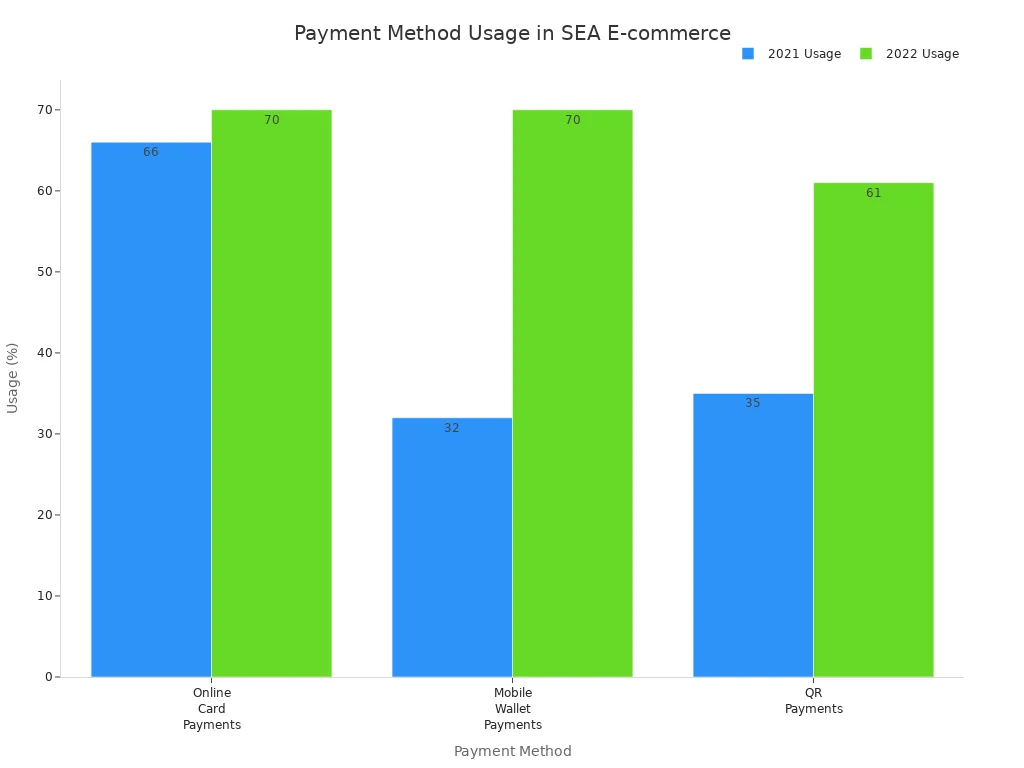
Payment and return methods are changing fast in Southeast Asia. You use online card payments, mobile wallets, and QR codes more than ever. The table below shows how payment methods have grown:
Payment Method | 2021 Usage | 2022 Usage |
|---|---|---|
Online Card Payments | 66% | 70% |
Mobile Wallet Payments | 32% | 70% |
QR Payments | 35% | 61% |
You still see cash-on-delivery in rural areas. Failed deliveries happen when customers are not home or addresses are wrong. Returns can be slow, especially in countries with less developed logistics networks.
Side-by-Side Comparison Table
You can use the table below to compare logistics requirements across Southeast Asian countries:
Country | Customs & Compliance | Shipping & Infrastructure | Last-Mile Delivery & Warehousing | Payment & Returns |
|---|---|---|---|---|
Singapore | Fast, digital | World-class ports | Reliable, tech-driven | Digital payments, easy returns |
Malaysia | Improving, some delays | Good road/port network | Modern in cities, covers rural | Cash and digital, easy returns |
Indonesia | Complex, slow | Fragmented, gaps | Difficult outside cities | Cash-on-delivery, slow returns |
Thailand | Upgrading, efficient | Multimodal, new hubs | Growing, innovative | Digital payments, improving |
Vietnam | Digitalizing, JUSDA helps | Building highways, flexible | Small warehouses, fierce competition | Mobile wallets, fast delivery |
Philippines | Needs education | High costs, slow | Limited, costly | Slow returns, cash common |
Tip: When Comparing Logistics Requirements, you should look at customs, shipping, delivery, warehousing, and payment systems for each country. This helps you find the best strategy for your business.
You see that each country has its own strengths and challenges. Comparing logistics requirements gives you the knowledge to choose the right partners and solutions, like JUSDA, to improve your cross-border e-commerce operations.
JUSDA and JusTrade: Enhancing Cross-Border Logistics

JUSDA’s Role in Vietnam and Southeast Asia
You face many logistics challenges when you do cross-border e-commerce in Southeast Asia. JUSDA helps you solve these problems by using advanced technology and smart planning. In Vietnam, JUSDA stands out because it combines air and sea transport. This gives you more choices and helps you ship goods faster and at lower costs.
JUSDA uses digital tools like AI and blockchain to make your supply chain more transparent and secure. AI helps you predict demand and manage inventory better. Blockchain keeps your transactions safe and easy to track. You can see where your goods are at every step. JUSDA also offers cloud warehousing, which lets you manage your stock in real time. This means you can respond quickly to changes in the market.
Tip: When you use JUSDA, you get flexible logistics solutions that fit your business needs in fast-growing markets like Vietnam.
Here is how JUSDA’s digital solutions help you:
Feature | Benefit for You |
|---|---|
AI Technology | Better demand forecasting |
Blockchain | Secure and transparent tracking |
Cloud Warehousing | Real-time inventory management |
Integrated Transport | Faster and flexible shipping |
JusTrade’s Smart Customs Solutions
Customs clearance can slow down your business if you do not have the right support. JusTrade, a part of JUSDA, gives you smart customs solutions that make the process simple and fast. JusTrade uses a special SAAS platform powered by AI and big data. This platform connects your business with customs offices and helps you handle all paperwork online.
You can track your shipments, check compliance, and get alerts about any issues. JusTrade’s system reduces mistakes and speeds up customs checks. You save time and avoid delays. JusTrade also supports many languages and currencies, so you can trade with partners in different countries easily.
With JusTrade, you get a one-stop customs solution that keeps your cross-border e-commerce running smoothly.
Challenges and Opportunities in Southeast Asia
Common Pain Points
You face many challenges when you run cross-border e-commerce in Southeast Asia. The systems for cross-border trade can be hard to set up and manage. You need to find reliable logistics partners who can handle your shipments without problems. Your customers expect fast and easy delivery, which puts extra pressure on your business.
Here is a table that shows the most common pain points for e-commerce businesses in the region:
Pain Point | Description |
|---|---|
Complexity of cross-border e-commerce systems | Developing a system for cross-border e-commerce is challenging and requires significant effort. |
Need for reliable logistics partners | Businesses struggle to find trustworthy logistics partners to handle cross-border shipments. |
Rising consumer expectations | Consumers expect convenience and timely delivery, adding pressure on e-commerce businesses. |
You may also deal with high shipping costs, slow customs clearance, and problems with last-mile delivery. These issues can make it hard for you to keep your customers happy and grow your business.
Market Opportunities for Logistics Providers
You also see many new opportunities in Southeast Asia’s logistics market. Demand for cross-border transportation is rising quickly. More businesses want to sell products across borders, so logistics providers are building integrated service networks to meet these needs. The logistics sector now plays a key role in making sure customers have a good experience.
You notice major logistics companies investing in bonded warehouse systems and service networks. These investments help speed up cross-border transportation and customs clearance.
Vietnam’s cross-border retail sales are growing by over 20% each year. Experts expect sales to reach VND256.1 trillion by 2026. Micro, small, and medium businesses drive most of this growth, creating a lively market for logistics providers.
You see that logistics providers who offer smart, efficient solutions can help businesses overcome pain points and stand out in the market.
Tip: If you choose the right logistics partner, you can turn these challenges into opportunities and help your business succeed in Southeast Asia.
Practical Recommendations for Businesses
Navigating Regulatory Differences
You face many rules when you do cross-border e-commerce in Southeast Asia. Each country has its own laws and updates them often. You need to stay informed about new decrees, such as 70/2025 for e-invoicing and 147/2024 for user verification. The upcoming E-Commerce Law may also affect your business. Always check for changes so you can avoid problems.
Here are some strategies to help you manage different regulations:
Strategy | Description |
|---|---|
Understand Regulatory Environments | Each ASEAN country has unique trade, labor, and tax rules. You must follow these to operate smoothly. |
Leverage Trade Agreements | The ASEAN-China Free Trade Area lowers tariffs on some goods. This makes cross-border trade easier for you. |
Tip: Keep your team updated on local laws and use trade agreements to reduce costs.
Leveraging Technology and Partnerships
You can improve your logistics by using technology and working with strong partners. In Vietnam, projects like SuperPort connect over 20 industrial parks and major transport hubs. This helps you move goods faster. Advanced technologies, such as AI, create a logistics marketplace that links small businesses and logistics providers. This makes your operations more efficient.
ViettelPost invests in technology and better infrastructure. You benefit from faster delivery and lower costs.
Deep-water ports and direct air routes help you reach international markets quickly.
Working with partners like YCH Group lets you use different transport methods, making your supply chain stronger.
Building partnerships and using new technology can help you compete in the fast-changing e-commerce market.
Optimizing Supply Chain with JUSDA
JUSDA gives you tools to make your supply chain work better. You can work with governments to simplify customs and set up regional logistics hubs. JUSDA helps you tailor logistics solutions to local needs and focus on sustainability. You can offer your customers personalized delivery and real-time tracking, which improves their experience.
JUSDA lets you connect your logistics with major e-commerce platforms. This streamlines your operations and saves time.
You can use JUSDA’s digital tools to track orders and manage inventory in real time.
By choosing JUSDA, you get flexible and smart solutions for cross-border e-commerce in Southeast Asia.
Use JUSDA’s expertise to optimize your supply chain and grow your business in the region.
You have seen that logistics requirements in Southeast Asian cross-border e-commerce differ by country. Each market needs a unique approach for customs, shipping, delivery, and payments. You can use technology and strong partnerships to overcome these challenges. The logistics landscape will keep changing as countries invest in infrastructure and develop new hubs. Providers like JUSDA will help you adapt and grow.
Trend | What It Means for You |
|---|---|
More opportunities and competition | |
Better infrastructure | Faster and more reliable deliveries |
Advanced logistics services | Flexible, affordable, and premium options |
Stay ready for change. Choose partners who innovate and support your business as the market evolves.
FAQ
What makes logistics in Southeast Asia different from other regions?
You face unique challenges in Southeast Asia. Each country has its own customs rules, payment systems, and delivery networks. You must adapt your strategy for each market to succeed.
How can JUSDA help my business with cross-border e-commerce?
JUSDA gives you digital tools like AI and blockchain. You get faster shipping, real-time tracking, and secure transactions. JUSDA helps you manage customs and warehousing with ease.
Why is last-mile delivery so important in this region?
Last-mile delivery affects how quickly your customers get their orders. In Southeast Asia, traffic and rural areas can slow deliveries. You need strong partners to keep customers happy.
What is the best way to handle customs clearance?
You should use digital customs solutions like JusTrade. These tools help you avoid delays and reduce errors. You can track your shipments and stay compliant with local laws.
Tip: Always check the latest customs rules before shipping. This helps you avoid surprises and keeps your business running smoothly.
See Also
Exploring Supplier Connections in Global E-commerce Strategies
Addressing Global Supply Chain Growth Issues Effectively
Enhancing Global E-commerce Through Supply Chain Transparency
Transforming Logistics for the Future with AI Solutions
Achieving Cross-Border Trade Success Through JUSDA Partnerships