Global Trade Shifts and Port Policies Drive New Waves of Freight Volatility — Insights from the World Container Index 2025

Global trade patterns continue to shift as new port policies drive freight volatility. The World Container Index 2025 offers critical insight into these changes. Recent port fees and vessel withdrawals have increased shipping rates and reduced vessel capacity, impacting supply chains worldwide.
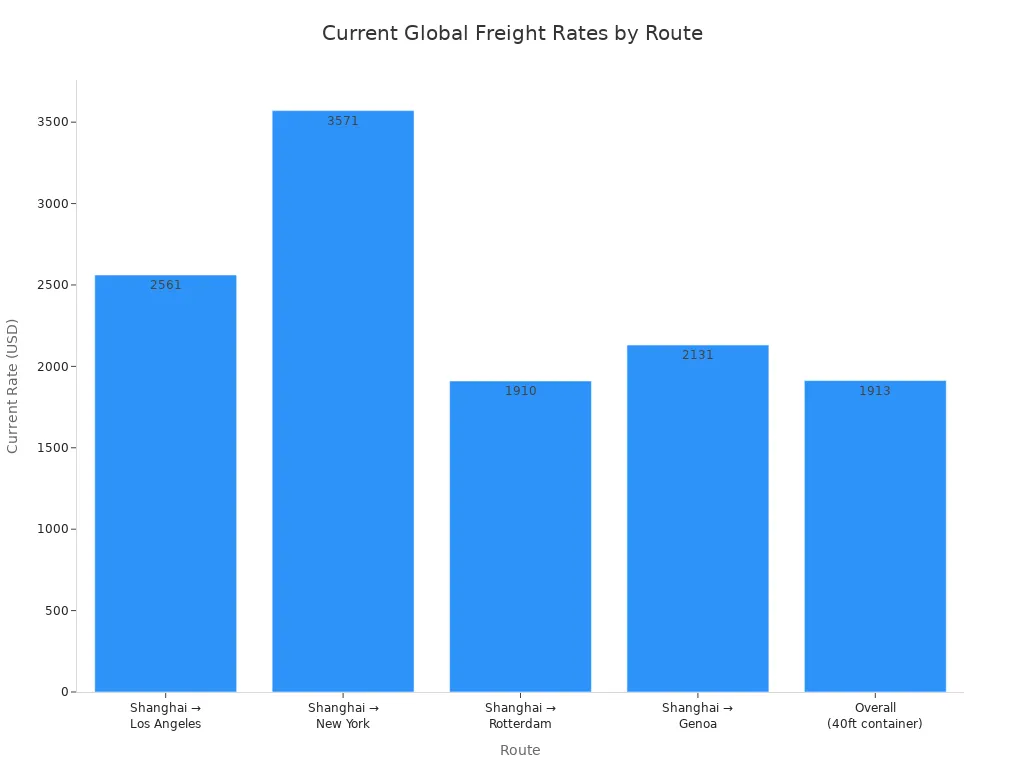
Route | Current Rate | Change This Week | Change From Last Year |
|---|---|---|---|
Shanghai → Los Angeles | $2,561 | -4% | -53% |
Shanghai → New York | $3,571 | -5% | -41% |
Shanghai → Rotterdam | $1,910 | -11% | -54% |
Shanghai → Genoa | $2,131 | -9% | -49% |
Overall (40ft container) | $1,913 | -6% | -48% |
Shippers and logistics professionals rely on data-driven strategies and intelligent solutions from JUSDA to navigate these complex market conditions.
Key Takeaways
Global trade patterns are changing. Businesses are shifting to local supply chains to avoid tariffs and geopolitical risks.
Recent port policy changes have increased shipping costs. New tariffs and sanctions have disrupted logistics and raised operational expenses.
The World Container Index is a crucial tool. It helps logistics professionals track freight rate movements and adapt to market changes.
JUSDA's JusLink platform offers AI-driven insights. It helps shippers predict rates and manage risks effectively during periods of volatility.
Adapting supply chains is essential. Companies should diversify suppliers and explore alternative transport modes to enhance resilience.
Freight Volatility Drivers
Trade Shifts
Global trade continues to evolve, creating new patterns in shipping and logistics. Businesses now favor local and regional supply chains, responding to rising tariffs and international conflicts. This shift disrupts established supply routes and leads to supply chain imbalances. Geopolitical tensions, such as the Iran-Israel situation, increase risks and force carriers to reroute vessels. E-commerce growth also changes shipping patterns, with higher demand for faster deliveries and flexible logistics solutions.
The container index highlights several notable changes in 2025. Transpacific routes have seen rate increases, while Asia-Europe routes have experienced declines. These trends reflect capacity issues, softening demand, and ongoing tariff uncertainties. Trade routes are rebalancing, with more activity between Southeast Asia, India, Africa, and Latin America. Tariff adjustments between the US and China influence freight rates and shipping decisions. Carriers often reroute vessels to avoid risky regions, which increases transit times and operating costs.
Note: Container equipment imbalances cause surpluses and shortages, leading to fluctuating rates and unpredictable shipping schedules.
Evidence Type | Description |
|---|---|
Localization of Supply Chains | Businesses shift to local and regional supply chains, causing disruptions. |
Geopolitical Tensions | Conflicts increase risks and affect trade routes. |
E-commerce Demands | E-commerce growth influences shipping patterns and rates. |
Container Equipment Imbalances | Surpluses and shortages drive rate volatility. |
Rising Fuel Costs | Higher fuel prices increase freight rates. |
Port Policy Changes
Recent port policy changes have directly impacted shipping costs and efficiency. Sanctions related to the Russia-Ukraine conflict disrupted logistics, forcing carriers to alter routes and increasing insurance costs. The removal of the de minimis exemption for sub-$800 shipments from China added expenses, especially for e-commerce businesses. New tariffs on US imports raised costs by over 70% for certain goods, complicating shipping dynamics.
The Red Sea crisis led carriers to avoid the Suez Canal, opting for longer routes that increased fuel consumption and shipping costs. Carrier alliance restructuring caused fluctuations in capacity and pricing, affecting the flow of goods. Investments in cleaner technologies, driven by new environmental regulations, raised short-term costs but may stabilize operations in the future.
Aspect | Impact on Shipping Industry |
|---|---|
Increased Operational Costs | Shipping companies must purchase carbon allowances, raising costs. |
Higher Freight Rates | Increased costs are passed on to customers, leading to higher freight rates. |
Longer Turnaround Times | Compliance with regulations leads to congestion and longer vessel turnaround. |
Port policy changes, combined with trade shifts, continue to drive volatility in global freight markets. The container index remains a vital tool for tracking these developments and helping logistics professionals adapt to changing conditions.
Container Index Insights
Rate Trends 2025
The container index serves as a vital benchmark for tracking global freight rate movements. In 2025, the World Container Index, Shanghai Containerized Freight Index (SCFI), and Freightos Baltic Index (FBX) all reflect significant volatility. Each index captures the effects of new port fees, vessel withdrawals, and tightening capacity across major trade lanes.
Index | Rate (USD) | Change (%) |
|---|---|---|
2,812 | -5.7% | |
SCFI | 1,763 | -5.3% |
FBX | 2,894 | -19.7% |
The World Container Index shows a 5.7% decrease, while the SCFI records a similar drop. The FBX, however, experiences a sharper decline of nearly 20%. These shifts highlight the impact of recent regulatory changes and market adjustments. New port fees in China and the United States have led to vessel withdrawals, reducing available capacity and driving up rates on some routes. Shipping lines continue to adjust their schedules to avoid higher costs, which further amplifies rate fluctuations.
JUSDA's JusLink platform enables shippers to monitor these trends in real time. By leveraging AI-driven freight rate prediction, JusLink helps businesses anticipate changes and make informed decisions. This data-driven approach supports proactive risk management and cost optimization, especially during periods of heightened volatility.
Regional Variations
Regional differences in container shipping rates have become more pronounced in 2025. The container index reveals that some routes experience sharp declines, while others see rate increases due to shifting supply and demand dynamics.
Route | Rate Change | Current Rate (per FEU) |
|---|---|---|
Shanghai–Rotterdam | -10% | $2,143 |
Shanghai–Genoa | -12% | $2,342 |
Shanghai–Los Angeles | +6% | $2,678 |
Shanghai–New York | +2% | $3,743 |
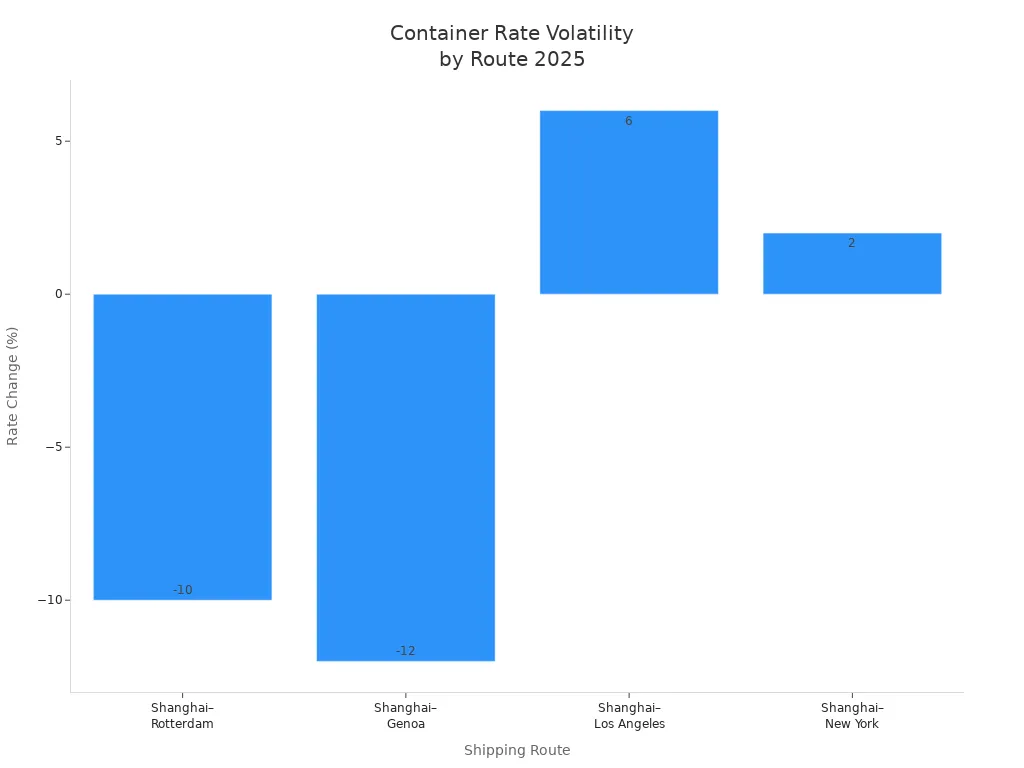
Transpacific routes, such as Shanghai to Los Angeles and New York, have seen rate increases. This trend results from vessel shortages and increased demand for imports. In contrast, Asia-Europe routes like Shanghai–Rotterdam and Shanghai–Genoa show double-digit declines. These changes reflect softer demand and adjustments in shipping line capacity.
Several factors drive these regional differences:
Geopolitical tensions, including trade policies and international relations, influence shipping costs.
Economic growth in certain regions increases demand for imported goods, raising transportation prices.
Supply and demand dynamics, such as port congestion and shipping line capacity adjustments, play a critical role in determining freight rates.
The container index remains an essential tool for logistics professionals. JUSDA's JusLink platform enhances visibility by integrating real-time data from multiple indices. This capability allows shippers to respond quickly to market changes and optimize their supply chain strategies.
Note: Data-driven insights from the container index empower businesses to navigate uncertainty and maintain operational efficiency.
Impact on Global Shipping
Capacity and Vessel Availability
New port fees in China and the United States have created significant challenges for global shipping capacity. Shipping companies now face higher operational costs, which has led many to withdraw vessels from key trade lanes. This reduction in vessel availability has caused a capacity crunch across the industry.
Fee Structure | Details |
|---|---|
Fee for Foreign-Built Vehicle Carriers | $50 per net ton, charged multiple times per year. |
Priority for PRC Vessel Operators | Specific fees targeting PRC vessels, reflecting geopolitical tensions. |
Evidence Description | Impact on Capacity Constraints |
|---|---|
US and China implementing tit-for-tat port fees | Increases operational costs, reducing available vessels. |
13% of crude tankers and 11% of container ships affected | A significant portion of the global fleet faces operational challenges. |
Shipping routes may change due to proposed fees | Route changes further strain shipping capacity. |
Container booking activity rebounded in early May, but year-over-year comparisons remain negative. Global TEU volumes increased by 29.6% week-over-week, yet bookings are still down 21.2% compared to last year. U.S. import bookings rose by 40.3% week-over-week, but volumes are 30.3% lower than the same week last year. Shipments from China to the U.S. surged by 70.6% week-over-week, but remain down 61.5% year-over-year. These numbers show ongoing instability and highlight the impact of new policies on vessel availability.
JUSDA’s China-Europe Express Rail offers a reliable alternative for shippers affected by ocean freight volatility. This service provides faster transit times than sea freight and more affordable rates than air freight, helping businesses maintain supply chain stability.
Consumer and Market Effects
The ripple effects of these shipping disruptions extend to consumers and markets worldwide. Increased shipping rates and tariffs have raised the cost of imported goods. In June 2025, U.S. customs collected over $27 billion in tariffs, much higher than the previous year’s $7.9 billion. The average effective tariff rate increased to 7.1%, and for every dollar of imports from China, costs rose by about 22 cents. Tariffs on imports from Canada and Mexico also increased, raising their effective rates to 15.5% and 11.9%.
The freight market has experienced unprecedented rate fluctuations and capacity shortages over the last five years. Macroeconomic factors and industry-specific challenges have made cost forecasting and capacity planning more difficult. About 60% of businesses have changed their ocean freight tendering strategies, as traditional methods no longer meet the demands of ongoing volatility.
The container index remains a critical tool for tracking these changes and helping logistics professionals adapt. JUSDA’s solutions, including the China-Europe Express Rail, support businesses in managing disruptions and maintaining efficient operations.
JUSDA Solutions
JusLink AI Capabilities
JUSDA’s JusLink platform stands at the forefront of intelligent supply chain management. JusLink uses advanced AI to deliver freight rate prediction, risk management, and supply chain optimization. The platform leverages historical and real-time data to model the impact of disruptions, such as weather events, on transit times. This capability allows logistics teams to reroute shipments and avoid delays, improving reliability and decision-making.
JusLink’s AI-driven tools provide several key benefits for logistics professionals:
Proactive risk mitigation by identifying potential non-compliance issues in real time.
Instant detection of shipment discrepancies, preventing incorrect deliveries.
Full visibility into warehouse operations, enabling immediate course correction.
Enhanced workforce allocation, ensuring staff deployment where needed most.
Improved on-time delivery performance and reduced freight costs through AI-driven forecasting.
JusLink’s impact extends to measurable operational improvements:
Automated quality checks saved $360,000 in the first year.
Over 100 hours saved weekly by reducing manual cycle counting.
Chargeback claims reduced by 50%, lowering operational costs.
JusLink’s AI also enhances supply chain transparency. The platform’s Control Tower Intelligent Risk Management system monitors risks in real time and provides timely warnings. JusElsa, the intelligent supply chain assistant powered by DeepSeek, supports users with shipment tracking, exception handling, and data queries. These features help businesses maintain efficiency and adapt quickly to changing market conditions.
JusLink’s AI capabilities empower logistics teams to make data-driven decisions, manage disruptions, and optimize every link in the supply chain.
China-Europe Express Rail
The China-Europe Express Rail offers a stable and efficient alternative for shippers facing ocean freight volatility. This service connects over 226 cities in 25 European countries and more than 100 cities in 11 Asian countries. The rail network supports a wide range of goods, including electronics, clothing, and medical supplies.
A comparison of operational advantages highlights the strengths of the China-Europe Express Rail:
Advantage | China-Europe Express Rail | Traditional Ocean Freight |
|---|---|---|
Transit Time | Slower | |
Cost | More affordable than air | Cheapest option |
Customs Processes | Improved | More complex |
Real-time Tracking | Available | Limited |
Environmental Impact | Lower emissions | Higher emissions |
Rail transport can save up to a month in travel time compared to sea freight. Sea transport often takes 30-40 days, while rail can deliver goods in less than 10 days. This speed helps businesses respond quickly to market demands and reduces inventory holding costs. The China-Europe Express Rail also features improved customs processes and real-time tracking, giving shippers greater control and visibility.
The rail service has played a crucial role during periods of ocean freight volatility. For example:
The New Silk Road carried 138,009 TEU in the reviewed period, reflecting ongoing market changes.
Rail transport’s faster transit time allows companies to avoid delays caused by port congestion or vessel shortages.
The network’s broad reach contributed to an increase in EU-China trade, which reached 739 billion euros by 2023.
JUSDA’s customer stories demonstrate the value of these solutions. Leading manufacturers have adopted JUSDA’s Supply Chain Management Collaboration Platform to address challenges such as complex overseas supply chains and regional customs differences. By integrating AI and digital tools, JUSDA helped these companies achieve end-to-end lifecycle management, real-time transparency, and significant cost reductions. Automated processes and intelligent risk management have improved efficiency and enabled cost-effective global expansion.
JUSDA’s JusLink platform and China-Europe Express Rail provide shippers with the tools and alternatives needed to navigate freight volatility, maintain supply chain stability, and achieve operational excellence.
Strategies for Shippers
Managing Rate Risk
Shippers face ongoing freight volatility, making rate risk management a top priority. Companies can take several practical steps to protect their operations from unpredictable market swings:
Leverage technology and digital tools to monitor market trends and ensure timely deliveries.
Use data-driven forecasting to predict rate movements and secure favorable contracts.
Build flexibility by accessing priority services through extensive logistics networks.
Diversify carrier partnerships to avoid disruptions from single-point failures.
A structured approach to rate risk can further strengthen resilience:
Apply automated rate floors to trigger spot bids when contract rates become unfavorable.
Classify carriers into performance-based tiers to prioritize tenders.
Distribute tenders across multiple high-performing carriers to minimize exposure.
Tip: Advanced analytics, such as those offered by JUSDA’s JusLink platform, provide predictive insights that help shippers forecast capacity needs and anticipate disruptions like port congestion. This enables better cost management and operational adjustments.
Key Outcome | |
|---|---|
Forecast capacity needs by lane and mode | Improved cost control and planning |
Anticipate disruptions | Smoother logistics and timely deliveries |
Adapting Supply Chains
Adapting supply chains to ongoing volatility requires both strategic planning and operational flexibility. Companies have found success by:
Diversifying their supplier base, sourcing from regions beyond those impacted by tariffs, such as Southeast Asia and North America.
Using tariff engineering and product classification to legally reduce duty exposure.
Shippers also benefit from exploring alternative transport modes:
Rail transportation offers energy efficiency and reliability for heavy cargo.
Air transportation provides speed for high-value, time-sensitive goods.
Multimodal solutions combine different modes to optimize costs and delivery times.
JUSDA’s China-Europe Express Rail stands out as a stable and efficient alternative during periods of ocean freight disruption. By integrating predictive analytics and multimodal options, shippers can build more resilient and adaptable supply chains.
Note: Regularly reviewing supply chain strategies and leveraging digital platforms like JusLink ensures shippers stay ahead of market changes and maintain operational efficiency.
Global trade shifts and evolving port policies have fueled new waves of freight volatility, as highlighted by the World Container Index 2025. Major US West Coast ports saw container traffic drop by over 60%, while Ningbo port in China remained more stable. Proactive risk management and intelligent solutions, such as JUSDA’s JusLink platform, help businesses respond quickly to disruptions. Logistics professionals rely on real-time data and predictive modeling to adapt to changing rates and optimize supply chains. Looking ahead, adaptability and data-driven decision-making will remain essential as freight rates and trade flows continue to fluctuate.

JUSDA Solutions
To provide you with professional solutions and quotations.
FAQ
What is the main advantage of JUSDA’s China-Europe Express Rail service?
JUSDA’s China-Europe Express Rail offers faster delivery than sea freight and lower costs than air freight. The service provides reliable transit times, improved customs processes, and real-time tracking for a wide range of goods.
How does JusLink help manage freight volatility?
JusLink uses AI to predict freight rates, monitor risks, and optimize supply chains. The platform provides real-time data and automated alerts, helping logistics teams make informed decisions and respond quickly to disruptions.
Which industries benefit most from JUSDA’s solutions?
JUSDA serves electronic manufacturing, 3C home appliances, FMCG, automotive, new energy, medical health, heavy equipment, and bulk materials. The company tailors supply chain solutions to meet the unique needs of each industry.
What types of goods can the China-Europe Express Rail transport?
The China-Europe Express Rail supports electronic products, clothing, small commodities, and medical supplies. The service handles a variety of goods, making it suitable for many industries.
How does JusLink’s AI assistant, JusElsa, support logistics operations?
JusElsa, powered by DeepSeek, assists with shipment tracking, risk assessment, exception handling, and data queries. The AI agent improves efficiency and provides real-time support for supply chain management tasks.
See Also
Understanding Current Trends in Logistics Risk Management
Discovering Innovations in Sea Freight Logistics for 2024
Examining How Global Trade Policies Affect National Economies
Five Key Trends Shaping Future Supply Chain Efficiency
Getting Prepared: New Transport Technologies for Supply Chains