Global Container Rates Face Unprecedented Volatility as 2025 Shipping Markets Navigate Multiple Disruptions

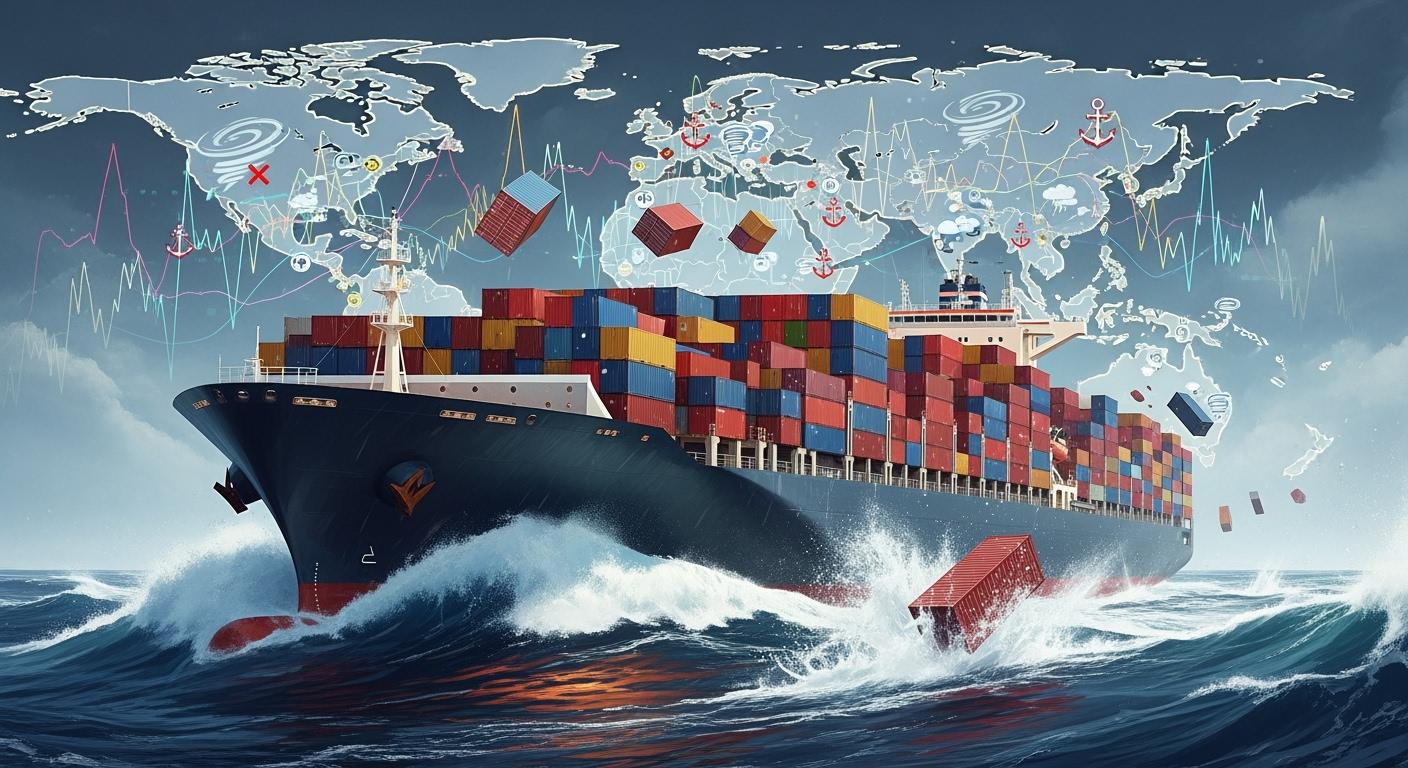
Container rates show high volatility heading into 2025 due to rapid shifts in global trade dynamics.
The shipping industry faces historically low freight rates, economic uncertainty, and new tariffs, such as the 25% U.S. tariff on autos and parts from Canada and Mexico.
Industries served by JUSDA, including automotive and electronics, must adapt to unpredictable conditions by using predictive intelligence and multimodal agility.
Year
Forecast Revisions
Key Factors Affecting Volatility
2025
Revised three times
+7% to -3% (base-case 4%)
Tariffs, trade agreements, economic conditions
JUSDA’s innovative supply chain solutions empower stakeholders to navigate these challenges with resilience and strategic preparedness.
Key Takeaways
Container rates are highly volatile due to factors like tariffs, economic uncertainty, and geopolitical tensions. Stay informed to adapt your shipping strategies.
Utilize predictive analytics and advanced data tools to forecast shipping costs and manage logistics effectively. This can help you make informed decisions.
Flexibility is key. Consider indirect routing and proactive inventory management to mitigate the impact of rising shipping costs and delays.
JUSDA’s solutions, like the China-Europe Express Rail and JusLink AI, provide reliable alternatives and real-time insights to navigate market disruptions.
Maintaining open communication with freight forwarders and monitoring market trends can lead to significant savings and better planning.
Container Rates Volatility in 2025

Main Disruptions Impacting Rates
Container rates in 2025 reflect a landscape shaped by multiple disruptions. Several factors drive volatility in container freight rates and container spot rates.
Tariff overhang remains a major obstacle. Global supply chains hesitate to make decisions until trade policies become clear.
Supply-side cost inflation affects operations. Rising fuel prices and stricter trucking regulations increase freight costs for shippers and carriers.
Demand-side policy paralysis creates uncertainty. Many companies delay shipments because they do not know how tariffs will change.
A Supreme Court ruling on tariffs could unlock pent-up demand. This event may shift the market and impact container freight rates.
Geopolitical tensions also play a significant role.
The US–China trade war suppresses trade growth and disrupts market stability.
Market dynamics have shifted from shortages to oversupply. This change affects rate stability and forces carriers to adjust their strategies.
Carriers respond with slow steaming and blank sailings. These tactics help manage supply and maintain profitability.
Customer expectations evolve. Shippers now prioritize reliability and visibility in their supply chains.
Note: The combination of policy uncertainty, cost pressures, and changing market dynamics creates a complex environment for global logistics providers.
Immediate Effects on Global Trade
The volatility in container rates has immediate consequences for global trade.
Major carriers reroute vessels around the Cape of Good Hope. This change extends shipping schedules by one to two weeks and disrupts delivery timelines.
Ongoing tariff uncertainties and geopolitical tensions complicate trade planning. Shippers face higher costs and unpredictable schedules.
The expiration of the U.S.–China tariff truce adds risk. Companies must adapt quickly to new trade policies and shifting container freight rates.
Impact Area | Description |
|---|---|
Shipping Schedules | Extended by 1-2 weeks due to rerouting |
Trade Planning | Complicated by tariff and policy uncertainty |
Shipping Costs | Increased by geopolitical and regulatory changes |
Risk Management | More complex due to policy shifts and disruptions |
Container spot rates fluctuate as carriers adjust routes and schedules. Shippers must monitor market changes and respond with flexible logistics strategies. JUSDA’s expertise in multimodal transport and predictive analytics supports clients in adapting to these challenges.
Recent Trends in Container Rates
Drewry World Container Index Insights
The Drewry World Container Index offers a clear view of the current container shipping market. Over the past year, global container volumes reached record highs. In August, volumes exceeded 16 million TEUs for four consecutive months. Despite this surge, freight rates continued to decline. The influx of new ships and diversions from the Red Sea and Suez Canal contributed to this trend.
The index recently showed a 4% increase, reaching $1,822 per 40-foot container. This marks the third consecutive week of rising rates. Spot rates from Shanghai to Los Angeles climbed by 6% to $2,438, while rates to New York rose by 4% to $3,568. Carriers are raising spot rates ahead of annual contract negotiations. Drewry expects a slight increase in rates next week due to General Rate Increases (GRIs), but this momentum may not last. The supply-demand balance could weaken in the coming quarters, which may lead to lower spot rates.
Note: General Rate Increases in mid-October and early November suggest a short-term market recovery. However, the outlook remains uncertain as fundamentals may soften.
Asia-U.S. and China-Europe Route Changes
Container rates on major trade routes have shifted sharply in 2024 and 2025. The table below highlights key changes:
Year | Route | Average Rate (Index Points) | Change from Previous Year (%) | Peak Rate (Index Points) | Notes |
|---|---|---|---|---|---|
2024 | Shanghai to Global | 2496 | 149% | 3600 | Geopolitical tensions and the Red Sea crisis drove rates higher. |
2025 | Asia-North America | 2069/FEU | 10.58% | N/A | Spot rates surged despite weak demand due to capacity tightening. |
2025 | Asia-North Europe | N/A | N/A | N/A | Carriers managed capacity to prevent price collapse. |
In 2024, geopolitical events, especially the Red Sea crisis, disrupted shipping and increased operating costs. This led to a sharp rise in spot container rates, with peaks not seen since the pandemic. In 2025, spot rates on the Asia-North America route surged by nearly 20% in a single week. Carriers held firm on General Rate Increases, using capacity management to support prices even as demand remained weak. The Asia-North Europe market reached a fragile balance, with carriers preventing a collapse in freight rates by carefully managing available space.
Drivers of Shipping Market Instability
Supply-Demand Imbalances
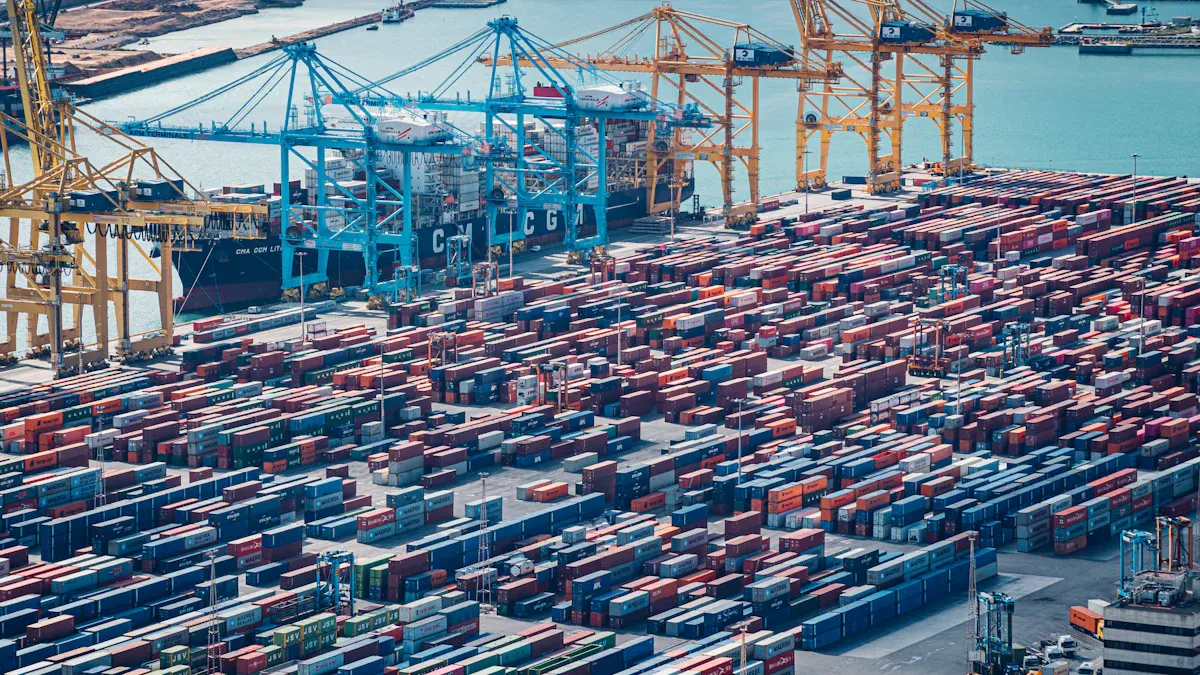
Supply-demand imbalances remain a primary driver of instability in global shipping markets. Carriers face a challenging environment as freight demand continues to fall. The U.S. economy is experiencing a goods recession, with freight demand dropping by 18% year-over-year. Truck driver employment has returned to pre-pandemic levels, which signals persistent overcapacity. Carriers have responded by increasing blank sailings, with 67 cancelled sailings from China to the U.S. and 71 in the opposite direction this month. Blank sailings between the U.S. West Coast and Southeast Asia have risen 75% year-to-date.
China’s imports have declined by 27%, and exports have dropped by 42% compared to last year. Operating margins on major routes have fallen below breakeven, forcing carriers to withdraw capacity. These actions have led to volatility in container rates and container spot rates, as carriers attempt to balance supply with weak demand.
Note: Capacity management through blank sailings and service adjustments has become essential for maintaining load factors and stabilizing container freight rates.
Indicator | Description |
|---|---|
Goods Recession | U.S. freight demand at pandemic-era lows |
Blank Sailings | 67 cancelled China-U.S., 71 cancelled U.S.-China sailings this month |
Imports/Exports | China imports down 27%, exports down 42% year-over-year |
Operating Margins | Major routes operating below breakeven, leading to capacity withdrawal |
Geopolitical and Regulatory Factors
Geopolitical risks and regulatory changes continue to disrupt global trade flows. These disruptions alter shipping routes, often forcing vessels to take longer and less efficient paths. As a result, carbon emissions increase and operational costs rise. National priorities have shifted toward domestic security, which may slow technological development in shipping decarbonization.
Shipping routes change, leading to longer transit times and higher costs.
Carbon emissions increase due to less efficient routing.
National security concerns slow progress in shipping technology.
The Arctic region has emerged as a new frontier for geopolitical competition. Nations are making territorial claims and reviving military strategies. Melting sea ice is opening new shipping routes, which could reduce transit times between Asia and Europe. However, these changes introduce new uncertainties for carriers and shippers.
Factor | Description |
|---|---|
Trade Policy Uncertainty | U.S. trade policy changes influence importer behavior |
Geopolitical Competition | Arctic territorial claims and new shipping routes |
Regulatory Shifts | National security focus slows shipping decarbonization |
Operational Challenges
Operational challenges add another layer of instability to the shipping market. Rising insurance premiums, maintenance costs, and fuel expenses squeeze profitability for carriers. Equipment shortages create maintenance challenges and operational delays. Regulatory uncertainty affects compliance and operational stability. Labor shortages, driven by generational shifts in workforce participation, further complicate operations.
Insurance premiums and equipment expenses continue to rise.
Equipment shortages lead to delays and maintenance issues.
Regulatory uncertainty impacts compliance and stability.
Labor shortages persist due to workforce changes.
A surge in carrier bankruptcies has occurred as spot market rates remain low and operational costs stay high. The imbalance between capacity and freight volume forces carriers to operate at a loss, which increases market instability.
Trend | Description |
|---|---|
Carrier Bankruptcies | Increased bankruptcies due to low spot rates and high operational costs |
Operational Costs | Insurance, maintenance, and fuel expenses squeeze profitability |
Capacity vs. Volume | Imbalance forces carriers to operate at a loss |
Tip: Companies can mitigate operational risks by leveraging advanced supply chain management solutions and predictive analytics to optimize freight planning and resource allocation.
JUSDA Solutions for Volatile Markets
China-Europe Express Rail Advantages
JUSDA’s China-Europe Express Rail service provides a strategic advantage for companies facing unpredictable global freight rates. The rail network connects major cities in China with key destinations in Europe, offering a reliable alternative to traditional sea and air transport. Businesses benefit from door-to-door delivery in 15-20 days, which is faster than ocean shipping and more cost-effective than air freight. This solution supports a wide range of goods, including electronics, clothing, and medical supplies. JUSDA’s expertise in customs operations and resource alignment ensures that shipments move smoothly across borders, reducing the risk of delays and stranded cargo. The rail service also expands connectivity for goods from Southeast Asia, Japan, and Korea, helping companies adapt to shifting market conditions.
Warehouse Network and Real-Time Inventory
JUSDA’s global warehouse network strengthens supply chain resilience during periods of market volatility. The company operates over 155 service points and more than 2.5 million square meters of warehouse space worldwide. Advanced inventory management systems, such as eVMI and JusLink, provide real-time tracking and control. Businesses gain transparency and efficiency, which helps them respond quickly to changes in demand or disruptions in freight schedules. JUSDA’s value-added services, including picking, packing, and labeling, support industries like automotive, electronics, and FMCG. The warehouse network enables companies to optimize inventory levels and reduce logistics costs, even when global freight rates fluctuate.
JusLink AI for Predictive Supply Chain Management
JUSDA’s JusLink AI solution empowers supply chain leaders to navigate volatile shipping markets with confidence. The platform uses artificial intelligence to forecast delays, monitor shipments in real time, and analyze data for better fulfillment operations. Companies rely on digital tools to manage complex supply chains and enhance resilience. JusLink AI agents optimize spend and capacity planning, helping organizations adjust to peaks and collapses in the shipping market. Most supply chain leaders now prioritize digital transformation, with many planning to invest in real-time freight rate data solutions. JusLink’s predictive analytics and risk control tower enable proactive decision-making, supporting operational efficiency and cost management.
JusLink AI transforms logistics by providing accurate demand forecasting and real-time visibility, which are essential for managing freight volatility.
Solution | Key Benefit | Industry Application |
|---|---|---|
China-Europe Express Rail | Faster, cost-effective delivery | Electronics, medical, apparel |
Warehouse Network | Real-time inventory, transparency | Automotive, FMCG, electronics |
JusLink AI | Predictive analytics, risk control | All industries |
How Disruptions Interact
Compounding Effects on Container Rates
Disruptions in global shipping rarely occur in isolation. When trade tensions, regional conflicts, and operational challenges overlap, they amplify volatility in container rates. The following table outlines how different types of disruptions interact and impact container pricing and availability:
Disruption Type | Impact on Container Rates |
|---|---|
Trade tensions | Contributes to uncertainty and potential delays in shipments, affecting pricing and availability. |
Regional conflicts | Can disrupt shipping routes and logistics, leading to increased costs and volatility in rates. |
Port strikes | Directly cause delays in cargo handling, impacting timely deliveries and increasing financial exposure. |
Vessel seizures | Result in unexpected disruptions, further complicating logistics and contributing to rate fluctuations. |
Unpredictable events | Such as natural disasters or political instability, can create sudden spikes in demand or supply shortages. |
Supply chain adaptations | Companies are revisiting strategies and insurance to mitigate risks, indicating proactive management of volatility. |
Shipping companies often experience compounding effects when disruptions overlap. Geopolitical crises can increase greenhouse gas emissions by at least 46%. Economic costs may rise by 51%. Voyage durations can extend by 20 to 34 days. These challenges force companies to prioritize short-term operational efficiency. Many overlook long-term sustainability, even though transformative innovations could offer lasting benefits. Freight rates respond quickly to these overlapping disruptions, making proactive risk management essential.
Note: Overlapping disruptions can multiply risks and costs, requiring advanced supply chain solutions for stability.
Case Studies Featuring JUSDA Clients
JUSDA supports clients across industries during periods of compounded volatility. One leading electronics manufacturer faced simultaneous port strikes and regional conflicts. JUSDA’s Supply Chain Management Collaboration Platform provided real-time transparency and lifecycle management. The client used JusLink AI to forecast delays and optimize freight planning. As a result, the company maintained stable deliveries and reduced financial exposure.
Another automotive client encountered vessel seizures and unpredictable events. JUSDA’s China-Europe Express Rail service offered a reliable alternative to ocean shipping. The client benefited from faster transit times and lower costs. JUSDA’s warehouse network enabled flexible inventory management, helping the client adapt to sudden changes in demand.
These examples show how JUSDA’s integrated solutions help companies navigate compounding disruptions. Clients gain resilience, operational efficiency, and improved freight cost control.
Actionable Insights for Shippers
Expert Forecasts and Data Tools
Shippers face a rapidly changing logistics environment in 2025. Industry experts predict a stable freight landscape, with spot rates likely to soften and contract pricing expected to remain flat. To navigate these shifts, shippers should leverage advanced data tools and forecasting models.
Freight Forecast: Rate & Volume Outlook offers predictive modeling based on historical shipping data.
Market indices, such as the Drewry World Container Index, provide real-time benchmarks for container rates and help shippers track market movements.
Data-driven insights enable companies to reassess their cost-to-serve, rebalance modal strategies, and renegotiate routing guides while capacity remains loose.
Tip: Using reliable data tools allows shippers to make informed decisions and respond quickly to market changes.
Strategies for Managing Container Rate Volatility
Successful shippers use a combination of proactive planning and flexible logistics strategies to manage volatility. One importer of raw materials for medical products shipped as much inventory as possible before a predicted tariff increase. This approach helped the company avoid higher shipping costs and saved thousands of dollars. Indirect routing also proves effective. Although it may increase transit time, it provides more options to secure favorable rates and still meet delivery commitments.
Staying informed about market trends and maintaining open communication with freight forwarders can lead to significant savings. Carriers must notify clients of rate increases at least 30 days in advance. This advance notice gives shippers time to adjust shipment timing and avoid unexpected costs. Relying solely on spot rates can expose companies to risk. Understanding contract rates and monitoring market indices, such as SCFI and WCI, supports better decision-making.
Shippers who combine data-driven planning with flexible execution can maintain resilience in the face of unpredictable container rates.
Industry analysts identify several causes for container rate volatility in 2025.
Massive overcapacity in the global fleet outpaces demand growth.
Weakening demand, especially in the US, reduces import volumes.
Geopolitical volatility creates uncertainty for shippers.
JUSDA’s China-Europe Express Rail, global warehouse network, and JusLink AI help companies adapt to these challenges. Stakeholders thrive by using real-time insights, securing trusted carriers, and leveraging advanced intelligence. Strategic planning, predictive analytics, and automation support effective supply chain management. Monitoring market trends and adopting new technologies remain essential for resilience.

JUSDA Solutions
To provide you with professional solutions and quotations.
FAQ
What makes JUSDA’s China-Europe Express Rail service valuable during container rate volatility?
JUSDA’s China-Europe Express Rail offers faster delivery than sea freight and lower costs than air freight. The service provides reliable transit times and supports diverse goods, helping companies manage unpredictable shipping rates.
How does JUSDA’s warehouse network support supply chain resilience?
JUSDA operates over 155 service points and 2.5 million square meters of warehouse space. Advanced inventory systems like eVMI and JusLink enable real-time tracking, improving transparency and efficiency for global supply chains.
What role does JusLink AI play in managing shipping market disruptions?
JusLink AI uses predictive analytics to forecast delays, monitor shipments, and optimize fulfillment. Companies gain real-time visibility and risk control, allowing them to respond quickly to market changes and disruptions.
Which industries benefit most from JUSDA’s supply chain solutions?
JUSDA serves electronics, automotive, FMCG, medical health, new energy, heavy equipment, and bulk materials industries. Each sector receives tailored logistics and supply chain management solutions for efficient global operations.
See Also
Understanding Logistics Risk Trends and Their Impacts
How to Manage Supply Chain Disruptions Amid Inflation
Five Key Trends Shaping Future Supply Chain Efficiency
Exploring New Developments in Sea Freight Logistics for 2024