Global container shipping rates plummet as carriers slash capacity ahead of China's Golden Week

Global container shipping rates have dropped sharply as major carriers implement capacity cuts before China’s Golden Week. The shipping industry faces immediate pressure, with recent data showing a 24% rate decrease on the Asia–U.S. West Coast route and a 5% drop on the Asia–U.S. East Coast route:
Route | Rate Change (%) | Current Rate (USD/FEU) |
|---|---|---|
Asia–U.S. West Coast | -24% | $2,369 |
Asia–U.S. East Coast | -5% | $4,888 |
Shippers now confront significant volatility in freight costs and service availability.
Key Takeaways
Global container shipping rates have dropped significantly, with a 24% decrease on the Asia–U.S. West Coast route. Shippers should prepare for fluctuating costs.
China's Golden Week causes shipping disruptions, often leading to a 7% rate increase. Shippers must act quickly to secure space before the holiday rush.
Carriers are cutting capacity due to weaker demand and oversupply. This trend may lead to further rate declines and requires shippers to adapt their logistics strategies.
JUSDA offers integrated logistics solutions to help businesses navigate market volatility. Their services can enhance supply chain resilience during uncertain times.
Utilizing AI-driven tools like JusLink can provide real-time insights and improve decision-making for shippers, helping them manage risks effectively.
Container Shipping Market Overview
Global Trends
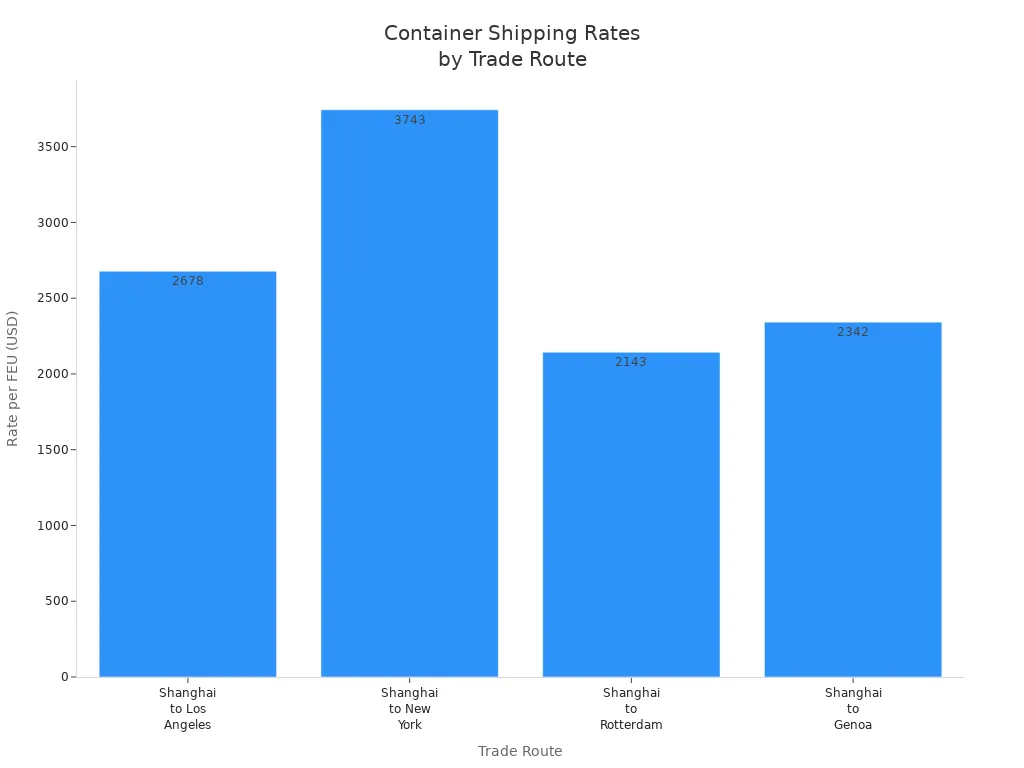
Recent data from the Drewry World Container Index and other market indicators reveal significant shifts in global container freight rates. The following table highlights current rates and changes across major trade routes:
Trade Route | Rate Change | Current Rate (per FEU) | Notes |
|---|---|---|---|
Shanghai to Los Angeles | +6% | $2,678 | Modest gains following GRI announcements. |
Shanghai to New York | +2% | $3,743 | Rates increased but sustainability is questioned. |
Shanghai to Rotterdam | -10% | $2,143 | Significant decline due to capacity management issues. |
Shanghai to Genoa | -12% | $2,342 | Further drop attributed to softening demand and new vessels entering service. |
U.S. container imports | N/A | N/A | Projected decrease through 2025 amid tariff uncertainty. |
Key global trends include:
Transpacific rates have dropped 60-70% since June, reaching their lowest since December 2023.
Rates to Northern Europe fell 7%, while Asia-Mediterranean prices declined 2%.
Year-over-year, rates are 60% lower on Asia-Europe lanes and 70% lower on transpacific routes.
Geopolitical tensions, such as the Russia-Ukraine conflict and the Red Sea crisis, have forced carriers to reroute, increasing costs and reducing reliability.
Economic factors like inflation and rising fuel prices have led to unpredictable market conditions.
E-commerce continues to drive demand for flexible shipping solutions, especially LCL shipments.
JUSDA, a global supply chain provider, supports businesses across industries by offering integrated logistics solutions. Its expertise in air, land, sea, and rail transport helps clients navigate market volatility and optimize supply chain operations.
Impact of China's Golden Week
China's Golden Week creates notable disruptions in container shipping. Rates typically rise by 7% within a week as shippers rush to move goods before the holiday. The increase stems from heightened demand, positive trade developments, and carriers tightening capacity by skipping sailings. Carriers often announce blank sailings and trim capacity during this period, compressing production schedules and managing freight rates to minimize delays.
Carriers utilize selective blank sailings.
Week-specific capacity trims are common.
Shippers must prepare for last-minute reductions in available space.
JUSDA’s extensive network and advanced logistics services enable businesses to adapt quickly to these seasonal fluctuations, ensuring continuity and reliability in global trade.
Capacity Cuts and Carrier Strategies
Reasons for Capacity Cuts
Carriers have responded to recent market challenges by implementing capacity cuts across major shipping routes. Several factors drive this trend. Weaker demand, influenced by changes to U.S. reciprocal tariffs, has led to fewer bookings than expected. Many carriers anticipated a surge in imports, but that increase did not materialize. As a result, excess shipping capacity now exists in the market. Structural issues, such as port congestion and vessel diversions, further limit available capacity and disrupt schedules.
The container shipping industry faces structural oversupply, which puts downward pressure on rates.
Fleet growth continues to outpace cargo demand because of record vessel orders and limited scrapping.
Carriers adjust their strategies by suspending services and cutting capacity when demand weakens.
Oversupply is expected to distort schedules and pressure rates for years.
The outlook for the second half of 2025 remains weak, with overcapacity prompting carriers to rethink their financial strategies.
Strategic blank sailings play a crucial role in managing shipping capacity. Carriers sometimes skip scheduled voyages to maintain service reliability and schedule integrity. This approach allows them to deliver cargo on time, even if it means omitting certain port calls. Blank sailings help carriers manage overcapacity, stabilize freight rate indexes, and adjust to sudden shifts in demand. By skipping unprofitable voyages, carriers save on operational costs like fuel and labor. This practice also helps them respond to demand fluctuations, optimize vessel utilization, and maintain market equilibrium.
Effects on Container Freight Rates
Capacity cuts have had a direct impact on container freight rates. The Drewry World Container Index recently declined by 3%, reaching $2,044 per 40-foot container. On transpacific routes, rates from Shanghai to Los Angeles increased by 6% to $2,678 per FEU. However, Asia-Europe routes experienced significant declines, with rates from Shanghai to Rotterdam dropping 10% to $2,143 per FEU. The decline in Asia-Europe rates results from oversupply and softening demand as new vessels enter service. Analysts expect the supply-demand imbalance to worsen in the second half of 2025, likely causing further rate contractions.
Short-term effects of capacity cuts include increased rates due to reduced capacity and heightened demand. In the long term, as carriers adapt and invest in compliance-driven operations, greater stability and cost control may emerge. Currently, spot rates remain at their lowest since late 2023, while contract rates stay higher. The worsening capacity situation and moderate demand, combined with tariff-driven risks, highlight the importance of capacity management in shaping future container freight rates.
JUSDA's Solutions
Shippers facing volatility from capacity cuts and shifting container shipping dynamics need reliable alternatives. JUSDA offers a suite of solutions designed to address these challenges. The China-Europe Express Rail service provides a faster option than sea freight and a more cost-effective choice than air freight. This service delivers goods from China to Europe in 15-20 days, balancing speed and cost for industries such as electronics, clothing, and medical supplies. JUSDA’s expertise ensures smooth customs operations and resource alignment, reducing the risk of goods being stranded.
JUSDA’s 8 Core Products further support shippers during periods of cutting capacity and market uncertainty. These products cover road, ocean, air, and rail transport, offering tailored solutions for industries like new energy vehicles, electronics, and clean energy. JUSDA optimizes resources, manages costs, and leverages a robust network infrastructure to provide efficient logistics services. The company’s focus on innovation and expansion into emerging markets strengthens its ability to meet evolving customer needs.
Tip: JUSDA’s integrated logistics solutions help businesses maintain supply chain resilience, even when trans-pacific capacity and global shipping capacity fluctuate.
JUSDA’s commitment to efficiency and innovation positions it as a trusted partner for companies navigating the complexities of today’s container shipping market.
Container Shipping Rates and Market Impact
Rate Fluctuations
Container shipping rates continue to show significant volatility across global trade lanes. Over the past 13 weeks, global container freight rates have declined, with the Drewry World Container Index falling 3% to $2,044 per 40-foot container. Spot rates on the Transpacific trade lane increased, with Shanghai–Los Angeles rising 6% to $2,678 per FEU and Shanghai–New York increasing 2% to $3,743. In contrast, asia-europe rates saw sharp declines, with Shanghai to Rotterdam dropping 10% to $2,143 per FEU and Shanghai to Genoa falling 12% to $2,342. U.S. import volumes are projected to decrease through the rest of 2025, influenced by ongoing tariff disputes.
Spot rates on Asia-Europe shipments are being discounted almost daily, indicating a rate war among carriers.
The decline in average spot rates has been more pronounced into North Europe compared to the Mediterranean.
Analysts predict the pace of spot rate decline may quicken into the Mediterranean due to increasing capacity.
Tariff uncertainties are causing downward pressure on rates, especially on Transpacific routes.
Geopolitical shifts disrupt usual freight rate patterns, particularly affecting Transpacific rates.
These fluctuations in prices reflect the dynamic nature of the shipping market. Carriers adjust their strategies to respond to changing demand and capacity, leading to frequent changes in freight rates. The market remains sensitive to global events, including geopolitical tensions and regulatory changes, which can quickly alter prices and service reliability.
Implications for Shippers
Changing container shipping rates create challenges for shippers. Increased costs arise from market volatility, geopolitical risks, and environmental regulations. Shippers must adapt their strategies to maintain supply chain reliability. When spot rates rise, securing capacity at reasonable prices becomes difficult, resulting in delays and higher expenses. Geopolitical instability can force carriers to reroute vessels, further complicating logistics and increasing costs.
Shippers respond to these challenges by enhancing real-time awareness and agility in their logistics strategies. Many frontload imports to mitigate delays and prioritize timely delivery. Diversification of capacity helps manage risks associated with fluctuating freight rates. Data-driven decision-making becomes essential for navigating the complexities of the current shipping landscape.
Note: Shippers who proactively monitor prices and adjust their logistics plans can better manage risks and maintain supply chain stability.
JUSDA's Intelligent Supply Chain
JUSDA supports clients with advanced solutions designed to manage risk and optimize logistics amid fluctuating container shipping rates. JusLink’s AI Solution provides real-time insights into market conditions, enabling clients to make informed shipping decisions. The platform uses AI-driven tools for dynamic pricing analysis, helping companies adjust shipping plans based on market signals.
JusLink’s AI Solution offers automated workflows and predictive analytics to enhance operational efficiency and cost management.
Real-time alerts on rate changes allow companies to stay competitive and respond quickly to market shifts.
AI tools identify optimal times for contract negotiations, using historical data and current market conditions.
JUSDA’s customer stories highlight how these intelligent solutions elevate manufacturers to global prominence. By integrating AI and blockchain technologies, JUSDA’s Supply Chain Management Collaboration Platform improves transparency, efficiency, and quality. Leading manufacturers benefit from standardized operations, reduced manual handling, and cost-effective global expansion.
JUSDA’s commitment to innovation and efficiency ensures that clients can navigate the challenges of fluctuating prices and downward pressure on rates. The company’s intelligent supply chain solutions empower businesses to optimize logistics, manage risks, and maintain reliable operations in a volatile market.
Industry analysts attribute the decline in container shipping rates to several factors:
The Drewry World Container Index fell 6% to $1,913 per 40ft container.
Trade policy uncertainty and tariffs increased operational costs.
U.S. port fees on Chinese-built vessels prompted fleet reorganization.
Impact | Description |
|---|---|
Capacity Decline | U.S. East Coast capacity dropped 6%, reducing space for importers. |
Sailing Cancellations | 7% of Asia–U.S. sailings were cancelled, amplifying booking challenges. |
Flexibility in supply chains remains essential. JUSDA’s innovative solutions, including RFID technology and real-time tracking, help businesses adapt and maintain efficiency. Forecasts suggest shipping rates may continue to decline after China’s Golden Week. Logistics providers should improve risk management, diversify networks, and invest in automation to navigate ongoing market uncertainty.
FAQ
What causes container shipping rates to fluctuate so sharply?
Global container shipping rates change due to supply-demand imbalances, geopolitical tensions, and carrier strategies like blank sailings. Economic factors such as inflation and fuel prices also influence rate volatility.
How does JUSDA help shippers manage market uncertainty?
JUSDA provides integrated logistics solutions, including China-Europe Express Rail and JusLink’s AI Solution. These services offer real-time insights, predictive analytics, and alternative transport options to help shippers adapt to changing market conditions.
What industries benefit most from JUSDA’s logistics services?
JUSDA serves electronic manufacturing, 3C home appliances, FMCG, automotive, new energy, medical health, heavy equipment, and bulk materials. Each industry receives tailored supply chain management solutions.
How does JusLink’s AI Solution improve supply chain efficiency?
JusLink’s AI Solution uses advanced analytics for demand forecasting, freight rate prediction, and risk monitoring. Clients gain real-time visibility and automated workflows, which optimize logistics operations and reduce costs.
What makes China-Europe Express Rail a valuable alternative?
China-Europe Express Rail delivers goods in 15-20 days, faster than sea freight and more affordable than air freight. JUSDA’s expertise ensures smooth customs operations and reliable delivery for electronics, clothing, and medical supplies.
See Also
Exploring 2024 Innovations in Sea Freight Logistics
Understanding Current Trends in Logistics Risk Management
Unlocking Supply Chain Efficiency: Expert Tips for Savings
Comprehensive Overview of Leading Global Logistics Firms
Addressing Global Supply Chain Growth Challenges Effectively