Container Shipping Rates Drop Sharply as Market Weakens in October 2025

Container shipping rates fell sharply in October 2025, driven by overcapacity, reduced demand, and the easing of earlier disruptions.
Rates on Asia-Europe lanes dropped about 60% year-over-year.
Transpacific routes saw a 70% decline.
Global container shipping rates decreased by 60-70% since June 2025.
Shippers, importers, and the global economy face significant changes as ocean container shipping costs shift. JUSDA’s expertise and digital supply chain solutions help businesses adapt efficiently to market volatility.
Key Takeaways
Container shipping rates have dropped significantly, with declines of 60-70% since June 2025. This shift impacts shippers and importers, requiring them to adapt their logistics strategies.
Overcapacity in the shipping industry is a major driver of falling rates. New vessels from the pandemic era are entering service, leading to a surplus of shipping capacity.
Shippers can leverage lower rates to negotiate better contract terms. Monitoring service levels and surcharges is essential to ensure cost savings do not compromise reliability.
JUSDA offers valuable solutions, including the China-Europe Express Rail, which provides faster and cost-effective shipping options compared to traditional ocean freight.
Businesses should adopt proactive planning and technology to navigate ongoing market volatility. This includes diversifying supply chains and using data-driven insights for better decision-making.
Market Trends in Container Shipping Rates
Recent Index Data and Rate Movements
Container shipping rates have experienced a steep decline in October 2025. The Containerized Freight Index stood at 1,114.52 points on October 3, 2025. This figure represents a 22.87% drop over the past month and a 47.80% decrease compared to the same period last year. The Drewry World Container Index reported $1,761 per forty-foot equivalent unit (feu) in October 2025. The index recorded an 8% weekly decline and marked its fifteenth consecutive week of falling freight rates.
Containerized Freight Index on October 3, 2025: 1,114.52 points
Decline over the past month: 22.87%
Year-over-year decline: 47.80%
Drewry World Container Index as of October 2025: $1,761 per feu
Weekly decline: 8%
Fifteen consecutive weeks of falling rates
The persistent downward trend in freight rates signals a significant shift in the ocean container shipping market. Shippers and importers must monitor these changes to adjust their logistics strategies.
Key Trade Lanes and Regional Differences
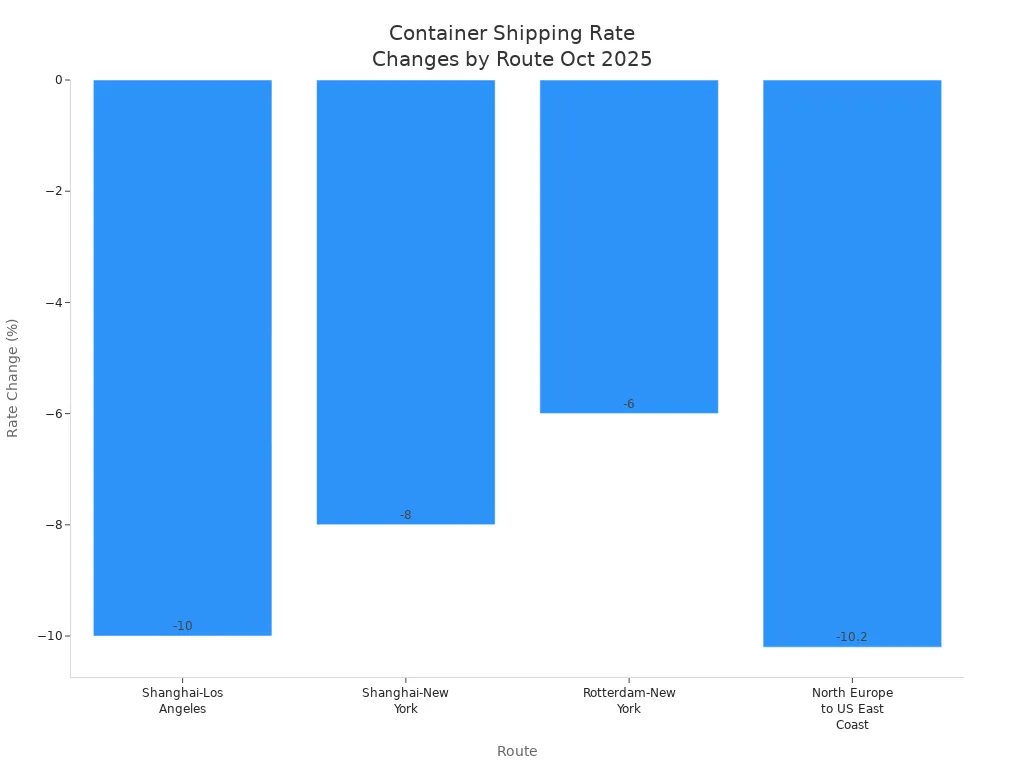
Major trade lanes have seen varied impacts on average spot rates and freight rates. The following table highlights the changes in rates across key routes:
Route | Rate Change (%) | Current Rate (per 40ft) | GRI (20ft) | GRI (40ft) |
|---|---|---|---|---|
-10% | $2,311 | $1,200 | $2,000 | |
Shanghai-New York | -8% | $3,278 | N/A | N/A |
Rotterdam-New York | -6% | $1,819 | N/A | N/A |
Far East to North Europe | N/A | $1,703 | $1,750 | $2,500 |
Far East to Mediterranean | N/A | $2,220 | $1,800-$2,150 | $2,600-$2,700 |
North Europe to US East Coast | -10.2% | $1,648 | N/A | N/A |
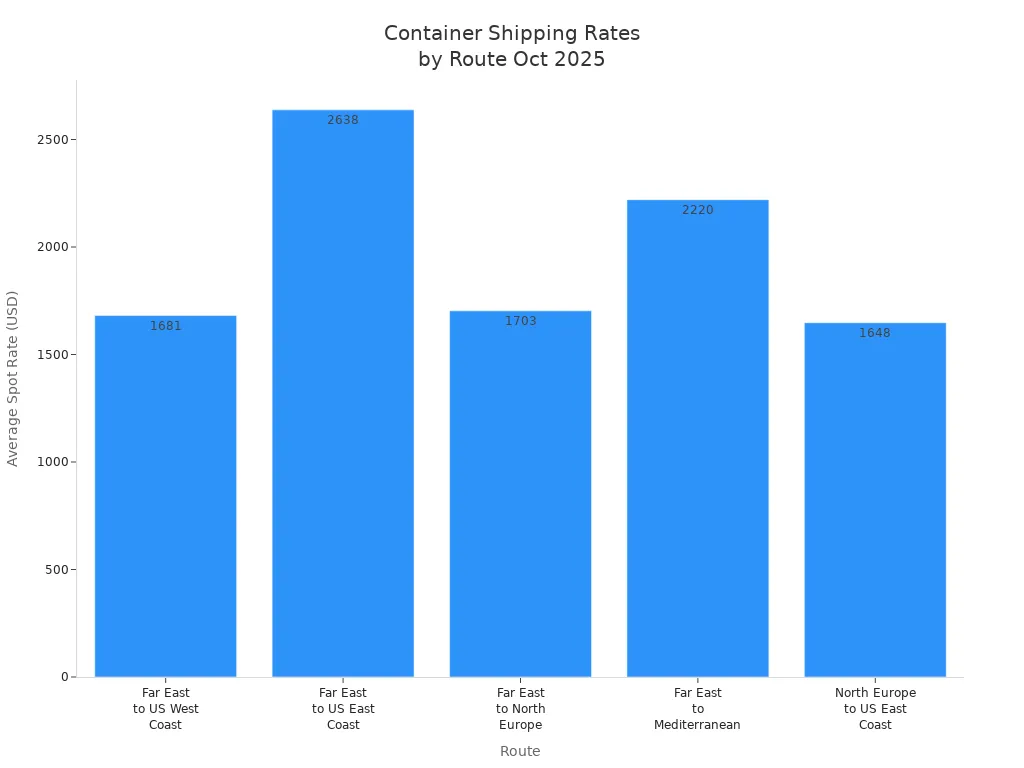
Average spot rates continue to fall across major routes. The table below shows the latest figures:
Route | Average Spot Rate (USD) | Change from Previous Week (%) |
|---|---|---|
Far East to US West Coast | $1,681 | -8% |
Far East to US East Coast | $2,638 | -8% |
Far East to North Europe | $1,703 | -6.6% |
Far East to Mediterranean | $2,220 | -4.6% |
North Europe to US East Coast | $1,648 | -5.5% |
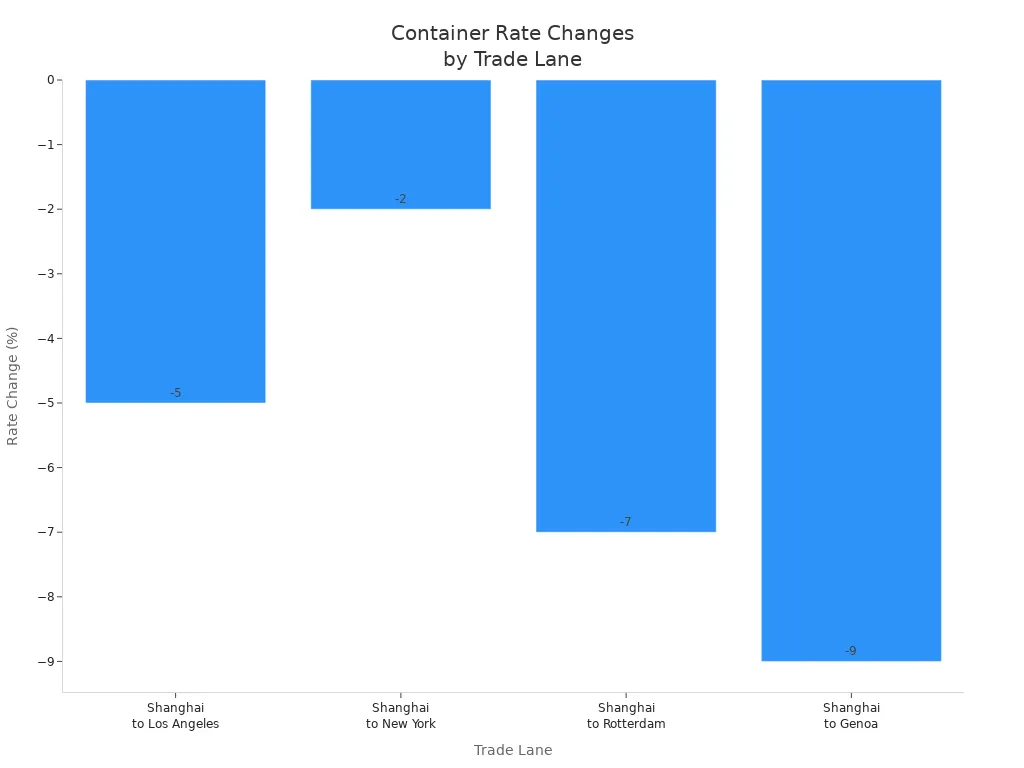
Shanghai–Genoa saw a 9% decline in freight rates. Shanghai–Rotterdam dropped by 7%. Shanghai–Los Angeles experienced a 5% decrease, while Shanghai–New York fell by 2%. The Drewry’s World Container Index showed a continuous decline, standing at USD 1,913 per forty-foot container as of September 18, 2025.
Regional differences have emerged in the market. Low demand for USA exports persists, driven by high tariffs affecting trade with India and Europe and an overflow of stocks from China. Seasonal changes, such as the Chinese Golden Week from October 1-7, 2025, are expected to impact exports, leading to blank sailings and increased space on ships.
Drewry’s World Container Index: USD 1,913 per 40’ container (September 18, 2025)
Low demand for USA exports due to tariffs and excess stocks from China
Seasonal changes like Chinese Golden Week impact exports and shipping space
Average spot rates and freight rates on ocean container shipping routes remain under pressure. Shippers must stay informed about these trends to optimize their logistics and supply chain decisions.
Drivers of the Decline
Overcapacity and Supply Chain Shifts
The global container shipping industry faces significant overcapacity in 2025. A surge of new vessels ordered after the pandemic has entered service, especially on Asia-Europe routes. Many carriers struggle to fill these ships due to lower cargo volume forecasts. The average age of ships continues to rise, while demolition rates remain at record lows, signaling abundant capacity in the market. Geopolitical factors may worsen the situation, with some shipping companies offering slots below cost.
Evidence Type | Description |
|---|---|
New Vessel Influx | Significant number of new vessels ordered during post-Covid years arriving, particularly on Asia-Europe routes. |
Cargo Volume Forecasts | Difficulties in filling these vessels due to cargo volume forecasts. |
Ship Age and Demolition | Increasing average age of ships and record low demolition rates indicating abundant capacity. |
Geopolitical Factors | Potential geopolitical issues could exacerbate overcapacity, leading to below-cost slot offerings by shipping companies. |
Supply chain shifts have also contributed to the decline in container shipping rates.
Ocean shipping rates from China to the U.S. West Coast have dropped by 68% since June.
The average cost of shipping a 40-foot container globally has fallen by 40% since mid-June.
U.S. container volume is projected to decrease by 17.5% in the remaining months of 2025, mainly due to tariff impacts.
The ongoing trade uncertainties and tariff changes have led importers to place fewer orders. This cautious approach reflects evolving trade strategies and tariff insecurities, which have played a direct role in lowering ocean container shipping rates.
Demand Slowdown and Economic Factors
Persistent overcapacity in the shipping market, driven by fleet expansion during the pandemic, signals declining demand for container shipping in 2025. The Drewry Global Supply/Demand Index has moved into overcapacity territory and is expected to keep falling, indicating vessel supply will exceed demand for an extended period.
U.S. trade measures, especially those targeting China, are projected to worsen the demand slump. New service fees on Chinese-built vessels calling at U.S. ports, set to begin in October 2025, may raise operational costs for carriers and reduce shipping activity.
Economic indicators point to a slowdown in consumer demand. GDP growth dropped sharply in the first half of the year. Senior economist Meagan Schoenberger notes that consumers are spending less, and tariffs are pushing prices higher. This trend is likely to continue, leading to a broader decline in demand that will affect container shipping.
In 2025, global trade volumes are expected to grow by 2.5-3.5%. However, U.S. imports will likely decline due to tariff uncertainties, causing container shipping rates to fall, especially for U.S.-bound routes. The National Retail Federation revised its 2025 projection, expecting a 3.4% decrease in total inbound volume. September data is expected to show a 10% drop in inbound volume at the Port of Los Angeles compared to last year.
Global container shipping rates continue to decrease, indicating that the surge driven by tariffs earlier in the year has faded. The Drewry’s World Container Index shows a consistent decline, marking a shift from volatility to stabilization in the freight market.
Impact on Shippers and the Industry
Cost Savings and Contract Negotiations
Lower container shipping rates have created new opportunities for shippers, importers, and logistics managers. Many companies now benefit from reduced container shipping costs, which helps them manage budgets and improve profit margins. The drop in ocean container shipping rates has shifted the balance of power in contract negotiations.
Shippers hold a stronger negotiating position than last year. They can leverage current market conditions to secure better terms.
Carriers respond by lowering service levels and capacity. They often raise surcharges to offset lower base freight rates.
Increased supply and decreased demand have led to lower freight prices. This change affects how companies negotiate contracts and plan logistics.
Shippers must remain vigilant. They should monitor service levels and surcharges to ensure that cost savings do not come at the expense of reliability.
Tip: Companies should review contracts regularly and use market data to negotiate favorable rates and service terms.
JUSDA’s China-Europe Express Rail Advantage
JUSDA’s China-Europe Express Rail offers a strategic alternative for businesses seeking time-sensitive and cost-effective shipping solutions. The rail service provides faster transit times than ocean container shipping and lower costs compared to air freight. JUSDA’s expertise in intercontinental logistics ensures smooth customs operations and reliable delivery.
In the first half of 2025, rail freight shipments between China and the EU decreased by 27%. Many shippers returned to maritime routes because of lower container shipping rates. Despite strong competition from ocean shipping, the rail service remains valuable for companies that prioritize speed and sustainability.
Feature | China-Europe Express Rail | Ocean Container Shipping |
|---|---|---|
Transit Time | 15-20 days | 30-40 days |
Cost | Lower than air freight | Lowest |
Reliability | High | Variable |
Sustainability | Strong | Moderate |
JUSDA’s rail solution supports industries such as electronics, clothing, and medical supplies. It helps businesses optimize freight costs and maintain supply chain resilience.
Managing Container Shipping Costs
Warehouse Solutions from JUSDA
JUSDA provides advanced warehousing solutions that help shippers manage logistics costs in a volatile market. The company operates warehouses across China, Hong Kong, Taiwan, Japan, Vietnam, India, the United States, and Mexico. These facilities offer general storage, bonded warehouses, distribution centers, and finished goods storage. JUSDA uses management systems like eVMI and JusLink for real-time inventory tracking. This technology gives clients transparency and control over their freight and inventory. Value-added services such as picking, packing, labeling, and kitting support efficient logistics planning. Clean room facilities meet strict environmental standards, making JUSDA a trusted partner for industries like electronics and automotive.
Shippers can optimize container usage by packing efficiently and using JUSDA’s warehouse network to reduce the number of containers needed. Monitoring seasonal surcharges and leveraging distribution centers during off-peak periods can further lower costs. Building strong relationships with logistics providers like JUSDA often leads to volume discounts and better service.
Tip: Conduct transportation assessments regularly to uncover cost-saving opportunities and improve efficiency.
Leveraging Digital Tools and AI
JUSDA’s JusLink AI solution empowers shippers to adapt quickly to changing container shipping rates and market conditions. JusLink uses AI for supply chain trend analysis, freight rate prediction, and sales demand forecasting. The platform streamlines logistics, enhances fleet management, and enables predictive maintenance for equipment reliability. JusLink’s risk control tower provides real-time monitoring and early warnings, helping companies prevent disruptions.
AI-driven tools optimize route planning, reduce operational costs, and improve workforce productivity. JusLink also protects goods and data through advanced cybersecurity measures. Shippers can use freight calculators and rate benchmarking tools to plan shipping costs and ensure competitive pricing. Monitoring the Freight Rate Index helps adjust strategies based on market trends.
Optimize container usage with efficient packing.
Use freight calculators and benchmarking tools.
Monitor seasonal surcharges and market trends.
Build strong relationships with logistics providers.
JUSDA’s digital solutions and warehousing expertise help shippers control costs and maintain resilience in the ocean container shipping market.
Outlook for the Coming Months
Rate Forecasts and Market Signals
Container shipping rates are expected to remain under pressure in the coming months. Forecasts show a steady decline in container volumes through the end of 2025. The table below outlines projected TEU volumes and year-over-year changes:
Month | Forecasted TEU | Year-over-Year Change |
|---|---|---|
September | 2.12 million | -6.8% |
October | 1.95 million | -13.2% |
November | 1.74 million | -19.7% |
December | 1.70 million | -20.1% |
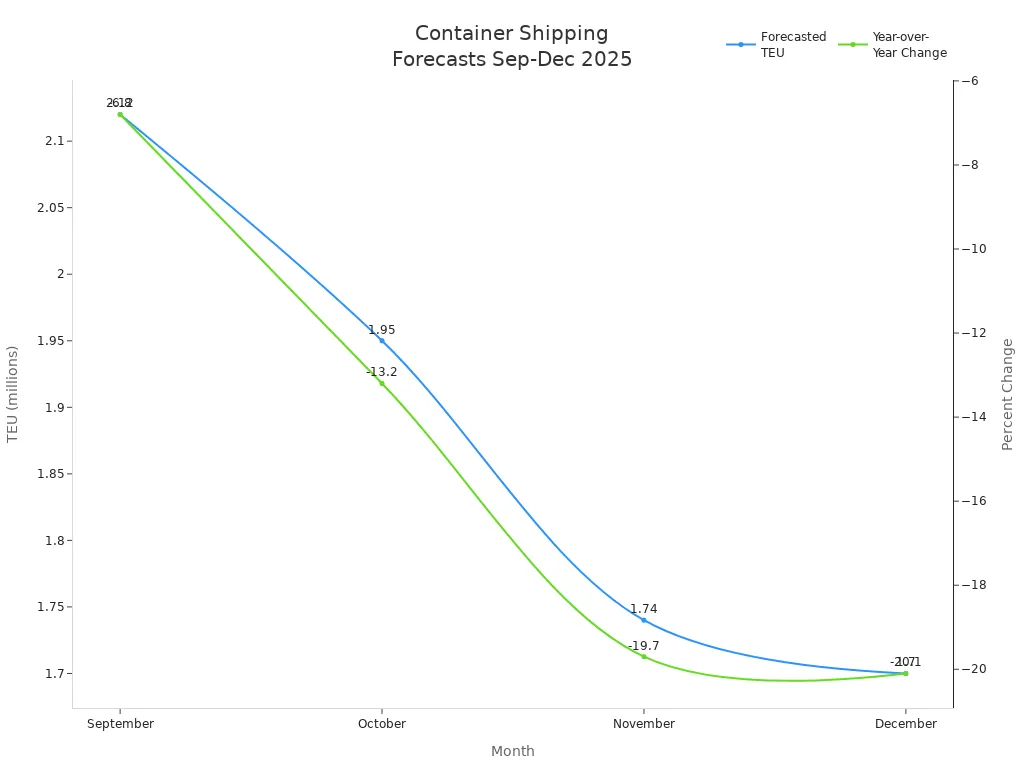
Experts monitor booking trends, tariff impacts, and capacity utilization to predict future movements in container shipping rates. Spot rates on the Transpacific market continue to weaken. New U.S. tariffs and reduced demand contribute to further rate softening. Capacity utilization has reached its lowest point since April. Macroeconomic uncertainties also affect demand expectations. These signals suggest that freight rates will likely remain subdued for the rest of the year.
Strategic Planning for Businesses
Businesses must adjust their supply chain strategies to address ongoing volatility in container shipping rates. Companies can take several steps to strengthen their operations:
Consider regional diversification to reduce risks from geopolitical factors and tariffs.
Use data-driven insights to optimize operations and anticipate delays in the shipping market.
Prioritize scenario modeling to navigate unpredictable demand and cost structures.
Diversify supply chains and ensure real-time visibility.
Prepare for a long-term tariff environment and macroeconomic instability by adjusting supply chain strategies.
Adapt to higher costs and avoid assuming full tariff relief.
Risk management practices play a key role in maintaining stability:
Leverage technology for real-time rate visibility.
Diversify carrier networks for flexibility.
Adopt dynamic pricing strategies to respond to market changes.
Implement effective financial planning, including contingency funds and freight derivatives.
Note: Proactive planning and technology adoption help businesses stay resilient in a changing freight market.
Container shipping rates have dropped sharply, signaling a weaker market and new challenges for global trade. Shippers must understand the causes—overcapacity, demand shifts, and economic changes—to adapt quickly. Logistics providers like JUSDA offer vital expertise in supply chain management, route optimization, and real-time updates. Companies benefit by staying flexible, using diverse shipping strategies, and leveraging digital tools for visibility.
Proactive steps—such as consolidating shipments, reassessing production, and monitoring market indicators—help businesses remain resilient in a changing landscape.
FAQ
What is the China-Europe Express Rail service?
JUSDA’s China-Europe Express Rail connects China and Europe with reliable rail logistics. The service offers 15-20 day door-to-door delivery, faster than sea freight and more affordable than air freight. It supports electronics, clothing, and medical supplies.
How does JUSDA’s warehousing solution help shippers?
JUSDA operates warehouses across Asia, Europe, and North America. Advanced systems like eVMI and JusLink provide real-time inventory tracking. Value-added services include picking, packing, labeling, and clean room facilities for industries such as electronics and automotive.
What benefits does JusLink’s AI solution offer?
JusLink’s AI solution delivers supply chain trend analysis, freight rate prediction, sales demand forecasting, and risk monitoring. The platform enhances decision-making, optimizes logistics, and improves operational efficiency for global supply chain management.
Which industries does JUSDA serve?
JUSDA supports electronic manufacturing, 3C home appliances, FMCG, automotive, new energy, medical health, heavy equipment, and bulk materials. The company tailors supply chain solutions to meet the unique needs of each industry.
How does JUSDA ensure reliable customs operations?
JUSDA leverages its extensive network and expertise to manage customs operations efficiently. The company aligns resources and coordinates communication across countries, minimizing delays and ensuring smooth cross-border logistics.
See Also
Exploring Innovations in Sea Freight Logistics for 2024
Understanding Current Trends in Logistics Risk Management
Analyzing Economic Factors in Supply Chain Cost Efficiency
A Detailed Look at the Future of LTL Freight
Unlocking Savings: Expert Tips for Supply Chain Optimization