Container shipping rates hit new lows as market volatility continues


Container shipping rates are now very low. This shows the market is changing a lot.
The Shanghai Containerized Freight Index is $1,460 per FEU. This is the lowest since July 2023. It was over $5,100 in early 2022.
E-commerce has grown and made small shipments go up by 22%. South Asia had export container growth of 13.6%.
These changes affect many businesses like electronics, FMCG, automotive, and e-commerce. Companies need to watch for shipping problems and change plans to stay ahead.
Key Takeaways
Container shipping rates are the lowest since July 2023. There have been big drops compared to past years. Companies need to watch these rates often. This helps them change their shipping plans if needed.
E-commerce is growing fast and needs more small shipments. This change affects many industries. Businesses must change how they work to keep up.
The shipping industry has too many ships and not enough cargo. This creates a supply-demand problem. Companies should look for partners who are flexible. They should also use partners who give real-time data. This helps them deal with the problem.
New rules and world events can make shipping costs go up and down. It is important to know about these changes. This helps businesses handle risks better.
Technology like JUSDA's solutions can make supply chains work better. Real-time tracking and data analytics help companies act fast. This lets them keep up with market changes.
Container shipping rates: latest trends and data

Recent rate movements and benchmarks
Container shipping rates are very low right now. The Drewry World Container Index is $1,913 for a 40-foot container. The Freightos Baltic Index is close, at $1,871.60. Both indexes show a big drop from last year. The WCI fell by 56% compared to last year. This means the freight market is weak. Global shipping is facing many problems.
Drewry World Container Index (WCI): $1,913 per FEU
Freightos Baltic Index (FBX): $1,871.60
WCI year-over-year decrease: 56%
Spot rates are lower on many trade lanes. For example, shipping from Shanghai to Los Angeles costs $3,500 per FEU. The Shanghai-Genoa route dropped 9% to $2,131 for a 40-foot container. These numbers show the freight market changes quickly.
Market volatility and trade lane impacts
The freight market changes a lot. Spot rates on the transpacific trade lane move up and down. At one time, Shanghai to Los Angeles rates went up 6% to $2,678 per FEU. Shanghai to New York rose 2% to $3,743. But Asia-Europe routes have more problems. Rates from Shanghai to Rotterdam dropped 10% to $2,143 per FEU. Shanghai to Genoa fell 12% to $2,342.
Trade Lane | Rate (USD/FEU) | Recent Change (%) |
|---|---|---|
Shanghai to Los Angeles | 3,500 | - |
Shanghai to Rotterdam | 2,143 | -10 |
Shanghai to Genoa | 2,342 | -12 |
Transpacific and Asia-Europe routes react in different ways. The China to US West Coast route has seen rates go down since June. U.S. import volumes may keep dropping through 2025. This will probably keep shipping rates low.
JUSDA helps industries like electronics, FMCG, and automotive. These industries need steady container shipping rates. The market changes show why companies need good partners. Reliable partners help manage risk and adjust to new freight conditions.
Drivers of rate declines and market volatility
Supply-demand imbalance and fleet expansion
The container shipping industry has too many ships right now. Shipping companies bought lots of new vessels. But there is not enough cargo to fill them. This makes shipping rates go down on many routes.
The Drewry World Container Index fell 3% to $2,044 for a 40-foot container. This is the thirteenth week in a row that rates dropped.
Experts say there are more ships than cargo. This is why rates keep falling.
Some transpacific routes have small rate increases. But Asia-Europe routes have big drops. For example, rates from Shanghai to Rotterdam fell 10%.
There are more ships than needed. The world’s container vessel orderbook is 9.6 million TEU. That is 30.5% of all ships working now. Too many ships will be a problem until at least 2028. The global fleet size grew from 100 points in 2019 to 145 points now. But demand only reached 113 points. Even with diversions, demand is just 130 points. So, supply is growing much faster than demand.
Carriers have trouble keeping spot rates steady. Too many ships make it hard to keep rates stable, especially from China to the US West Coast.
JUSDA helps clients deal with these problems. JusLink’s AI Solution lets companies see market trends and predict rate spikes. It helps them change their shipping plans. This technology gives shippers more control, even when rates are low.
Regulatory and geopolitical influences
Rules and world events also change the freight market. In 2023 and 2024, new rules changed how shipping companies work. The EU ended a special rule in April 2024. This could change shipping alliances and the market. Big companies like CMA CGM want to stay in alliances. But rates could still change.
World events, like the Red Sea crisis, made rates jump up and down. The table below shows how rates changed during important times:
Time Period | Container Rate (FEU) | Change in Rate |
|---|---|---|
December 2023 | $1,521 | - |
February 2024 | $5,500 | Tripled |
March-April 2024 | $3,300 | More than double |
July 2024 | $8,400 | Peak |
Current (October 2024) | $3,523 | 4X higher than a year ago |
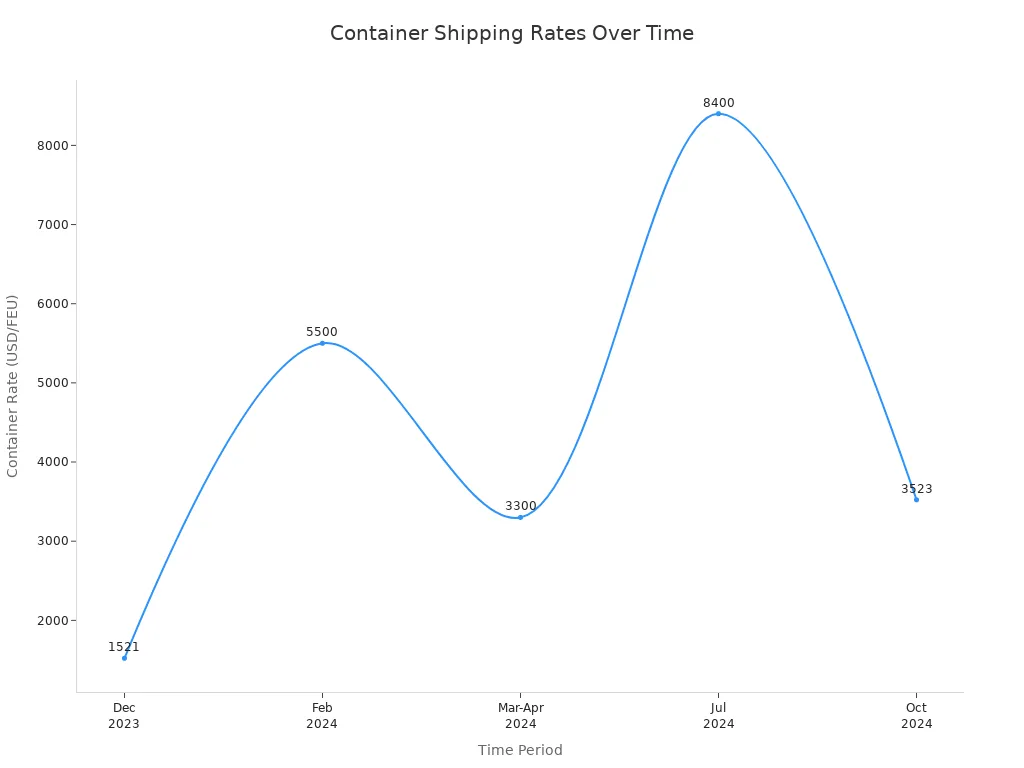
These events caused:
Shipping delays, with trips taking 30-50% longer.
Insurance costs rising from 0.07% to 2%.
US Customs and Border Protection (CBP) now checks shipments more closely. CBP wants clear descriptions of what is shipped. They ended some special rules for feeder vessels. Now, many importers pay higher duty rates. New port fees and stricter rules also raise costs and cause delays at US ports.
JUSDA helps clients with smart supply chain solutions. JusLink’s AI Solution lets companies watch for rule changes and rate spikes. It helps them manage risks. This support helps shippers react fast to new rules and market changes.
In a changing market, companies need partners who give real-time help and flexible solutions. JUSDA’s technology and experts help clients stay ahead, even when rates and market conditions change fast.
Impact on shippers, carriers, and supply chains

Cost and operational implications
Shippers and carriers have new problems as container shipping rates drop. Lower rates change how much it costs to ship goods. Shipping costs now change more often, so it is harder to plan. The table below shows what affects shipping costs:
Factor | Impact on Costs |
|---|---|
Market Forces | Changes in demand and fuel prices make shipping costs go up and down. |
Trade Policies | New tariffs, like U.S. tariffs on Chinese goods, raise costs before they show up on bills. |
Geopolitical Risks | Trouble in places like the Red Sea means ships take longer routes, so fuel and insurance cost more. |
Container Availability | If containers are not where they are needed, delays and extra charges happen. |
Port Performance | Good ports save money, but busy or slow ports make costs go up. |
Environmental Regulations | New rules about emissions mean companies must spend more, so shippers pay extra fees. |
There are more problems for supply chains now. Shipments take longer and delays happen more often. For example, Europe-to-Asia shipments now take 84 days, which is 11 days more than last year. Ocean shipments around the world take 66 days from booking to final port, which is eight days longer. The Panama Canal drought made Asia-to-North America shipments take 63 days on average.
Carriers are changing how they work. They run fewer trips, use ship space better, and pick new routes. These changes affect the transpacific trade and the china to us west coast route. Spot rates and shipping costs on these routes keep changing.
JUSDA and JUSDASR: solutions for efficiency
JUSDA helps clients with smart supply chain solutions for a changing market. The JusLink Smart Supply Chain Management Platform lets shippers see and control their shipments from start to finish. This helps companies handle spot rate changes and new freight trends.
JUSDASR’s cross-border logistics service covers every part of the supply chain. It keeps things flexible and efficient, even when shipping costs and rates change fast. JUSDA focuses on each customer’s needs, so their logistics fit each industry and respond to market changes.
Many clients have seen good results. JUSDA helped one customer save $100,000 each week by making payments faster. Using Expedock made cash flow better and shipments faster. These solutions help businesses stay strong, even when the freight market keeps changing.
JUSDA’s technology and experts help shippers and carriers deal with tough markets, control shipping costs, and keep supply chains strong.
Outlook for container shipping rates
Short-term and medium-term forecasts
Experts think container shipping rates will change soon. In Europe, rates may go up because of new green rules. The EIU says the Red Sea problems should end by late 2024. Shipping rates around the world should become steady by then. Europe will have higher costs from new rules like the EU Emissions Trading Scheme and the Carbon Border Adjustment Mechanism for three years.
TEU demand is expected to grow 4.5% in 2024. Shippers are stocking up, so demand is higher than normal. In 2025, TEU demand growth may slow to 3%. There may be more ships than needed, which could affect rates. Things like tariff wars and politics could also change rates. By 2026, freight rates should rise slowly after falling for a long time. Shippers should get ready for a market that favors sellers. Carriers might get more power to set prices, but increases will likely be small.
Strategies for navigating volatility
Shippers and logistics managers can use different ways to handle changing rates. Experts say to use rate management tools to find and lock in good rates. Working with many carriers helps companies get better deals. Sending shipments together can save money and make rates easier to handle.
If you think nothing bad will happen to you, you could be wrong.
It is important to react fast, use data, stay flexible, and talk often. These are lessons from times when rates were low.
Technology/Service | Benefit |
|---|---|
Dynamic Inventory Management | Helps control inventory and manage rate changes. |
Real-time Tracking | Makes it easier to see shipments and fix problems fast. |
JusLink Smart Supply Chain Platform | Gives full control and lets you see everything. |
Automation in Warehousing | Cuts down on mistakes and helps work faster. |
JUSDA’s JusLink platform and JUSDASR service help companies act fast when the market changes. Tracking containers and watching trends helps teams spot rate hikes early and respond. Comparing performance and locking in low rates before they go up can save money. Shippers and carriers should update their plans to get ready for slow rate increases and work more efficiently.

JUSDA Solutions
To provide you with professional solutions and quotations.
Container shipping rates are still low for a few reasons.
There are too many ships because companies bought a lot.
Inflation makes it harder for businesses to pay for shipping.
Good supply chain management helps companies deal with these problems. Businesses use live data, AI, and machines to plan better and stop delays. Srini Rajagopal from Oracle says:
"Speed, agility, real-time visibility, and data-backed decision-making are key to navigating this new era of supply chain disruption."
New ideas help companies stay strong:
Solution | Benefit |
|---|---|
Real-time tracking | Lets companies watch shipments closely |
Automation | Makes work faster and saves money |
AI analytics | Helps plan better and avoid problems |
You can learn more from Container Trades Statistics and Drewry's Container Freight Rate Insight.
See Also
Understanding Logistics Risk Trends and Their Business Impact
Managing Supply Chain Challenges Amid Rising Inflation Insights
Exploring New Developments in Sea Freight Logistics for 2024
Optimizing Supply Chain Costs: Key Economic Strategies Explained