Global Trade Finance Set to Dominate 2025: Cross-Border Growth, Supply Chain Diversification, and Digitalization Reshape Logistics and Risk Management


Global trade finance will reach new heights in 2025, with the market size projected at $52.39 billion and a growth rate of 5.9%. The convergence of cross-border trade growth, supply chain diversification, and digitalization drives this surge.
Companies must assess how these trends will reshape logistics and risk management.
Consider the following impacts:
Trend | Impact on Logistics and Risk Management |
|---|---|
Cross-border trade growth | Redesigns trade networks and supply chains to adapt to shifting flows and protectionist moves. |
Supply chain diversification | Promotes investment in varied sourcing to reduce risks from disruptions and tensions. |
Digitalization | Streamlines processes, boosts efficiency, and enhances resilience through better coordination. |
Leaders who embrace these changes will secure a competitive advantage in the evolving landscape.
Key Takeaways
Global trade finance is projected to reach $52.39 billion by 2025, driven by cross-border trade growth and digitalization.
Businesses should diversify their supply chains to reduce risks from geopolitical tensions and disruptions.
Adopting digital tools like JUSDA’s platforms enhances efficiency, transparency, and risk management in global trade.
Investing in supply chain resilience is crucial; companies must treat it as a strategic priority, not just a cost.
Prioritize cybersecurity measures to protect against increasing threats in trade finance and maintain operational integrity.
Global Trade Finance in 2025
Market Trends and Growth Drivers
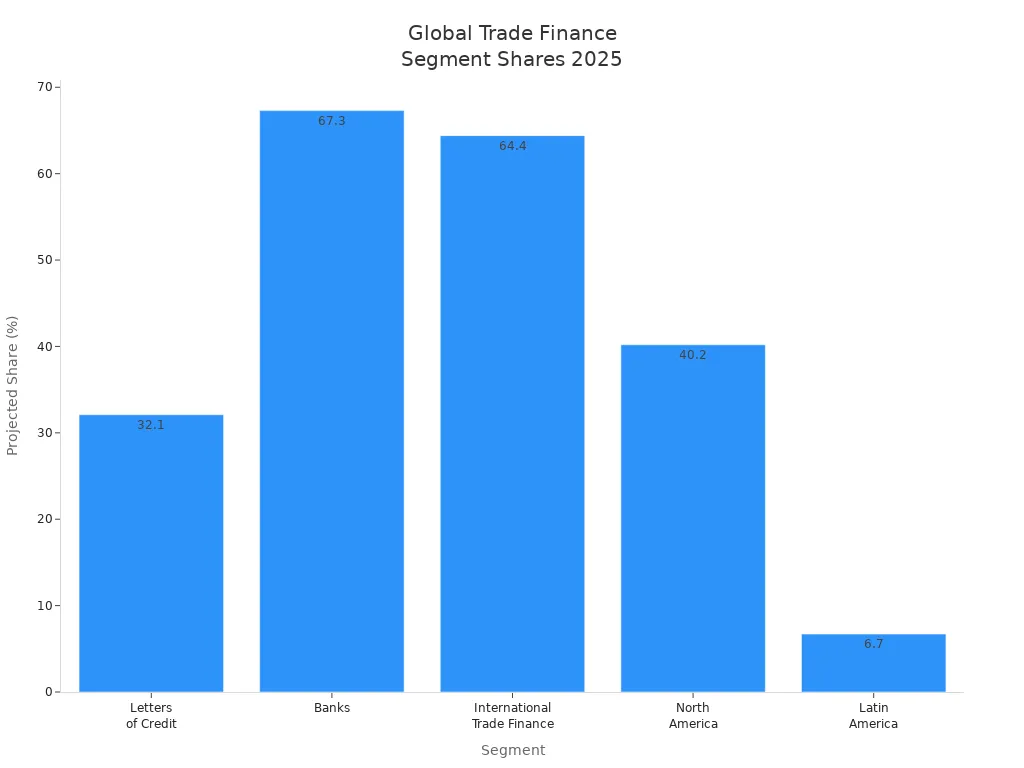
Global trade finance continues to evolve rapidly in 2025. Several market segments stand out for their projected influence:
Segment | Projected Share in 2025 |
|---|---|
Letters of Credit (LC) | 32.1% |
Banks | 67.3% |
International Trade Finance | 64.4% |
North America | 40.2% |
Latin America | 6.7% |
Digital technologies now dominate the landscape. They enhance transparency and reduce processing times. Geopolitical tensions increase the demand for risk-mitigating instruments. Sustainability and ESG criteria gain importance as companies seek responsible financing.
Key growth drivers include the need for liquidity due to rising costs and the digitalization of trade finance processes. Supply chain finance demand rises, especially in emerging markets. About half of global trade involves supply chain transactions, making stable financing essential. Fragmented supply chains, caused by disruptions, further increase the need for reliable financial solutions.
The Role of Cross-Border Trade
Cross-border trade volume is set to grow in 2025. Manufacturing and technology sectors, especially electronics and automotive, drive this expansion. Trade in AI-related goods surges by 20% in the first half of the year. Companies frontload imports into North America to prepare for possible tariff increases. Developing economies lead the growth, with South-South trade becoming more prominent.
Trade finance instruments play a vital role in supporting cross-border trade:
Trade Finance Instrument | Role in Cross-Border Trade |
|---|---|
Letters of Credit (LCs) | Guarantee payment to sellers upon fulfillment of terms. |
Trade Credit Insurance | Protects exporters against buyer default and political risks. |
Documentary Collections | Links payment to shipping documentation, ensuring verification. |
Factoring | Converts receivables into immediate cash, improving liquidity. |
Trade finance mitigates risks such as non-payment and political instability. It enhances liquidity for businesses and fosters trust among trading partners. The World Trade Organization reports that over 80–90% of global trade relies on some form of trade finance, highlighting its critical role in sustaining international commerce.
Cross-Border Trade Expansion
New Markets and Payment Corridors
JUSDA supports cross-border trade for a wide range of industries, including electronics manufacturing, automotive, FMCG, and medical health. In 2025, new payment corridors are emerging, reshaping how businesses move goods and funds internationally. JusTrade, JUSDA’s specialized customs clearance service, enables seamless transactions by integrating advanced digital platforms and AI-driven processes.
Key regions and corridors gaining significance include:
Africa: The Pan-African Payment and Settlement System (PAPSS) allows local-currency transactions, reducing costs and settlement times for intra-African transfers.
Americas: Enhanced cross-border payment systems focus on remittance corridors, especially between the U.S. and Mexico, and throughout Latin America.
JUSDA’s global network and JusTrade’s proprietary SAAS platform help clients navigate these corridors efficiently. The platform connects procurement, logistics, customs, and finance, ensuring real-time tracking and management of customs processes. JusTrade’s expertise minimizes delays and optimizes logistics for clients entering new markets.
Businesses face several challenges when entering new payment corridors:
Challenge | Description |
|---|---|
Cost | Fees and FX markups can reduce the amount received by recipients. |
Speed | Long settlement timelines disrupt cash flow. |
Access | Fragmented infrastructure limits routing options and increases costs. |
Transparency | Lack of real-time visibility leads to uncertainty and delays in reconciliation. |
Compliance & Fraud | Complex regulations increase the risk of errors and potential fines. |
Political and currency volatility, complex regulatory environments, and fragmented payment systems further complicate cross-border trade.
Regulatory and Compliance Factors
JUSDA’s JusTrade platform streamlines compliance for cross-border transactions. In 2025, businesses encounter stricter environmental regulations, especially in industries like aviation and automotive. Companies must provide detailed reporting on carbon footprints and sustainable practices. Regional trade agreements require careful navigation to access reduced tariffs, which demands staff training and system upgrades.
Digital trade compliance becomes essential as nations modernize laws for e-commerce and data localization. Automation and AI enhance compliance management, reducing human error and improving efficiency in tracking regulatory changes. Sanctions and export controls tighten due to geopolitical tensions, making it vital for businesses to stay informed about international regulations.
Changing compliance standards introduce stricter rules, leading to delays and increased costs. Businesses must implement stronger controls to prevent scams and fraud. JusTrade’s intelligent customs clearance and real-time analytics help clients adapt to evolving regulations, ensuring efficient and compliant cross-border trade.
Supply Chain Diversification Strategies
Building Resilience with JUSDA
Global businesses in 2025 prioritize supply chain diversification to build resilience against disruptions. JUSDA delivers industry-specific solutions for sectors such as electronics manufacturing, automotive, FMCG, and medical health. Companies avoid relying on a single source, as disruptions can halt operations. Multi-country sourcing creates redundancy and mitigates risks from geopolitical tensions and natural disasters. Geographic diversification is key, with many businesses choosing locations like Mexico, Vietnam, and India to reduce dependency on one region.
JUSDA’s global network supports these strategies. Its Rail+ Solutions cut transit times by 50% compared to sea freight, while air freight costs decrease by 10%. Efficient routes, such as Rail+Rail from Hanoi to Europe in 25-27 days and Land+Rail from North Vietnam to Europe in 23-25 days, help clients maintain steady supply chains. JUSDA’s customer story highlights how its Supply Chain Management Collaboration Platform uses AI and blockchain to optimize global processes, standardize operations, and reduce manual handling. This platform enables manufacturers to expand globally with lower costs and higher efficiency.
Tip: Diversification is a long-term resilience strategy. It enhances negotiating power and helps businesses understand export rebates and tax incentives.
Risk Mitigation in Global Trade
Risk mitigation remains essential in global trade. Companies focus on risk assessments and management throughout the supplier lifecycle. JUSDA’s solutions enable comprehensive risk management by vetting new suppliers and establishing redundant supply networks. Businesses invest in manufacturing diversification, spreading risk across multiple countries.
The following table outlines significant risks in global trade and common mitigation strategies:
Significant Risks in Global Trade | Mitigation Strategies |
|---|---|
Evolving regulations | Enhanced compliance tools |
Geopolitical dynamics | AI-driven trade surveillance |
Technological complexities | Blockchain for traceability |
Market access barriers | Collaborative enforcement and data sharing |
Payment uncertainties | Enhanced compliance tools |
Logistical challenges | AI-driven trade surveillance |
Compliance with international trade regulations | Blockchain for traceability |
JUSDA’s intelligent platforms provide real-time data monitoring and predictive technologies. These tools help companies detect and address risks swiftly, supporting cross-border trade and ensuring supply chain stability.
Digitalization and Intelligent Supply Chains

JusLink and AI-Driven Solutions
JUSDA’s JusLink platform stands at the forefront of digital supply chain transformation. JusLink leverages AI, IoT, and big data to deliver intelligent supply chain management for global businesses. The platform uses predictive analytics to optimize planning, inventory, and risk management. JusLink’s AI-driven sales forecasting and replenishment tools analyze historical data and market trends, enabling companies to predict demand with greater accuracy. This approach reduces overstocking and minimizes shortages.
JusLink’s Control Tower Intelligent Risk Management system integrates external data sources to monitor supply chain risks in real time. The platform’s automated application management tracks shipment status and detects anomalies, ensuring efficient cargo transport. JusLink’s microservices architecture allows businesses to customize features for specific scenarios, supporting scalable and flexible operations.
Feature | Description |
|---|---|
Predictive analytics for demand, inventory, and risk. | |
Real-Time Visibility | Smarter control towers powered by IoT and AI. |
Inventory Optimization | Enhances forecasting, planning, and resource allocation. |
JusElsa, JusLink’s intelligent supply chain assistant, uses DeepSeek’s advanced natural language processing to support users in tracking shipments, assessing risks, and generating reports. The integration of JusElsa and DeepSeek enables smarter logistics and risk control. The SafeLogFL framework, which employs Federated Learning, allows stakeholders to collaboratively train models while maintaining data privacy. This system achieves a high accuracy rate in identifying risks such as shipment delays and regulatory non-compliance, making it highly effective for real-time logistics needs.
JusLink’s AI-driven solutions automate repetitive tasks, reduce operational costs, and support faster decision-making. Businesses benefit from improved forecasting, increased warehouse throughput, and optimized supplier performance.
Enhancing Cross-Border Trade Visibility
Visibility is essential for effective supply chain management. JusLink consolidates tracking data from IoT devices and sensors, providing real-time updates on the status and location of goods. This level of transparency allows businesses to respond quickly to disruptions and maintain operational efficiency. The platform’s integrated tracking and exception management tools notify stakeholders of delays or issues, enabling proactive intervention.
IoT devices and sensors collect and transmit data from various points in the supply chain.
Cloud platforms and data analytics process and centralize information, supporting global operations.
AI and machine learning identify patterns and anomalies, enhancing logistics management.
Integrated tracking platforms automate communications and improve visibility across geographies.
Exception management tools alert users to disruptions, allowing for quick resolution.
Industry experts agree that comprehensive visibility is the foundation of risk management in global supply chains. Without real-time information, businesses cannot respond effectively to global events or disruptions. JusLink’s end-to-end visibility helps organizations anticipate issues and act before they escalate.
Real-Time Risk Management
JusLink’s risk control tower provides real-time monitoring and early warning for potential risks in the supply chain. The platform uses AI-driven algorithms to analyze market data, forecast price movements, and identify risks proactively. Automation of routine tasks allows supply chain professionals to focus on strategic decisions, improving operational efficiency.
Evidence Type | Description |
|---|---|
Predictive Analytics | AI algorithms forecast risks and enhance decision-making. |
Automation | Routine tasks are automated, freeing up resources for strategic work. |
Cloud Solutions | Cloud-based tools offer scalability and real-time data access. |
Regulatory Compliance | Automated reporting and monitoring reduce compliance risks. |
Mobile Access | Mobile solutions enable efficient operations from any location. |
JusLink’s cloud-based infrastructure adjusts resources based on demand, supporting scalable operations. The platform’s predictive maintenance features minimize downtime by forecasting equipment failures and scheduling maintenance. JusLink also supports sustainability and ESG compliance by reducing waste and emissions.
JUSDA’s digitalization strategy empowers businesses to manage cross-border trade with greater confidence. Enhanced visibility, real-time risk management, and AI-driven automation position JusLink as a leader in intelligent supply chain solutions.
Logistics and Risk Management Evolution
Cybersecurity in Trade Finance
Trade finance platforms face a growing range of cybersecurity threats in 2025. JUSDA’s digital platforms address these risks by implementing advanced security protocols and AI-driven monitoring systems. The most common threats include:
Ransomware attacks that lock critical systems and demand payment.
Supply chain attacks that exploit vulnerabilities in third-party networks.
AI-powered cyberattacks that automate and enhance malicious strategies.
Social engineering tactics that manipulate individuals to gain unauthorized access.
JUSDA’s platforms use real-time threat detection and automated response mechanisms to protect sensitive data and maintain operational integrity. The company prioritizes defense against business email compromise, phishing, and distributed denial of service (DDoS) attacks. Insider threats and vulnerabilities in software also receive continuous attention through regular updates and employee training.
Note: Proactive cybersecurity measures help businesses maintain trust and ensure uninterrupted cross-border trade operations.
Operational Resilience with JUSDA
JUSDA strengthens operational resilience by leveraging digital platforms and AI tools. Real-time data collection and automation play a crucial role in mitigating risks associated with cross-border trade. The company’s AI-powered compliance tools automate data gathering and generate error-free compliance reports. These tools help businesses stay compliant and reduce the risk of penalties.
Human errors account for a significant portion of compliance failures. JUSDA’s automation solutions minimize these risks by providing consistent and accurate reporting. AI tools deliver real-time updates on regulatory changes, allowing businesses to adapt quickly and maintain compliance across multiple jurisdictions.
Risk Mitigation Feature | Benefit |
|---|---|
Automated Compliance Tools | Reduce errors and ensure regulatory accuracy |
Real-Time Data Updates | Enable rapid adaptation to new regulations |
AI-Driven Monitoring | Enhance detection of operational risks |
JUSDA’s commitment to digital innovation ensures that clients can respond swiftly to disruptions and maintain supply chain stability. The integration of automation and real-time data supports efficient logistics and robust risk management.
Strategic Actions for 2025
Adapting to the New Trade Finance Landscape
Businesses face a rapidly changing trade finance environment in 2025. They must act decisively to remain competitive. Leading organizations focus on building resilience and adaptability across their supply chains. They treat resilience as a strategic investment, not just a cost to control. Companies allocate resources to achieve end-to-end visibility and foster strong partnerships. This approach creates long-term advantages and supports growth in uncertain markets.
Key actions for adapting to the new landscape include:
Enhance supply chain resilience by investing in adaptability and flexibility.
Leverage technology for advanced risk mapping and improved supply chain visibility.
Foster adaptive leadership with a focus on crisis management and understanding global trade regulations.
Diversify sourcing and manufacturing to avoid overreliance on single regions.
Establish innovation centers in technology hubs to attract skilled talent.
Tip: Companies that prioritize resilience and technology gain a stronger position in global trade.
Leveraging JUSDA, JusTrade, and JusLink
JUSDA provides a comprehensive suite of solutions for businesses navigating global trade finance. JusTrade streamlines customs clearance and compliance, reducing delays and ensuring smooth cross-border transactions. Its SAAS platform connects procurement, logistics, customs, and finance, offering real-time tracking and management.
JusLink delivers intelligent supply chain management through AI, IoT, and big data. The platform enables predictive analytics, real-time risk monitoring, and automated operations. JusElsa, powered by DeepSeek, supports users with shipment tracking, risk assessment, and reporting. These tools help companies respond quickly to disruptions and maintain operational efficiency.
By integrating JUSDA’s solutions, businesses gain end-to-end visibility, reduce risks, and improve decision-making. They position themselves to thrive in the evolving trade finance landscape of 2025.
Cross-border trade growth, supply chain diversification, and digitalization continue to reshape global trade finance. Businesses must adapt by leveraging intelligent solutions from JUSDA to stay competitive.
Increased regionalization and automation optimize supply chains.
Strategic reshoring and enhanced risk modeling improve resilience.
Sustainability and geopolitical intelligence drive smarter decisions.
Diversify suppliers to reduce risk.
Adopt robust contingency plans.
Prioritize cybersecurity and transparency.
JUSDA’s innovative platforms position organizations for success in the future of global trade finance.

JUSDA Solutions
To provide you with professional solutions and quotations.
FAQ
What industries does JUSDA support with its supply chain solutions?
JUSDA serves electronics manufacturing, automotive, FMCG, new energy, medical health, heavy equipment, and bulk materials. The company tailors solutions to each industry’s unique logistics and compliance needs.
How does JusTrade simplify cross-border customs clearance?
JusTrade uses a proprietary SAAS platform with AI and big data. The platform connects procurement, logistics, customs, and finance, enabling real-time tracking and efficient customs clearance for global transactions.
What digital tools does JusLink offer for supply chain management?
JusLink provides AI-driven sales forecasting, smart replenishment, risk management, and automated shipment tracking. The platform uses IoT and big data to enhance visibility and decision-making across the supply chain.
How does JUSDA help businesses manage compliance and risk?
JUSDA’s platforms automate compliance reporting and monitor regulatory changes in real time. AI-driven risk control towers provide early warnings, helping businesses adapt quickly and reduce operational risks.
See Also
Understanding Logistics Risks: Key Trends to Watch
Enhancing Supply Chain Performance: Five Key Trends
Addressing Global Supply Chain Growth Challenges Effectively
Transforming Logistics Through Innovative Supply Chain Solutions