A Sanctions Shockwave: Why Crude Tanker Costs Are Soaring and Trade Flows Are Being Rerouted Worldwide-duplicate

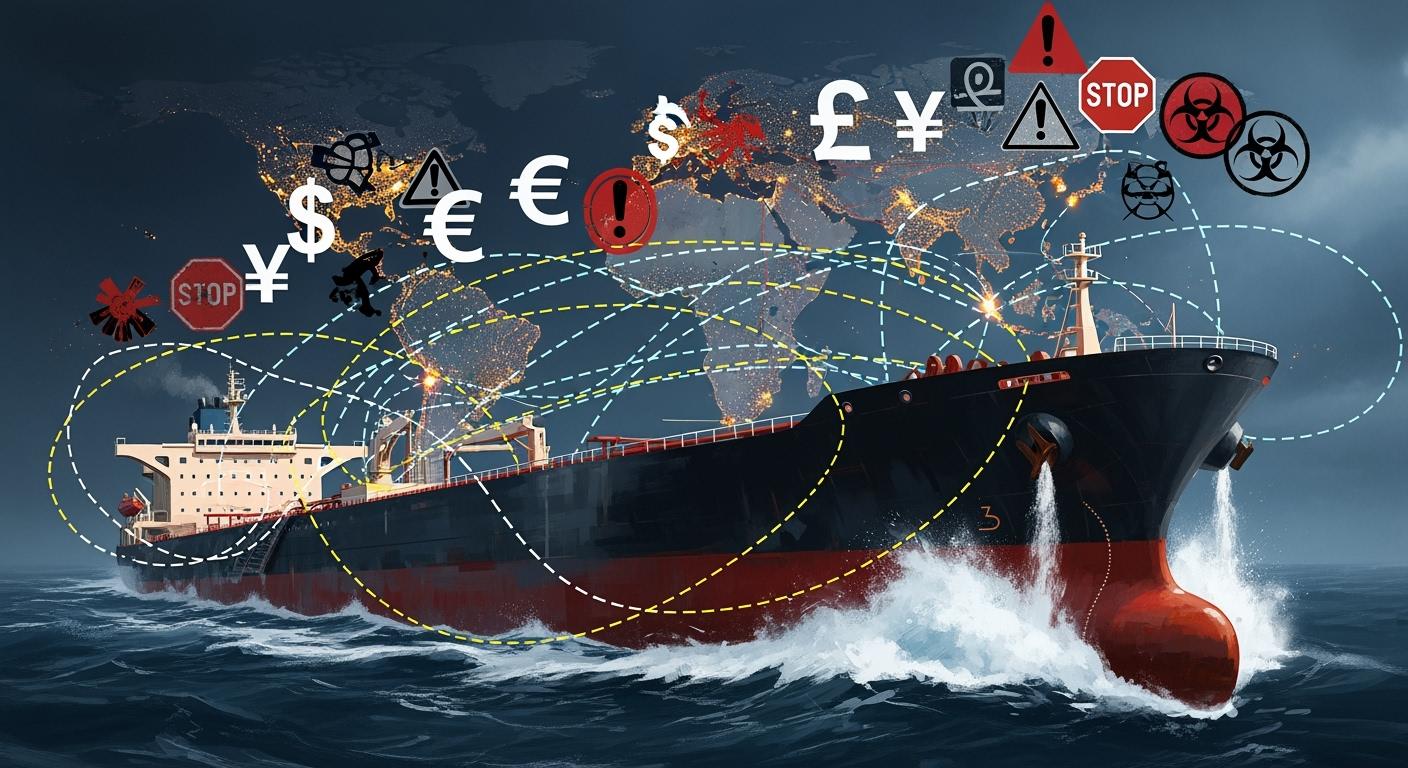
Western sanctions on Russian oil have sent a shockwave through the global crude shipping market. Tanker rates have surged as traditional routes face new restrictions. For example:
Freight rates for Russian crude from Baltic ports to India jumped to $6 million per trip in August, up from $5.3–$5.5 million in July.
Shipments from Novorossiisk climbed to $5.5 million, compared to $5.2 million the previous month.
The European Union’s price cap on Russian crude stands at about $47.60 per barrel, below the G7’s $60 cap.
These shifts force supply chain managers and logistics professionals to adapt quickly. Disrupted routes and rising costs drive demand for innovative logistics solutions like those offered by JUSDA.
Key Takeaways
Western sanctions on Russian oil have caused tanker rates to soar, with costs rising significantly for shipments to Asia.
The global crude shipping landscape has changed, with Russian oil now primarily flowing to China and India, while European imports have dropped sharply.
The rise of shadow fleets, or dark shipping practices, complicates compliance and increases risks for shipping companies.
Companies must adapt to higher shipping costs and longer routes, which can impact global energy prices and supply chains.
Innovative logistics solutions, like JUSDA's services, can help businesses navigate these challenges and maintain operational efficiency.
Western Sanctions and the Crude Shipping Surge
Impact on Russian Oil Exports
Western sanctions have reshaped the landscape of Russian oil exports. Russian oil now flows predominantly to Asian markets. China and India have become the primary destinations for these shipments. European imports of Russian oil have dropped sharply. The shift in export routes has led to increased reliance on shadow tankers. In September 2025, 69% of Russian crude oil exports traveled on these vessels, marking a 6% increase from the previous month. Russian oil export revenues have halved from September 2022 to September 2025, even though export volumes declined by only 5% during the same period.
Russian oil exports to Asia, especially China and India, have surged.
European imports of Russian oil have plummeted.
The use of shadow tankers for Russian crude exports reached 69% in September 2025.
Russian oil export revenues dropped by 50% over three years, despite a modest decline in volumes.
This rerouting has forced crude shipping companies to adapt quickly, often at higher costs and with increased operational complexity.
Rise of Dark Fleets and Compliance Challenges
Sanctions have fueled the rapid expansion of dark fleets. The number of shadow fleet vessels grew from about 600 in 2022 to between 1,100 and 1,400 in 2023. Of these, 435 are crude oil tankers, representing 16% of the global tanker fleet. Estimates suggest that 17% of the world tanker fleet now belongs to the shadow fleet, with 591 tankers trading Russian oil. Around 80% of Russia’s oil exports rely on these vessels.
Shipping companies face significant compliance challenges. They must interpret a constantly changing landscape of sanctions. This uncertainty increases the risk of unintentional breaches, especially for companies operating across multiple jurisdictions. The unauthorized practice of dark shipping raises questions about the effectiveness of sanctions. Untracked oil continues to reach global markets, which can influence energy prices and supply.
Regulatory and insurance requirements have also evolved. Coastal states now inspect vessels to verify insurance credentials. Tankers passing through EU waterways must show proof of sufficient P&I insurance. Compliance with price caps is mandatory for standard insurance, increasing costs for shadow fleet operators. The table below summarizes recent changes:
Evidence | Description |
|---|---|
Demand for insurance | Push for proof of sufficient P&I insurance for tankers in EU waterways. |
Compliance with price caps | Standard insurance requires compliance with price caps, raising costs. |
Enforcement of documentation | Coastal states inspect vessels, but compliance is often voluntary. |
Recent incidents highlight the risks. In March 2024, the tanker ANDROMEDA STAR collided with a freighter, and its insurance documents had expired. In December 2024, two aging Russian tankers caused an oil spill during severe weather, underscoring the dangers of operating without proper insurance.
Freight Rate Trends and Market Data
Crude shipping rates have surged since 2022. Freight rates reached their highest levels in five years. Sanctions on Russian oil exports have caused significant delays and forced buyers to change purchasing patterns. Refiners in India and China have paused or reduced their purchases of Russian crude, contributing to market volatility.
Windward’s market insights and compliance analytics provide clarity in this turbulent environment:
Geopolitical tensions and sanctions drive up shipping costs due to compliance and operational challenges.
Predictive analytics help stakeholders understand market fluctuations, which is vital in a volatile market.
Real-time data enables companies to optimize logistics and address increased costs in crude shipping.
The combination of rerouted trade flows, expanded shadow fleets, and stricter regulatory requirements has created a complex and costly environment for crude shipping. Companies must leverage advanced analytics and compliance tools to navigate these challenges and maintain operational efficiency.
Global Trade Flows Rerouted

Shifts in Major Export and Import Routes
Western sanctions have forced a dramatic reconfiguration of global crude oil trade routes. Tankers now travel longer distances to deliver oil, bypassing traditional paths to avoid detection and regulatory scrutiny. The price gap between Brent crude and Russia's Urals has widened, reflecting reduced demand from Indian and Chinese refiners. These refiners have scaled back purchases of Russian oil, responding to new U.S. sanctions. As a result, Russian oil trades at a substantial discount, which impacts Russia's revenue and alters established trade flows.
Major Indian refiners, such as Hindustan Petroleum Corp. and Bharat Petroleum Corp., have stopped ordering Russian crude.
Chinese state oil companies have ceased purchasing seaborne Russian oil.
The rise of dark shipping practices, where tankers disable location signals, has become common. This tactic helps vessels evade sanctions but leads to longer and more expensive routes.
The following table illustrates the shift in Russian crude exports since 2021:
Year | Percentage of Crude Oil Exports to Asia | Percentage of Crude Oil Exports to Europe |
|---|---|---|
2021 | 40% | 50% |
2024 | 81% | 12% |
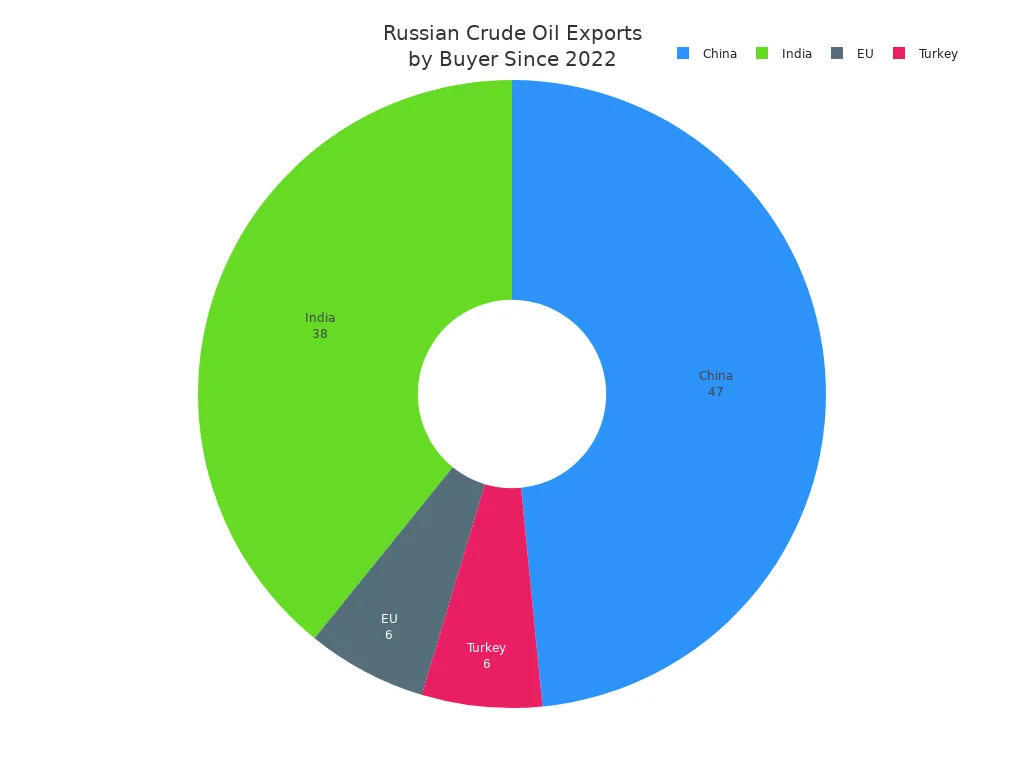
The chart below shows the distribution of Russian crude exports among major buyers since 2022:
Effects on Asia, Europe, and the Middle East
Sanctions have increased voyage times and shipping costs for crude shipping companies. Tankers now detour around South Africa’s Cape of Good Hope, adding up to three weeks to transit times. Fuel consumption rises by 30–40% on these longer routes. Crew costs also increase due to extended voyages. These changes put pressure on global energy supply chains.
Ships avoid high-risk areas, resulting in significant delays.
Freight costs continue to climb, affecting the price of energy worldwide.
The shadow trade in Russian oil has led to dangerous practices at sea. Many vessels involved are old and poorly maintained, which increases risks and costs.
Asia has absorbed most of the rerouted Russian crude. China’s imports have increased by 26%, while India’s imports have surged by 111%. Europe’s share of Russian crude imports has dropped sharply. The Middle East has seen less direct impact but remains a key transit region for global oil flows.
Country | Increase in Imports (%) |
|---|---|
China | 26% |
India | 111% |
Case Studies of Rerouted Crude Shipping
Countries have adapted their purchasing strategies to navigate the new landscape. India, once Russia’s top seaborne crude buyer, purchased up to 1.7 million barrels per day. Indian Oil Corp (IOC) secured five cargoes of non-sanctioned Russian ESPO crude for December delivery, demonstrating selective compliance. Other refiners canceled orders to avoid secondary sanctions. Turkey has absorbed discounted Russian oil, taking advantage of the price differential.
Country | Adaptation Strategy | Details |
|---|---|---|
Turkey | Absorbing discounted oil | Turkey has been reported to absorb discounted Russian oil amidst sanctions. |
India | Selective compliance | IOC secured five cargoes of non-sanctioned Russian ESPO crude, demonstrating selective compliance. |
India | Use of third-party traders | Indian firms may increasingly rely on third-party traders and the 'dark fleet' to evade detection while purchasing oil. |
Western sanctions have redirected crude oil flows from Europe to Asia. New trade clusters have formed around China, India, and Russia. Key ports such as Fujairah, Singapore, and Rotterdam have strengthened their roles in the global oil transportation network.
The rerouting of Russian crude to India stands out as a notable case. India has become the largest buyer of Russian crude at discounted prices, marking a significant shift in global oil trade patterns. These changes have created logistical challenges for crude shipping companies. Limited infrastructure, high transportation costs, unpredictable weather, and safety concerns complicate operations. Companies must address operational constraints and unexpected disruptions to maintain supply chain stability.
Note: The transformation of global crude shipping routes highlights the need for advanced logistics solutions and risk management strategies. Companies that adapt quickly can mitigate costs and maintain reliable energy supplies.
Supply Chain Innovation: JUSDA’s Solutions
China-Europe Express Rail as an Alternative
JUSDA’s China-Europe Express Rail provides a vital alternative for businesses facing crude shipping disruptions. This rail service connects China and Europe, offering a balanced solution between speed and cost. Companies can move goods in 15–20 days, which is much faster than sea freight and more affordable than air freight. The service supports a wide range of products, including electronics, clothing, and medical supplies. JUSDA’s expertise in customs operations and resource alignment ensures that shipments avoid delays and complications. The rail network also extends to Southeast Asia, allowing for seamless intermodal transport.
Multimodal logistics solutions like this rail service help companies maintain supply chain resilience. Key benefits include:
Real-time visibility for tracking shipments and optimizing costs
Proactive communication that reduces the impact of outdated records
Enhanced flexibility to respond to disruptions such as maritime attacks or extreme weather
Key Findings | Description |
|---|---|
Maintains resilience against cascading failures in global shipping networks | |
Stepwise Cascading Mitigation (SCM) | Explores load redistribution strategies to mitigate cascading effects during disruptions |
Sensitivity analysis results | Shows that redundancy and optimal redistribution can effectively support system resilience |
JUSDA’s 8 Core Products for Efficient Logistics
JUSDA offers eight core logistics products that cover air, land, sea, and rail transport. These services include cloud warehousing, consolidation, and comprehensive foreign trade solutions. JUSDA’s network spans over 155 service points worldwide, supporting industries such as electronics, automotive, FMCG, and medical health. The company’s refined supplier management and cost control strategies ensure efficient and reliable logistics. Specialized vehicle matching, consolidated cargo volumes, and standardized operational capabilities help businesses adapt to changing market conditions.
JusLink AI for Predictive Supply Chain Management
JusLink’s AI solution empowers companies to manage risk and predict freight rates in volatile markets. The platform uses advanced analytics for supply chain trend analysis, sales demand forecasting, and replenishment strategies. JusLink’s risk control tower provides real-time monitoring and early warnings, helping businesses respond quickly to disruptions. The intelligent assistant, JusElsa, leverages natural language processing to streamline operations and improve decision-making. Companies gain enhanced visibility, reduced costs, and improved customer satisfaction by integrating JusLink’s AI into their supply chain management.
Market Impacts and Future Outlook
Oil Prices and Tanker Asset Values
Crude shipping disruptions have triggered significant changes in oil prices and tanker asset values. Freight rates for Very Large Crude Carriers (VLCCs) have surged above $100,000 per day as demand for shipping capacity increases. The market for second-hand VLCCs has reached an all-time peak, with prices surpassing last year’s record. Older VLCC units have seen their values rise by about $5 million since the start of the year. Suezmax and Aframax tanker values have remained stable but are expected to exceed previous highs in the fourth quarter of 2025. Crude tanker earnings are projected to remain strong into the first quarter of 2026.
Indicator | Change/Trend |
|---|---|
VLCC Freight Rates | Surged over $100,000pd due to increased demand |
Second-hand VLCC Prices | Reached all-time peak, surpassing last year’s record |
Older VLCC Units | Prices increased by around $5 million since start of the year |
Suezmax and Aframax Values | Stable, expected to surpass previous highs in 4Q25 |
Crude Tanker Earnings | New highs expected to continue until 1Q26 |
Implications for Global Supply Chains
Rising crude shipping costs have broad effects on global supply chains. Businesses face higher operational costs, which can reduce profitability. Inflationary pressures from increased shipping expenses often lead to higher prices for goods, affecting consumer purchasing power. Companies must adjust their demand and supply chain strategies, sometimes reducing orders during economic downturns.
Rising crude shipping costs increase operational expenses for businesses.
Inflation from higher shipping costs can raise prices for goods.
Companies adjust demand and supply chain strategies, leading to decreased orders during downturns.
Many global businesses now use technology such as IoT for real-time shipment monitoring. Blockchain adoption improves transparency and data security. Companies invest in compliance training to keep up with changing regulations. Sustainability initiatives, including eco-friendly transportation, have become a priority. Infrastructure investments help improve transportation efficiency.
What to Watch in Crude Shipping and Logistics
Ongoing sanctions on Russian oil exports will likely keep crude shipping markets volatile. These sanctions introduce price swings, shift global trade patterns, and create new regulatory challenges. Shipping companies must adapt to tighter inspections and greater transparency requirements. The International Energy Agency expects oil consumption to rise by 25% by 2030, which will increase demand for crude tankers. Regulatory changes, such as the IMO 2020 sulfur cap, drive the need for more efficient vessels and sustainable fuels.
Logistics providers help businesses remain resilient by adopting flexible contracting models, investing in contingency planning, and diversifying supply routes. Building inventory buffers supports operational continuity. The global tanker shipping market is projected to grow steadily, driven by rising oil and gas demand and the development of the petrochemicals industry.
Companies that embrace technology, compliance, and sustainability will be best positioned to navigate the evolving landscape of crude shipping and global logistics.
Industry experts identify several drivers behind soaring crude shipping costs and rerouted trade flows:
Geopolitical tensions and sanctions on Russian energy
Increased demand for longer-haul routes
Aging VLCC fleets and tightening vessel supply
JUSDA’s innovative supply chain solutions help businesses adapt to these market realities. Companies benefit from AI-powered technology, big data analytics, and sustainable logistics practices. To stay competitive, businesses should leverage predictive analytics and monitor global shipping developments.

JUSDA Solutions
To provide you with professional solutions and quotations.
FAQ
What industries does JUSDA serve?
JUSDA supports electronic manufacturing, 3C home appliances, FMCG, automotive, new energy, medical health, heavy equipment, and bulk materials. The company tailors supply chain solutions for each industry.
How fast is the China-Europe Express Rail service?
The China-Europe Express Rail delivers goods door-to-door in 15–20 days. This service offers a faster alternative to sea freight and a more affordable option than air freight.
What are JUSDA’s eight core logistics products?
Product Type | Description |
|---|---|
Air Transport | Efficient global air freight |
Land Transport | Extensive road logistics |
Ocean Shipping | International sea freight |
Rail Transport | Cost-effective rail solutions |
Cloud Warehousing | Real-time inventory management |
Consolidation | Efficient distribution |
Foreign Trade | End-to-end trade services |
JusLink AI Platform | Intelligent supply chain management |
How does JusLink’s AI solution help supply chains?
JusLink’s AI solution provides supply chain trend analysis, freight rate prediction, demand forecasting, replenishment strategies, and real-time risk monitoring. JusElsa, the intelligent assistant, streamlines operations and improves decision-making.
Can JUSDA handle customs operations efficiently?
JUSDA leverages its global network and expertise to ensure smooth customs operations. The company minimizes delays and complications for shipments across borders.
See Also
Understanding Current Trends in Logistics Risk Management
The Importance of Supply Chains in Global Trade
Managing Supply Chain Challenges Amidst Rising Inflation