Global Trade Turbulence Triggers Sharp Container Freight Price Swings in Late 2025

Container freight prices experienced sharp swings in late 2025, reshaping global trade dynamics. Rates on major routes dropped nearly 60-70% compared to the previous year, with transpacific lanes reaching their lowest levels since December 2023. Industries such as electronics, FMCG, and automotive faced increased volatility, including higher fuel costs, equipment shortages, and inland port bottlenecks. Lower shipping rates benefited manufacturers but also introduced new risks, like disrupted delivery schedules and price wars among carriers. Businesses must urgently evaluate the causes and implications of these shifts to protect supply chains and maintain competitiveness.
Key Takeaways
Container freight prices dropped significantly in late 2025, with rates falling 60-70% compared to the previous year, impacting global trade dynamics.
Geopolitical tensions and tariff changes disrupted shipping routes, leading to increased costs and unpredictability for businesses relying on international logistics.
Port congestion and logistics disruptions created additional challenges, forcing companies to adapt quickly to maintain supply chain efficiency.
Businesses should implement flexible logistics strategies, such as diversifying shipping methods and enhancing inventory management, to navigate price volatility.
Leveraging advanced solutions like JUSDA’s rail services and AI tools can help companies stabilize operations and respond effectively to market changes.
Global Trade Shipping Rate Volatility
Recent Price Trends
Container freight rates saw dramatic changes in late 2025. Prices on major trade lanes dropped sharply compared to the previous year. For example, rates in August 2025 fell to $1,900 per container, which was 65% lower than the same period in 2024. By September 2025, rates declined another 10% to $1,744 per FEU. During the 2024 peak season, rates reached $7,000–$8,000 per FEU, but by late 2025, they were 60% lower. These shifts affected global trade by making shipping more affordable for some, but also introduced uncertainty for businesses planning their logistics.
The following table highlights the most significant fluctuations in global shipping rates during this period:
Trade Lane | Rate Change |
|---|---|
Asia–US West Coast | |
Asia–N. Europe | Rates dipped 3% to $3,327 per FEU |
Asia–Mediterranean | Prices fell 4% to $3,144 per FEU |
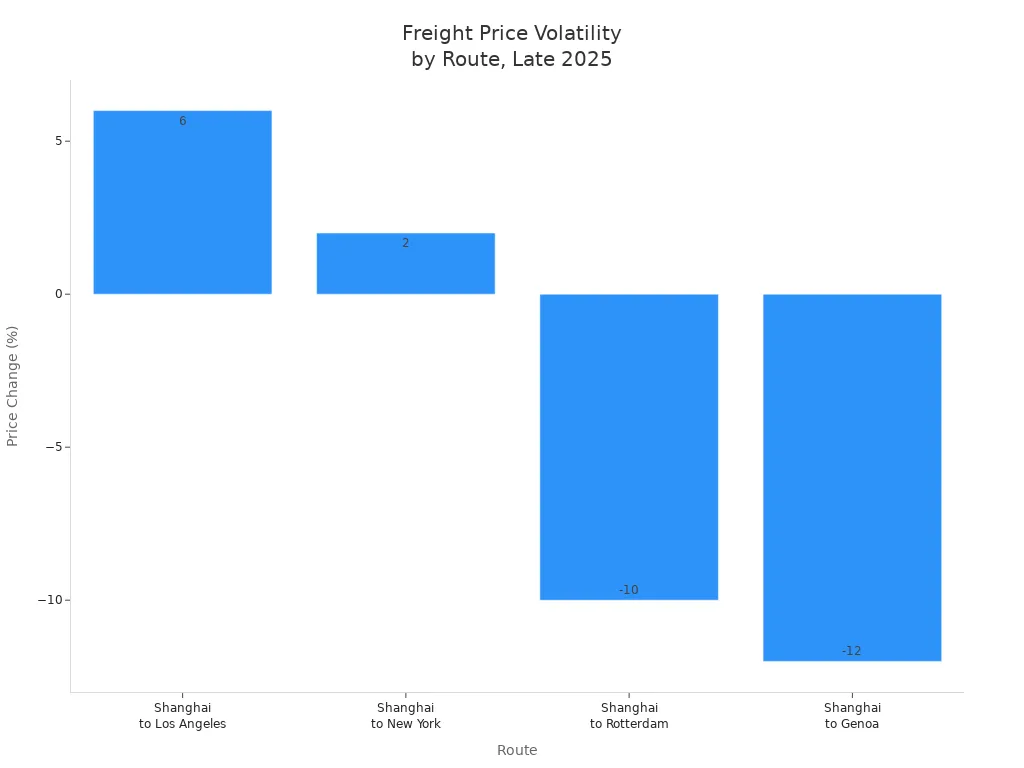
Some routes experienced even more volatility. For instance, the Shanghai to Los Angeles route saw a 6% increase, reaching $2,678 per FEU, while Shanghai to Rotterdam dropped 10% to $2,143 per FEU.
Key Indices and Market Signals
Shipping rate indices reflected these turbulent conditions. The Shanghai Containerized Freight Index (SCFI) recorded a 14.3% weekly drop on September 19, 2025, its largest in years. The Drewry World Container Index (WCI) also fell 6% in late September, dropping below the $2,000 mark. Year-over-year, the SCFI declined 37% in Q2 2025, while the China Containerized Freight Index (CCFI) dropped 19%.
Index | Change | Date | Notes |
|---|---|---|---|
SCFI | -14.3% | 19th September 2025 | Largest weekly percentage dip |
WCI | -6% | Late September 2025 | Breached USD 2,000 mark |
SCFI | -37% YoY | Q2 2025 | Steepest weekly drop in a decade |
CCFI | -19% YoY | Q2 2025 | Significant decline |
Several market signals pointed to ongoing volatility. Geopolitical tensions, trade policy changes, and capacity challenges all played a role. Carriers responded with blank sailings to manage vessel utilization. Spot rates on East-West routes trended downward, while contract rates increased due to disruptions such as port strikes. These factors combined to create a complex environment for global trade, requiring businesses to stay alert and adaptable.
Drivers of Price Swings
Geopolitical and Tariff Impacts
Geopolitical tensions and tariff changes have played a major role in shaping container freight prices in late 2025. Shipping routes through the Strait of Hormuz faced disruptions, which affected oil prices and increased costs for manufacturers. Carriers responded by suspending freight contracts in high-risk regions, highlighting the seriousness of these threats.
Tensions in the Strait of Hormuz are disrupting main shipping routes, affecting oil prices. Frontline’s suspension of freight contracts in the region shows how seriously carriers are treating the risk. China remains a major importer of Iranian oil, so any disruption affects energy costs for manufacturers, especially for steel, paint, and plywood. That’s already feeding into container pricing.
Trade routes between Asia and the U.S. shifted as tariffs and geopolitical events forced carriers to reroute vessels. This adjustment limited losses but did not prevent spot rates from dropping further.
Asia-U.S. sea freight rates are set to drop further in 2025 as shipping capacity outpaces demand and trade routes shift due to tariffs and geopolitical tensions, though vessel rerouting is expected to limit some losses.
Average spot rates for containers from Asia to the U.S. west and east coasts slumped by 58% and 46%, respectively, since June 1. Shipping analytics firms expect rates to fall further as global trade adapts to new patterns.
Average spot rates for containers from Asia to the U.S. west and east coasts have slumped by 58% and 46%, respectively, since June 1 and are expected to fall further, according to shipping analytics firm Xeneta.
Tariffs have disrupted established freight patterns, reducing load availability and increasing unpredictability for businesses. The first half of 2025 saw a 32.2% year-over-year increase in units shipped, despite a 20% decline in order volume. This shift reflects a move toward fewer but fuller shipments. Monthly order volatility rose by 63.7%, showing heightened market uncertainty.
Record-high tariff levels disrupted established freight patterns, reducing load availability on key shipping lanes.
Agricultural retaliatory tariffs significantly decreased export freight from the U.S., impacting truckers transporting agricultural products.
Cross-border restrictions complicated trade routes between Canada and the U.S., creating uncertainty for carriers.
The trucking tariff impact has severely affected freight transportation, influencing fuel costs and available loads.
Ongoing trade tensions have constrained freight demand, further complicating shipping logistics.
Supply and Demand Shifts
Supply and demand dynamics have shifted rapidly in late 2025. Geopolitical events, such as Houthi-linked Red Sea diversions, forced carriers to reconfigure global shipping routes. This change increased industry concerns and compressed peak season timelines.
Trade policy changes and tariff movements caused demand volatility between Asia, Europe, and North America.
The global container fleet expanded significantly in 2024, with a projected 4.8% growth for 2025, raising concerns about potential overcapacity.
Inventory positioning became erratic, leading to shorter contract tenures and reactive logistics in the ocean freight ecosystem.
The restructuring of major shipping alliances introduced uncertainty in service coverage and port rotation consistency.
A surge in blanked sailings, particularly from China to the US and Europe, is being used by carriers to manage overcapacity and stabilize freight rates.
The freight market experienced a significant shift as weak demand and excess trucking capacity drove freight rates down, impacting carrier margins. By early 2025, the load-to-truck ratios began to rise, signaling a gradual improvement in the balance between supply and demand. This trend suggests that the fluctuations in freight prices were closely tied to changes in consumer demand and manufacturing output, as the market adjusted to a new equilibrium after the pandemic.
In late 2025, manufacturing output faced challenges due to component delays and raw material sourcing issues, leading to a decline in the U.S. Manufacturing PMI for three consecutive months. Retailers managed high inventory levels and delayed replenishment, which created uncertainty in demand and influenced freight pricing strategies. This cautious approach to inventory management and the shift from monthly to quarterly replenishment cycles reflect how changes in consumer demand and manufacturing output directly contributed to freight price fluctuations.
The freight market in early 2025 was characterized by stable but subdued demand, with only a 2% year-over-year growth in shipment indices. This normalization of inventory management led to fewer emergency shipments and more balanced freight flows. The ongoing adjustments in supply and demand dynamics, including a gradual rebalancing of the market and rising load-to-truck ratios, indicate that changes in consumer demand and manufacturing output were pivotal in shaping freight price swings.
Port and Logistics Disruptions
Port congestion and logistics disruptions have created additional volatility in container freight prices. Export capacity to Europe became critically constrained, with only three weekly sailings available. European ports faced ongoing congestion, slowing vessel turnarounds and reducing service frequency. The implementation of 50% U.S. import tariffs on Brazilian products led to significant shipping cancellations across various sectors, creating uncertainty in multiple trade lanes. The Panama Canal emerged as a major bottleneck, affecting multiple trade routes and exacerbating delays and costs.
Disruption Type | Description |
|---|---|
U.S.-Europe Trade Capacity Constraints | Export capacity to Europe is critically constrained, with only three weekly sailings available. |
European Port Congestion | Ongoing congestion in European ports is slowing vessel turnarounds and reducing service frequency. |
U.S. Tariffs on Brazilian Goods | Implementation of 50% tariffs has led to cancellations and uncertainty in shipping across various sectors. |
Panama Canal Congestion | Identified as a major bottleneck affecting multiple trade routes, exacerbating delays and costs. |
The August 7, 2025, implementation of 50% U.S. import tariffs on Brazilian products led to significant shipping cancellations across various sectors, creating uncertainty in multiple trade lanes.
Importers may need to reroute shipments to less congested ports, leading to longer transit times and increased costs.
Increased vessel traffic at alternative ports can lead to port congestion, further delaying cargo clearance.
Extended delays can result in higher storage fees for goods held at ports or warehouses.
Labor strikes, port congestion, and weather events have also affected shipping schedules and costs. Factories waiting on raw materials faced production delays, leading to backorders and supply shortages. Extended shipping times, fuel use, and rerouting drove up costs for logistics providers and shippers. Retailers struggled to keep products in stock, especially those using just-in-time inventory models. Congestion threw off schedules and caused delays inland, while warehouse overflows slowed down distribution further.
Impact Type | Description |
|---|---|
Manufacturing Slowdowns | Factories waiting on raw materials face production delays, leading to backorders and supply shortages. |
Higher Shipping Costs | Extended shipping times, fuel use, and rerouting all drive up costs for logistics providers and shippers. |
Empty Shelves & Lost Sales | Retailers struggle to keep products in stock, especially those using just-in-time inventory models. |
Trucking & Rail Disruptions | Congestion throws off schedules and causes delays inland. |
Warehouse Overflows | When shipments finally arrive in bulk after long delays, warehouses get overwhelmed, slowing down distribution further. |
These disruptions have forced businesses to adapt quickly, often at higher costs, as global trade continues to face unpredictable challenges.
Impact on Global Trade and Supply Chains
Business and Consumer Effects
Container freight price swings in late 2025 created ripple effects across international supply chains. Many companies faced sudden increases in ocean freight prices, such as a 9% rise to $5,994 per FEU on the Asia–US West Coast route and an 11% surge to $7,099 per FEU on the East Coast. These changes forced businesses to act quickly. Many shippers adopted a "ship now, worry about costs later" approach, pulling forward orders to avoid higher tariffs. This led to a 70% increase in global index levels over just four weeks.
Importers and exporters encountered several challenges:
Delayed cargo movements and stricter port inspections
New import documentation requirements
Increased costs from tariffs and volatile freight rates
Capacity constraints in shipping lanes
Retailers struggled with higher landed costs for imported goods, which directly impacted consumer prices. Small and mid-sized businesses found it difficult to pass these costs onto customers. As a result, consumers became more price-sensitive, and product availability declined. The volatility in shipping rates made traditional just-in-time delivery risky, pushing companies to rethink their logistics strategies.
To adapt, businesses:
Implemented flexible rate structures
Diversified capacity to manage uncertainties
Enhanced warehousing models for better cost control
Industry-Specific Challenges
Industries such as electronics, FMCG, and automotive faced unique pressures. Original equipment manufacturers (OEMs) in the automotive sector dealt with financial strain from production inefficiencies and fierce competition. The transition to electric vehicles added complexity to logistics, while tariffs increased cost pressures and squeezed margins.
Companies in these sectors responded by:
Adopting conservative inventory strategies
Securing space allocations early
Exploring dual booking strategies to handle demand uncertainty
JUSDA’s expertise in supply chain management helped manufacturers navigate these disruptions. By leveraging advanced digital platforms and AI-driven collaboration tools, JUSDA enabled clients to achieve real-time transparency and efficient global operations. For example, JUSDA’s customer story highlights how leading manufacturers used its platform to optimize processes, reduce manual handling, and maintain supply chain resilience during periods of volatility.
Solutions for Managing Volatility
JUSDA’s China-Europe Express Rail
JUSDA’s China-Europe Express Rail provides a resilient logistics solution for businesses facing container freight price swings. The service operates over 700 routes, offering more than 30 trains weekly for westbound shipments and over 20 for eastbound, which ensures consistent space availability. Proactive capacity expansion strategies help address constraints during periods of high volatility. Advanced technologies and strategic partnerships stabilize freight rates and enhance reliability. The 24/7 tracking system delivers real-time updates, allowing companies to monitor shipments and respond quickly to disruptions.
Rail freight offers significant advantages over traditional trucking and ocean shipping. Companies can achieve 10–30% savings on long-distance shipments. Rail is up to four times more fuel-efficient than trucking, which helps maintain stable pricing when fuel markets fluctuate. Intermodal shipping through JUSDA’s network mitigates the impact of tariffs by reducing inland costs, enabling businesses to protect margins and maintain delivery timelines.
Tip: Businesses seeking to optimize logistics during uncertain times can leverage JUSDA’s China-Europe Express Rail for faster transit, cost savings, and reliable service.
JUSDASR for Cross-Border E-Commerce
JUSDASR supports cross-border e-commerce merchants and manufacturers with efficient supply chain solutions. The service utilizes the China-Europe Railway Express to provide reliable transportation during freight price fluctuations. JUSDA expands capacity and maintains stable carriage through strategic partnerships, ensuring timely deliveries even when ocean freight rates swing unpredictably.
E-commerce companies benefit from enhanced connectivity, faster transit times, and reduced costs. JUSDASR connects over 223 cities in Europe and more than 100 in Asia, expanding market reach for businesses. Advanced technologies, such as real-time tracking and monitoring, improve supply chain efficiency and provide peace of mind. JUSDA’s commitment to sustainable practices sets new standards in the logistics industry.
Benefit | Description |
|---|---|
Enhanced Connectivity | The railway connects over 223 cities in Europe and more than 100 in Asia, expanding market reach. |
Faster Transit Times | Businesses experience quicker delivery times, facilitating access to international markets. |
Reduced Costs | Cost savings are reported, making logistics more affordable for e-commerce operations. |
Advanced Technologies | Real-time tracking and monitoring improve supply chain efficiency and provide peace of mind. |
Sustainability | JUSDA's commitment to sustainable practices sets new standards in the logistics industry. |
JusLink AI and Digital Tools
JUSDA’s JusLink AI Solution empowers companies to predict and manage shipping rate volatility. Modern systems provide predictive alerts for disruptions, enabling proactive management of logistics operations. AI-driven intelligence enhances inventory positioning and reduces waste. JusLink’s platform consolidates data across transportation, warehouse, and inventory systems, helping businesses identify disruptions early and reroute shipments dynamically.
Machine learning algorithms analyze vast amounts of data to forecast demand and optimize shipping routes. Predictive analytics improve accuracy in anticipating inventory needs and transportation capacity. JusLink’s AI tools recommend actions such as rerouting shipments and adjusting carrier selections based on real-time data. Companies can simulate scenarios to predict impacts on transportation networks, which supports better decision-making.
Note: JusLink’s AI Solution shifts from task automation to providing real-time decision support, helping companies maintain resilience in global trade.
Solution Type | Description |
|---|---|
Focus on visibility and dynamic routing to manage tariffs, port fees, and crane costs. | |
Dynamic Carrier Sourcing | Utilize freight exchanges and real-time bidding platforms to reduce exposure to price swings. |
Data Consolidation | Leverage platforms that consolidate data across transportation, warehouse, and inventory systems to identify disruptions early. |
Risk Alerts | Configure alerts for weather events, carrier delays, or port congestion to anticipate risks. |
JUSDA’s integrated approach, combining advanced rail services, cross-border logistics, and AI-powered digital tools, enables businesses to navigate volatility and maintain supply chain stability.
Outlook for Global Trade Rates
Market Stabilization Factors
Global container freight rates may stabilize in 2026 as several factors support market balance. Carriers continue to manage capacity with discipline, using blank sailings and strategic vessel deployments to protect rate levels. This approach helps prevent oversupply and keeps pricing steady. The cargo mix remains diversified, with a wide range of goods moving across major trade lanes. This diversity limits the impact of downturns in any single sector.
China’s export drive sustains strong shipping demand. Manufacturing growth in China ensures a steady flow of goods, supporting robust freight activity. Targeted tariffs focus on specific products, leaving most trade flows unaffected. This selective approach reduces the risk of widespread disruptions. Historical trends suggest that container shipping often rebounds quickly when global conditions improve. The potential for a cyclical rebound remains high, especially as businesses adjust to new market realities.
Diversified cargo mix across trade lanes
Ongoing demand from China’s export drive
Targeted tariffs on specific products
Cyclical rebound potential in global shipping
Note: Businesses should monitor carrier strategies and trade policy changes to anticipate rate movements and optimize logistics planning.
Ongoing Risks
Despite signs of stabilization, several risks could continue to drive volatility in container freight prices beyond 2025. Geopolitical tensions, especially in the Middle East, disrupt shipping services and may lead to service suspensions. Port congestion remains a challenge, affecting schedule reliability and increasing freight costs. Equipment repositioning issues create shortages and drive up costs for shippers.
Ongoing Risk | Description |
|---|---|
Geopolitical tensions | Ongoing tensions, particularly in the Middle East, disrupt shipping services and lead to service suspensions. |
Port congestion | Market factors such as congestion can impact schedule stability and freight costs. |
Equipment repositioning | Challenges in repositioning containers lead to shortages and increased costs for shippers. |
Shippers and logistics providers must stay alert to these risks. Proactive strategies, such as diversifying transport modes and leveraging digital supply chain tools, help maintain resilience. JUSDA’s integrated solutions support businesses in navigating ongoing market uncertainties and protecting supply chain performance.
Late 2025 saw container freight price swings driven by geopolitical tensions, supply-demand shifts, and port disruptions. These changes affected global trade, forcing businesses to adapt quickly. JUSDA’s rail, e-commerce, and AI solutions helped companies manage volatility and maintain supply chain stability. Businesses should monitor market signals, carrier strategies, and digital innovations. Partnering with experts like JUSDA supports resilience in uncertain times.

JUSDA Solutions
To provide you with professional solutions and quotations.
FAQ
What makes JUSDA’s China-Europe Express Rail a reliable choice during freight volatility?
JUSDA’s China-Europe Express Rail offers consistent space, proactive capacity expansion, and real-time tracking. The service balances speed and cost, helping businesses maintain stable supply chains when ocean and air freight rates fluctuate.
How does JUSDASR support cross-border e-commerce during shipping disruptions?
JUSDASR provides strategic warehouse locations, direct partnerships with major carriers, and efficient last-mile delivery. Merchants benefit from timely shipments, cost savings, and reliable inventory management, even when global shipping faces uncertainty.
What advantages does JusLink’s AI Solution offer for supply chain management?
JusLink’s AI Solution delivers predictive analytics, real-time risk alerts, and intelligent inventory recommendations. Companies gain better visibility, faster decision-making, and improved resilience against sudden changes in freight rates or logistics disruptions.
How has JUSDA helped manufacturers manage global supply chain challenges?
JUSDA’s digital platforms and AI-driven tools enable manufacturers to optimize processes, reduce manual handling, and achieve real-time transparency. These solutions support efficient global expansion and help businesses adapt quickly to market changes.
See Also
Understanding Current Trends in Logistics Risk Management
Discovering Innovations in Sea Freight Logistics for 2024
Five Key Trends Shaping Future Supply Chain Efficiency
Addressing Global Supply Chain Expansion Challenges Effectively
Getting Prepared: New Transport Technologies for Supply Chains