How to Select the Right International Freight Partner for Your Business Needs

Choosing the right international freight services provider is crucial for your business success. It ensures your company excels in global shipping by saving costs, simplifying customs procedures, and accelerating delivery times. Top international freight companies operate worldwide, leveraging advanced technology and effective risk management. Selecting the right international freight services partner aligns with your business needs and supports your growth.
Business Objective | Explanation |
|---|---|
Combine shipments, select the best transport modes, and plan ahead to avoid extra fees. | |
These factors are key when choosing shipping methods, ensuring timely and dependable service. |
Key Takeaways
Understand your shipping needs. Know what you ship, where it goes, and how often. This helps you pick the best freight service. It also helps you avoid extra costs.
Pick a freight partner with lots of experience. They should have a big global network. Good technology like real-time tracking is important. This makes sure your shipments are reliable and smooth.
Use digital tools and talk clearly with others. This helps speed up customs. It can also reduce delays. Your supply chain will stay flexible and work well.
Shipping Needs & International Freight Options
Define Your Shipping Requirements
You should know your shipping needs before picking a freight company. Look at what you send, where it goes, and how often you ship. These things help you pick the best way to ship and the right freight forwarder.
Where you ship and how far it is changes the cost. Shipping to far places can cost more.
The size and weight of your package affect the price. Bigger or heavier packages cost more.
Some goods need special care, like fragile or dangerous items. These need extra handling and may cost more.
How you ship—by air, sea, rail, or road—changes speed and price.
Each country has its own customs, duties, and taxes. These add to your total shipping cost.
The carrier and service level you pick affect price and trust.
Fuel prices and busy seasons can make costs go up.
Insurance and security cost more but help keep your goods safe.
Extra services like storage or repackaging can add fees.
Currency exchange rates can change your final price.
You also need to know your main markets and products. Check demand, distance, and if your product fits the market. Learn each country’s rules, including banned or limited goods. Be clear about all costs, like taxes and handling fees, so customers are not surprised. Pack your goods well to keep them safe and save money. Pick a freight forwarder with a strong network, good compliance skills, and tracking tools. This helps your shipments arrive safely and on time.
Types of International Freight Services
There are different freight services, and each has its own benefits. The best one depends on your needs, budget, and what you ship.
Freight Mode | Cost | Speed | Reliability | Environmental Impact | Ideal Use Cases |
|---|---|---|---|---|---|
Highest | Fastest | Highly reliable | Largest carbon footprint | Good for urgent, valuable, or perishable goods like electronics or medicine | |
Sea Freight | Cheapest for big loads | Slowest | Not as reliable (weather, port delays) | Most efficient per ton | Best for bulk, non-urgent, or big cargo |
Rail Freight | Medium cost | Faster than sea, slower than air | Reliable for set routes | Less pollution than air | Good for long trips and time-sensitive goods |
Road Freight | Medium cost | Flexible, local | Medium reliability (traffic, weather) | More than rail, less than air | Good for door-to-door and local shipments |
Tip: If you want both speed and good price, try rail freight like JUSDA’s China-Europe Express Rail. It links China and Europe in 15-20 days. This is faster than sea and cheaper than air. In the last ten years, this rail service grew a lot. Shipments went from 4,000 TEUs in 2011 to 500,000 TEUs in 2022. Better technology and new tracks made it more efficient. Many businesses now use this option.
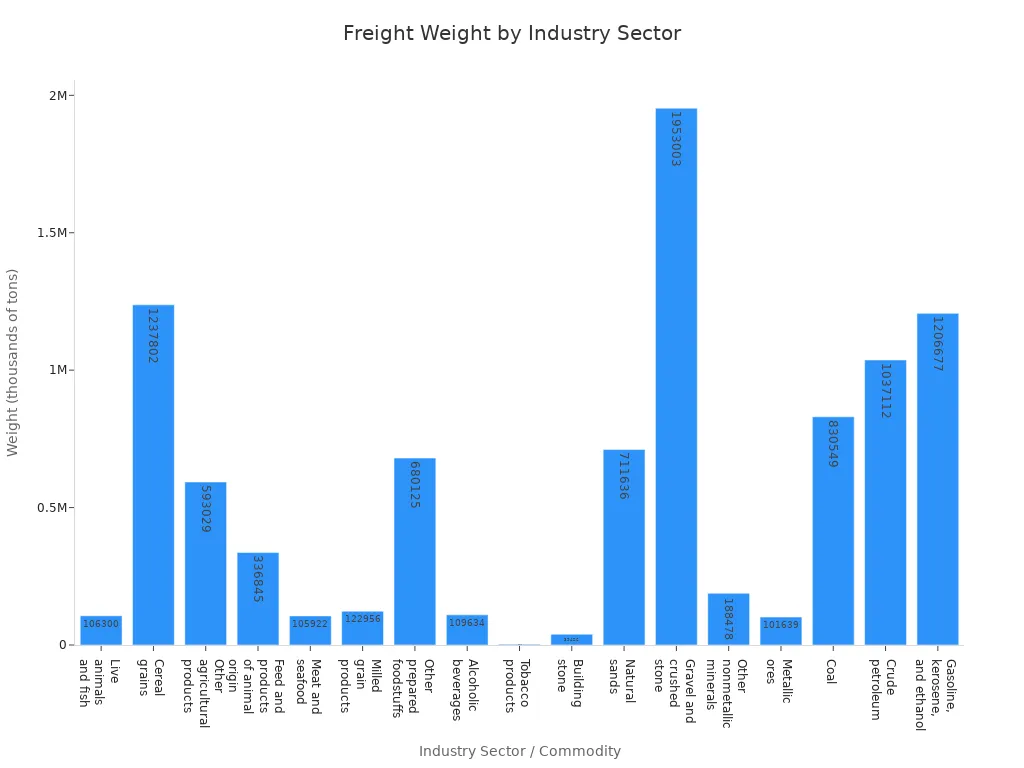
Most global goods travel by sea. Ships carry over 80% of all goods by volume. Common items shipped are oil, iron ore, grain, electronics, and finished products. As trade changes, developing countries, especially in Asia, now ship more than half of all sea freight.
Special Cargo and Compliance Needs
Shipping special cargo like electronics or medical supplies is harder. You must follow strict rules and handle goods with care. If you do not have the right paperwork, your shipment can be delayed or taken away.
Customs and rules are different in every country. You must follow each country’s import and export laws.
You need correct paperwork, like invoices and certificates.
Packing and handling must protect fragile or dangerous goods.
Insurance and risk plans help protect against theft or damage.
Language and culture differences can make things harder.
Sensitive goods like electronics or medical devices need extra care. Some groups, like the U.S. FDA or European Commission, may ask for special labels or tracking. These goods may need temperature control and fast delivery. A freight forwarder with experience in special cargo can help you follow the rules and ship smoothly.
Note: Many industries, like electronics, FMCG, cars, and healthcare, have tight deadlines and tough rules. You can solve these problems by using digital tools and working with expert suppliers. Technology like AI and data tools can help too. A good freight company with experience in your field helps you handle these challenges and keeps your supply chain working well.
Evaluate Freight Forwarders & International Shipping Partners
Research Provider Experience & Global Network
When you check freight forwarders, look at their experience and network. A good freight forwarder knows your business and how to move your goods. You want a company that has shipped things like yours before and has the right papers. This helps you avoid problems and delays.
To pick the best one, do these things: 1. See if they have shipped your kind of cargo, even special or dangerous ones. 2. Check if their network is strong. A big network means they can reach all your markets. 3. Make sure they have agents in important countries. This helps with customs and local rules. 4. Ask if they know how to use air, sea, rail, and road shipping. 5. Read what other people say about them. Good reviews mean they are reliable. 6. Try their customer service. Fast and helpful answers show good support. 7. Check their certificates and awards. These show they are trustworthy.
A big agent network helps with rules and on-time delivery. Local agents know the language and customs, so things go smoother. A global company can help your business grow. You also want a freight company that can fix problems, like customs trouble or port closures.
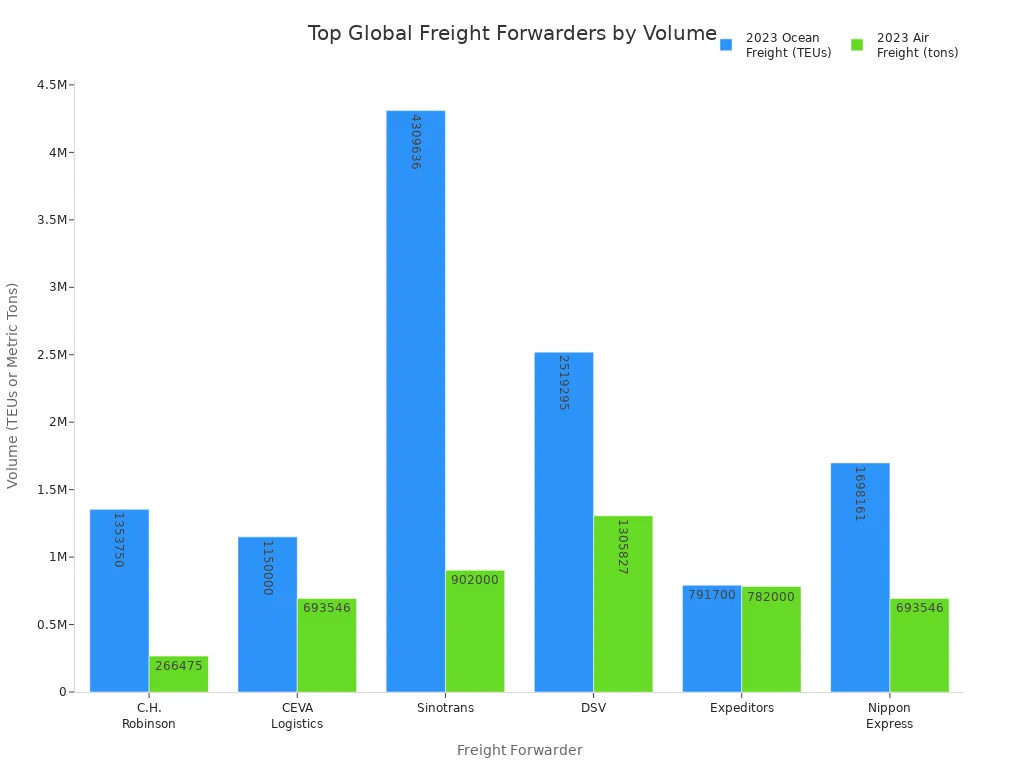
Freight Forwarder | Global Network & Reach | 2023 Ocean Freight (TEUs) | 2023 Air Freight (metric tons) | Key Expertise & Services | Headquarters | Founded | Employees |
|---|---|---|---|---|---|---|---|
C.H. Robinson | Services across 5 continents, 85,000+ carriers | 266,475 | Air, sea, rail, intermodal, customs, trade compliance, last mile, project logistics, warehousing | Eden Prairie, Minn. | 1905 | 15,000+ | |
CEVA Logistics | Presence in 170+ countries, 600+ ocean routes | 1,150,000 | 693,546 | Air, sea (FCL, LCL), ground, rail, refrigerated, customs brokerage, warehousing, supply chain management | Tokyo, Japan | 1937 | 78,000+ |
Sinotrans | Extensive rail network in China, SE Asia, Europe | 4,309,636 | 902,000 | Sea, air, rail, supply chain security, terminals, feeder/barges | Beijing, China | 2002 | 32,000+ |
DSV | Operates in 80+ countries, multimodal services | 2,519,295 | 1,305,827 | Sea, air, road, rail, warehousing, customs clearance, e-commerce | Hedehusene, Denmark | 1976 | 75,000+ |
DB Schenker | 1850+ locations worldwide | N/A | N/A | Land, air, ocean freight, contract logistics, supply chain operations, proprietary ERP system | Essen, Germany | 1872 | 30,000+ |
Expeditors | 340+ locations in 100+ countries | 791,700 | 782,000 | Air, ocean, multimodal, customs brokerage, supply chain security, warehousing | Seattle, Washington | 1979 | 18,000+ |
Nippon Express | Network in 50+ countries | 1,698,161 | 693,546 | Global freight movement, multimodal, specialized cargo handling | Tokyo, Japan | 1937 | 78,000+ |
Assess Service Range & Technology
A top freight company does more than just move goods. You need a freight forwarder that offers many services. Look for these important things:
Customs clearance and help with rules
Warehousing and keeping track of inventory
Risk management and insurance for your cargo
Real-time tracking so you always know where your shipment is
Extra services like putting shipments together, sending orders, and distribution
Company | Essential Service Offerings and Differentiators |
|---|---|
UPS | Sustainability, healthcare logistics, e-commerce fulfillment, freight forwarding services. |
DHL Express | Global network, specialized industry services, advanced tracking, contract logistics. |
CEVA Logistics | Freight management, contract logistics, real-time tracking, warehouse automation, value-added services. |
DB Schenker | End-to-end supply chain, digital platforms for tracking and inventory management. |
Expeditors | Personalized solutions, integrated systems, customs clearance, cargo insurance, distribution, warehousing. |
Technology is very important in shipping today. Real-time tracking lets you see your freight at any time. IoT sensors and GPS help you watch your goods’ location and condition. Digital platforms, like JUSDA’s JusLink, connect everyone in the supply chain. This makes talking easier, speeds up customs, and cuts down on delays.
Real-time tracking and digital tools keep your shipments safe and help you make smart choices. They also save money by finding better routes and using less fuel. Centralized platforms help everyone work together and stay updated.
A good freight company uses automation, AI, and big data to guess demand, manage stock, and fix problems early. This makes shipping faster and more reliable.
Compare Pricing & Contract Terms
When you compare freight forwarders, look closely at how they set prices. Many use dynamic pricing, which changes with shipment size, distance, and transport type. Some offer contract prices for big orders, while others use spot rates for single shipments. You need to balance steady contract rates with the chance to save on spot deals.
Watch out for extra fees like customs, terminal handling, demurrage, and detention. These can make your total cost higher.
Look at freight rates and ask for clear details. This helps you get better deals.
Use tools to compare rates from different companies so you don’t pay too much.
Pricing Component | Description | Value |
|---|---|---|
Total Cost | Cost incurred by freight forwarder for leasing container and related expenses | |
Estimated Volume | Anticipated container fill volume based on historical data | 25 CBM |
Cost per CBM (Buy rate) | Total Cost divided by Estimated Volume | $40 per CBM |
Markup | Percentage added to cost to determine selling price | 25% |
Selling Price per CBM | Cost per CBM multiplied by (1 + Markup) | $50 per CBM |
Contract terms are just as important as price. Top freight companies use clear Incoterms to show who pays for what and when risk changes. Good contracts have penalties for late deliveries and rewards for early ones. They also explain packaging, labeling, and inspection rules. Make sure your contract covers delays, big problems, and how to solve arguments. Clear communication and regular updates help you avoid surprises.
Tip: Always pick a freight company that shares updates and talks clearly. This builds trust and helps you fix problems fast.
JUSDA’s Approach to International Freight
JUSDA is a leader in international freight and logistics. The company uses AI tools to guess demand, fix things before they break, and find the best routes. This saves money and makes deliveries faster. JUSDA’s cloud systems give you real-time data and let you change plans quickly, making your supply chain flexible.
JUSDA’s JusLink platform uses IoT, cloud computing, and big data. It connects suppliers, makers, and customers so everyone works together. With JusLink, you get smart inventory management, predictions, and can see everything from start to finish. This platform can cut lead times by 20% and make your business run better.
JUSDA’s China-Europe Express Rail is a big change for cross-border shipping. It cuts travel time from 30–34 days by sea to about 14–16 days by rail. Trains run every day, making shipping more reliable. Digital systems speed up customs and cut paperwork, saving up to four days at borders. Better stations and new tech keep your shipments moving.
JUSDA also cares about the environment, using green warehouses and electric vehicles. The company follows strict trade rules, so you avoid trouble with compliance. Automation and better processes let your team focus on helping customers and making sales.
JUSDA’s best practices are strong communication, advanced technology, and a global network. These make JUSDA a trusted partner for safe and reliable shipping and supply chain management.
JUSDA Solutions
To provide you with professional solutions and quotations.
Picking the right freight partner takes careful planning. You should match what the provider does well with what your business needs. This helps you get better results. Companies like JUSDA use smart tools like AI and real-time tracking. These tools help them work faster and better. Here are some important lessons from real business stories:
Key Takeaway | Explanation |
|---|---|
Industry-Specific Expertise | It is important that your partner knows your industry and the rules. |
Structured Methodology | Using facts and clear steps helps you do well. |
Cultural Alignment | Working together is easier when you share values and ways to talk. |
Next, check their experience, network, safety, service, and technology. This will help you choose the best partner for your needs.
FAQ
What should you look for in a reliable international freight partner?
Check if they have lots of experience. Make sure their network covers many countries. See if they use good technology. Read what other customers say about them. They should know how to ship your kind of cargo. Real-time tracking is important.
How can you reduce shipping delays in international freight?
Get all your papers ready before shipping. Use real-time tracking to watch your shipment. Pick a partner who knows customs rules well. Fast and clear talking helps fix problems quickly.
Why does technology matter in international shipping?
Technology lets you see updates right away. It helps plan better routes for shipping. Customs can go faster with good technology. You can track your shipment at any time. If something goes wrong, you can act fast.
Tip: Always ask your freight partner about their digital tools and tracking systems.