How IoT Is Revolutionizing Connectivity in 2025


You experience the internet of things (iot) everywhere in 2025. The internet of things (iot) connects over 75 billion devices, shaping how you interact with real-time technology. You use smartwatches and home assistants powered by real-time data. Businesses rely on the internet of things (iot) for real-time supply chain management. Real-time insights drive innovation and smarter decisions. The internet of things (iot) enables real-time communication between devices, people, and systems. Real-time monitoring in logistics improves efficiency. Real-time data from the internet of things (iot) transforms healthcare and industry. Real-time analysis helps you manage risks. Real-time updates keep you informed. The internet of things (iot) supports real-time progress in every aspect of life.
Key Takeaways
IoT connects over 75 billion devices in 2025, enhancing real-time communication and decision-making across industries.
AIoT integration transforms supply chains and healthcare, enabling predictive analytics for better resource management and patient care.
5G connectivity offers ultra-fast speeds and low latency, revolutionizing how you use IoT devices for logistics, healthcare, and entertainment.
IoT Trends 2025

You see the world of 2025 shaped by several powerful iot trends. These trends drive the way you connect devices, manage data, and build smarter cities. Industry analysts highlight the top five technology trends for iot this year:
Industrial iot
Edge computing
Iot cybersecurity
5G connectivity
Environmental sustainability
These trends change how you experience connectivity, especially in supply chain management, healthcare, and urban environments. You benefit from faster data transfer, smarter decision-making, and greener operations.
AIoT Integration
You notice aiot integration everywhere in 2025. Aiot combines artificial intelligence with iot, creating intelligent systems that learn, predict, and act in real time. This integration powers smart factories, connected vehicles, and responsive cities. You see aiot trends in logistics, where predictive analytics and intelligent agents optimize every step.
JUSDA’s JusLink AI Solution stands out as a leader in aiot integration for supply chains. You use its predictive analytics to forecast demand and manage inventory. The risk control tower monitors disruptions, while intelligent agents automate tasks like material preparation and logistics management. JusElsa, the intelligent supply chain assistant, uses advanced natural language processing to help you interact with complex systems easily. This level of integration transforms your supply chain into a responsive, data-driven network.
You also see aiot integration in healthcare, where smart devices monitor patients and predict health risks. In cities, aiot trends enable real-time traffic management and energy optimization. These examples show how aiot integration shapes the future of connectivity.
Edge Computing
Edge computing becomes essential for iot in 2025. You process data closer to where it is generated, reducing delays and improving efficiency. This trend supports real-time analytics and decision-making, especially in industries like manufacturing and logistics.
Edge computing platforms in 2025 offer advanced features that help you manage distributed data and applications:
Platform | Key Features |
|---|---|
Scale Computing | Hyper-converged infrastructure, automated self-healing technology, ideal for distributed enterprises. |
Azure IoT Edge (Microsoft) | AI-driven analytics, machine learning models, real-time data processing. |
Eclipse ioFog (Backed by IBM) | Open-source framework for scalable, containerized workloads, integrates with Kubernetes. |
ClearBlade | Real-time predictive maintenance, supports multiple IoT protocols. |
Alef Private Edge Platform | Focused on 5G and IoT connectivity, fast and secure data processing. |
Google Distributed Cloud Edge | AI-powered analytics, real-time data processing, enterprise security. |
You benefit from ai integration in edge computing, which enhances real-time analytics and decision-making. Hyper-converged infrastructure becomes standard, especially for small and medium businesses. You see a shift from cloud-based infrastructure to edge solutions, driven by new technology trends and the need for faster, more reliable data processing.
5G & Connectivity
5G connectivity revolutionizes how you use iot devices in 2025. You experience ultra-fast speeds, low latency, and the ability to connect more devices than ever before. This technology trend supports real-time tracking in logistics, advanced healthcare applications, and immersive experiences in education and entertainment.
Benefit/Feature | Description |
|---|---|
Ultra-fast speeds | 5G provides significantly higher data transfer rates, essential for IoT devices to communicate effectively. |
Low latency | The reduced delay in data transmission enhances real-time interactions among connected devices. |
Increased capacity | 5G networks can support a larger number of devices simultaneously, crucial for IoT scalability. |
Real-time tracking | Connected logistics benefit from 5G, allowing for immediate updates and predictive analytics. |
Enhanced healthcare applications | Telemedicine and wearable devices leverage 5G for improved patient monitoring and diagnostics. |
Revolutionized education and entertainment | 5G enables immersive experiences in AR/VR and supports interactive learning environments. |
You see rapid adoption of 5G-enabled iot devices across industries. In logistics, 45% of companies use 5G by 2025. Manufacturing reaches a 60% adoption rate. The total number of iot-connected devices grows to 20.1 billion, with a market value of $714.48 billion. In the United States, smart home adoption reaches 57% of households.
Sustainability in IoT
Sustainability becomes a core focus for iot deployments in 2025. You use iot devices to improve energy efficiency, manage waste, and reduce environmental impact. In manufacturing, iot helps you optimize energy use and lower carbon footprints. You see advanced technologies like energy harvesting, which extends sensor lifetimes and reduces waste.
Companies like JUSDA lead the way in building greener supply chains. You benefit from ai-powered planning, which uses predictive analytics for demand, inventory, and risk. Real-time visibility through smart control towers helps you track carbon emissions and optimize logistics. JUSDA introduces carbon-neutral warehousing and electric vehicle fleets for last-mile delivery, making sustainability a reality in global supply chains.
Aspect | Description |
|---|---|
AI-Powered Planning | Predictive analytics for demand, inventory & risk. |
Sustainable & Circular Supply Chains | Green logistics and carbon tracking are going mainstream. |
Real-Time Visibility | Smarter control towers powered by IoT & AI. |
You see sustainability strategies like energy efficiency and waste management become standard. These efforts help you meet environmental goals and create a positive impact on your community.
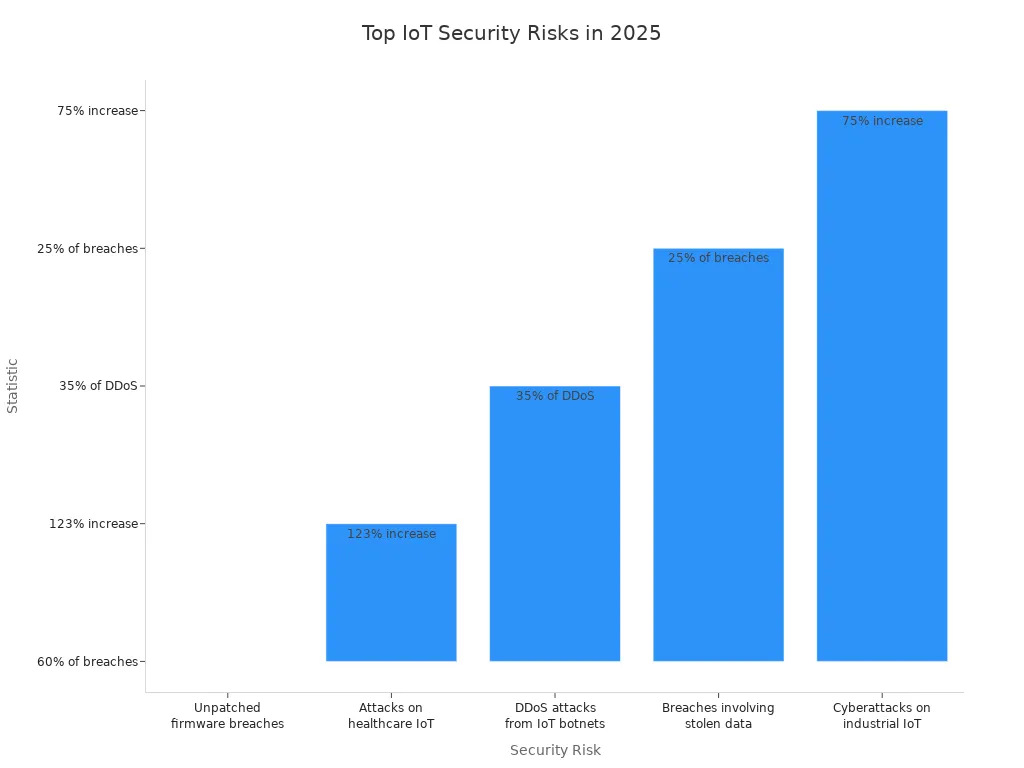
You must also consider security and privacy as part of these trends. Unpatched firmware, DDoS attacks, and data breaches remain major risks. You need to follow strict data privacy laws, like GDPR, to protect user information and ensure compliance.
In 2025, you shape the future of connectivity by embracing aiot integration, edge computing, 5G, and sustainability. These technology trends help you build smarter cities, efficient supply chains, and a more sustainable world.
AIoT Applications & Impact

Smart Supply Chains (JUSDA)
You see aiot changing supply chain management in 2025. You track materials and products at every stage using sensor networks and ai-powered systems. This gives you real-time visibility and helps you make better decisions. You use smart inventory management to predict needs and automate replenishment. You avoid excess stock and shortages. You optimize delivery routes with ai-driven logistics, reducing delays and costs. You plan ahead with predictive analytics, staying ahead of demand.
JUSDA’s JusLink AI Solution helps you manage global supply chains with advanced aiot features. You use intelligent agents for autonomous procurement, demand prediction, and logistics optimization. These agents monitor market conditions and internal demand patterns, adjusting production plans and inventory levels. You benefit from real-time risk monitoring and adaptive risk management. JusElsa, the intelligent supply chain assistant, uses natural language processing to help you interact with complex systems.
You experience measurable improvements in supply chain operations:
Benefit Category | Specific Improvement Metric | Reported Impact |
|---|---|---|
Demand Forecasting | Inventory Error Reduction | Up to 50% |
Route Optimization | Fuel Cost Reduction | Up to 15% |
Delivery Time Improvement | Up to 20% | |
Warehouse Automation | Productivity Enhancement | Up to 25% |
Picking Error Reduction | Up to 30% | |
Overall Visibility | Supply Chain Visibility Improvement | Up to 80% |
Cold Chain Management | Product Spoilage Reduction | Up to 40% |
Inventory Management | Stock Accuracy Increase | Up to 95% |
Predictive Maintenance | Maintenance Cost Reduction | Up to 25% |
Asset Uptime Increase | Up to 10% | |
Decision Making | Decision-Making Efficiency Improvement | Up to 35% |
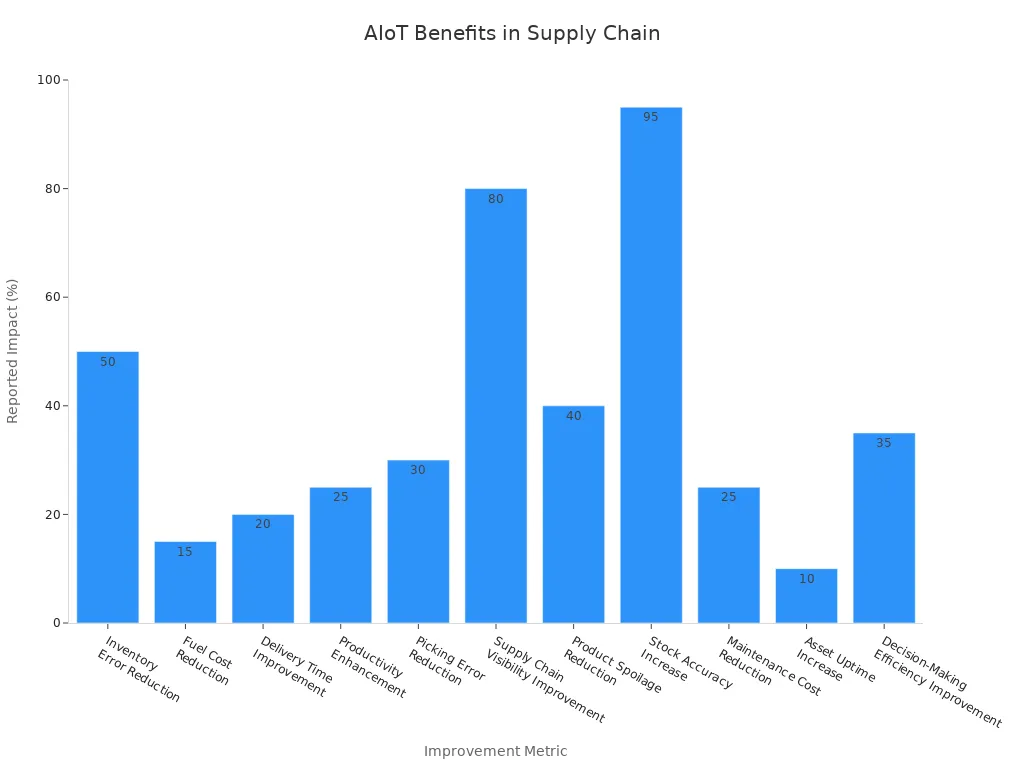
You gain agility, visibility, and tracking across your supply chain. You simplify information flow and boost productivity. You optimize inventory, transportation, and supplier selection, reducing costs and delivery times. You use blockchain for traceability and transparency, improving food safety and reducing waste. You see economic growth through increased efficiency.
You also help the environment by driving sustainability efforts. You optimize routing and resource utilization, lowering your carbon footprint by up to 30%. You monitor vehicle emissions and energy usage with sensor technology. You use edge computing for real-time data processing and environmental compliance.
Tip: You can use aiot to automate decision-making in supply chains. Intelligent agents manage supplier relationships, negotiate contracts, and optimize purchasing decisions. They monitor threats and implement mitigation strategies automatically.
Smart Cities
You live in cities that use aiot to improve daily life. You experience better traffic management with sensor-enabled traffic lights and ai-driven flow optimization. You see smart bins that signal collection needs based on real-time fill levels. You benefit from energy-efficient grids that adjust power distribution to reduce waste and lower costs.
You notice advanced security systems in public spaces. Cities like Chicago and Atlanta use aiot for facial recognition and surveillance, improving public safety. Boston uses sensors to detect infrastructure issues and potholes, speeding up repairs. You see aiot tracking emissions and managing energy resources, supporting environmental sustainability.
You use connectivity to access city services and information. Bivocom’s 5G Gigabit Gateway TG465 integrates 5G, edge computing, and ai for seamless data flow across industries. You see global revenue for smart city technologies reach 89 billion U.S. dollars in 2023.
Traffic management improves with real-time data analysis.
Smart lighting and waste management conserve energy and keep cities clean.
AIoT enhances public safety and infrastructure monitoring.
Environmental sustainability grows with emission tracking and energy management.
Healthcare IoT
You rely on aiot for better healthcare outcomes. You use sensor devices for continuous monitoring, leading to timely interventions and reduced hospital readmission rates. You receive personalized healthcare tailored to your needs, improving treatment effectiveness and patient experience. You save costs by streamlining operations and supporting preventive care.
You access remote healthcare, allowing you to receive care without visiting facilities. You benefit from data-driven insights that optimize healthcare delivery. You see real-time dashboards with comprehensive health parameter views and intelligent health analysis reports. AI predicts complications from raw health data, enabling proactive interventions.
You experience enhanced health accuracy through continuous monitoring.
You receive personalized treatments and improved patient satisfaction.
You benefit from cost reduction and remote healthcare accessibility.
You see operational efficiency improve with automated asset tracking and inventory management.
You use machine learning to analyze patient data, identify patterns, and predict abnormal conditions. You see contactless screening during epidemics, with ai monitoring vital signs to estimate infection presence.
Industrial IoT
You work in industries transformed by industrial iot and aiot. You use predictive maintenance systems to anticipate equipment failures and schedule repairs before breakdowns occur. You monitor machinery health with sensors tracking temperature, vibration, and pressure. You optimize production lines by predicting bottlenecks and ensuring smooth operations.
You manage energy efficiency by analyzing consumption data and reducing costs. You monitor electrical systems to prevent overheating and major downtimes. You use aiot for safety monitoring, tracking hazardous conditions like harmful gas concentrations.
Application | Efficiency Gains |
|---|---|
Predictive Maintenance | Reduced downtime and operational costs |
Machine Health Monitoring | Improved safety and optimal performance |
Energy Analytics | Identified inefficiencies and reduced costs |
Production Line Optimization | Fine-tuned processes and improved throughput |
Real-Time Process Visibility | Immediate response to anomalies and slowdowns |
Defect Detection & Quality Control | Reduced manual inspection and improved output quality |
Performance Monitoring | Enhanced detection of performance drops |
Grid Load Balancing | Prevention of outages through dynamic load balancing |
Smart Energy Management | Better decisions around energy storage and distribution |
You use aiot to track energy usage and waste generation, enabling smarter resource management. You support greener practices by adjusting resource use based on real-time data. You reduce carbon emissions and improve operational efficiency.
Note: Predictive maintenance exemplifies the proactive nature of aiot. You use data and ai to forecast equipment failures, allowing timely interventions and reducing maintenance costs. You detect anomalies before they lead to significant issues.
You experience comfort, convenience, security, and time savings in your daily work. You see energy saving and improved psychological well-being from smart technologies. You recognize the need for human-centric design in industrial iot to align with user behaviors and preferences.

JUSDA Solutions
To provide you with professional solutions and quotations.
You see IoT and AIoT trends shaping connectivity in 2025.
Trend | Description |
|---|---|
Devices learn and adapt, boosting market potential. | |
Sustainability Focus | Green practices drive IoT development. |
JUSDA’s smart platforms improve supply chain efficiency and visibility.
Automation reduces errors and supports global logistics.
Experts predict AIoT will transform device processing and networking.
You can use these advancements to enhance your business or daily life.
See Also
Transforming Supply Chains: The Rise Of IoT Innovations
The Impact Of AI Technology On Global Change
Future Logistics Transformed By AI Supply Chain Solutions
Five Key Trends Shaping The Future Of Supply Chains
Navigating Future Logistics Through Advanced Digital Technologies