Real-Time Logistics Optimization Enhanced by Autonomous AI Agents while reducing inventory cycle times from days to minutes

Autonomous AI agents have transformed logistics optimization, enabling companies to reduce inventory cycle times from days to minutes. JUSDA’s global reach and innovative use of AI, cloud computing, and big data analytics drive measurable improvements in supply chain efficiency. The company’s approach delivers real-time data access, predictive insights, and sustainable logistics operations.
Technology | Impact on Supply Chain Efficiency |
|---|---|
AI-driven tools | Improved forecasting and route optimization, lowering operational costs |
Cloud Computing | Real-time data access, enhancing flexibility |
Big Data Analytics | Better supplier performance and inventory management |
Sustainability | Eco-friendly warehousing and electric delivery fleets |
Supply chain professionals now face an urgent need to embrace intelligent solutions to stay competitive in a rapidly evolving market.
Key Takeaways
Autonomous AI agents can reduce inventory cycle times from days to minutes, improving supply chain efficiency.
Real-time data access through AI and cloud computing enhances decision-making and operational flexibility.
Predictive analytics helps companies avoid stockouts and overstocking by accurately forecasting demand.
Dynamic routing powered by AI optimizes delivery routes, reducing fuel costs and improving delivery speed.
Continuous monitoring of key performance indicators (KPIs) ensures that supply chain operations remain efficient and responsive.
Autonomous AI Agents in Supply Chain
What Are Autonomous AI Agents
Autonomous AI agents represent a new era in supply chain management. These ai agents operate with intelligent autonomy, interpreting data and making decisions without human intervention. They do not rely on static rules. Instead, they use context awareness to understand information from multiple sources. This approach allows them to adapt quickly and optimize supply chain processes.
Supply chain professionals use AI agents for several core functions:
Enhanced decision-making and communication speed
Improved customer satisfaction
Reduced costs and increased productivity
AI agents predict demand, optimize inventory levels, and streamline logistics. They analyze vast amounts of data, enabling autonomous execution across operations. Their adaptability ensures that supply chains remain resilient in dynamic environments.
Note: JusLink’s intelligent supply chain platform leverages ai agents for real-time collaboration, predictive analytics, and autonomous load balancing. This technology supports global logistics and inventory management.
Unique Capabilities vs. Traditional Automation
AI agents differ from traditional automation in several important ways. Traditional automation follows predefined rules and requires manual updates when processes change. AI agents, however, learn from new information and adjust strategies in real time.
Key differences include:
Adaptability: AI agents thrive in changing environments. They learn from experiences and modify their behavior based on new data. Traditional automation remains rigid and needs reprogramming for new tasks.
Decision-Making Speed: AI agents analyze data and evaluate multiple options before acting. This thoughtful approach may take longer than the rapid execution of traditional automation, but it leads to better outcomes.
Autonomous load balancing: AI agents distribute tasks efficiently, responding to fluctuations in demand and resource availability.
For example, a customer service AI agent improves responses by learning from past interactions. In contrast, a data entry automation tool must be reconfigured if the data format changes. AI agents provide intelligent autonomy, supporting continuous improvement and operational excellence.
Real-Time Logistics Optimization
Instant Data Processing
JUSDA and JusLink lead the way in logistics optimization by enabling instant data processing. Their platforms use autonomous AI agents to gather and analyze information from multiple sources in real time. These AI agents provide a clear view of logistics operations, allowing companies to track shipments, monitor inventory, and respond to changes as they happen. This approach ensures transparency and control across the entire delivery system.
JUSDA uses AI and machine learning to boost operational efficiency.
Real-time tracking systems offer full visibility over shipments.
Efficient route planning reduces transit times and fuel use.
Risk management practices keep the supply chain resilient.
A measurable impact of instant data processing appears in several areas:
Improvement Type | Measurable Impact |
|---|---|
Decision-Making | Enhanced through immediate insights |
Route Optimization | Dynamic optimization reduces delays by 58% |
Cost Efficiency | 20% improvement in fuel economy |
Customer Satisfaction | Superior due to timely deliveries |
Inventory Management | Continuous monitoring prevents stockouts |
Autonomous Decision-Making
Autonomous AI agents drive logistics optimization by making fast, informed decisions. These AI agents analyze streams of supply chain data, monitor trends, and adjust strategies based on real-time feedback. They focus on defined logistics goals, such as improving delivery performance and reducing costs. With autonomous decision-making, companies can adapt to market changes and secure better deals faster than traditional teams.
AI agents automate repetitive tasks, increasing speed and efficiency.
They learn from past outcomes and improve future actions.
Objective-oriented execution ensures continuous optimization.
Coordination Across Operations
Coordinated operations are essential for effective logistics management. Autonomous AI agents enable seamless communication between different parts of the supply chain. They optimize routing, manage inventory, and automate procurement, leading to better resource allocation and fewer delays. Real-time adjustments keep the delivery system running smoothly, even when unexpected events occur.
Benefit | Improvement Metrics |
|---|---|
Cost Reduction | |
Delivery Speed | 20% improvement in average delivery speeds |
Forecasting Reliability | Up to 90% improvement in accuracy rates |
Freight Cost Reduction | Up to 15% reduction in freight costs |
Unplanned Downtime Reduction | Increased productivity through predictive maintenance |
JUSDA’s logistics optimization platforms demonstrate how AI agents deliver measurable results, from cost savings to improved delivery performance.
Reducing Inventory Cycle Times
Predictive Analytics
Predictive analytics plays a crucial role in reducing inventory cycle times. JUSDA’s warehouse solutions and JusLink’s eVMI system use advanced technologies to monitor inventory levels in real time. IoT devices collect data from every storage location. Cloud computing provides scalable access to this information. Big data analytics processes the data, enabling AI agents to forecast demand and optimize stock levels.
Technology | Role in Inventory Tracking |
|---|---|
IoT | Enables real-time data collection and monitoring |
Cloud Computing | Provides scalable storage and access to data |
Big Data Analytics | Analyzes data for informed decision-making |
AI agents analyze historical sales data and market trends. They generate accurate forecasts, which help companies avoid overstocking and stockouts. Real-time monitoring of inventory levels allows for prompt responses to market changes. This approach leads to faster inventory turnover and improved supply chain management.
Note: The integration of advanced technologies within JUSDA's systems not only facilitates real-time inventory tracking but also enhances operational efficiency by enabling data-driven decision-making and reducing costs through optimized inventory management practices.
Dynamic Routing
Dynamic routing powered by AI agents transforms the way companies manage deliveries and inventory turnover. AI agents evaluate real-time data from logistics networks. They select optimal routes for shipments, reducing transit times and fuel consumption.
AI-powered dynamic routing can decrease fuel costs by 15% by optimizing delivery routes based on real-time data, which leads to reduced delivery times and improved customer satisfaction.
Operations utilizing dynamic, AI-driven routing can cut fuel consumption by up to 20% and achieve significant improvements in on-time delivery rates.
Organizations using AI agents in inventory management typically see inventory turns increase and a drop in MAPE by 10 to 30 percent within 1 to 3 quarters.
AI agents coordinate shipments across regions, ensuring products reach their destinations quickly. This autonomous approach to routing supports continuous optimization and helps companies respond to disruptions without delay. JUSDA’s global network and JusLink’s intelligent platform enable seamless coordination, driving efficiency in supply chain management.
Automated Inventory Management
Automated inventory management relies on AI agents to track, count, and replenish stock. JUSDA’s warehouses and JusLink’s eVMI system provide real-time visibility into inventory levels. AI agents monitor key performance indicators and trigger replenishment when needed.
Order Cycle Time: Measures the average time taken to ship out an order from the time it was placed, helping to monitor fulfillment efficiency.
Order Lead Time: The time between the customer’s order and order fulfillment, minimizing this leads to faster turnover and improved cash flow.
Cycle Count Accuracy: Assesses the accuracy of inventory levels based on periodic counts, crucial for preventing stock-outs and ensuring inventory records match actual stock.
AI agents automate cycle counts and inventory audits. They ensure records match actual stock, reducing errors and preventing shortages. Automated systems allow companies to minimize order lead times and improve order cycle times. This optimization results in faster inventory turnover and greater operational efficiency.
Tip: Real-time monitoring and dynamic tracking of KPIs empower supply chain teams to respond quickly to market changes and maintain optimal inventory levels.
Autonomous AI agents drive continuous improvement in inventory management. Their ability to analyze data, make decisions, and execute tasks without human intervention sets a new standard for supply chain optimization.
Supply Chain Optimization with JUSDA
Integrated Solutions
JUSDA delivers supply chain optimization through a global network and industry-specific solutions. The company operates over 155 service points and manages more than 2.5 million square meters of warehouse space. JUSDA supports sectors such as electronics, automotive, FMCG, and medical health. Its integrated approach combines air, land, sea, and rail transport with advanced cloud warehousing and consolidation services.
JUSDA’s autonomous AI agents enable rapid adaptation and real-time collaboration. These AI agents analyze supply and demand signals, helping companies respond quickly during disruptions. The platform integrates GS1 Standards, which increases flexibility and applicability across industries.
Evidence Type | Description |
|---|---|
Award | JUSDA won first place in the GS1 US Hackathon for a solution enhancing supply chain flexibility. |
Real-time Insights | The solution provides real-time visualizations and actionable insights into supply and demand signals. |
Industry Applicability | The judges recognized the solution for its real-world applicability across various industries. |
JUSDA’s solution won a $12,000 prize for improving supply chain resiliency.
The system allows for rapid response during crises using real-time data.
JusLink AI Capabilities
JusLink enhances AI-enabled supply chains with advanced AI agents. These agents support forecasting, replenishment, and risk management. JusLink’s ai-driven supply chains use deep learning to predict demand and optimize inventory. Ai agents monitor logistics, trigger replenishment, and provide real-time risk alerts.
Companies using JusLink’s AI agents see logistics costs drop by about 15%. Service levels improve by 65%. Forecasting errors decrease by up to 50%. Practical implementations show an 11% increase in delivery accuracy and an 8.5% reduction in overstock. JusLink’s autonomous AI agents enable continuous improvement and dynamic management.
JusLink’s AI agents empower supply chain teams to make faster decisions, reduce risks, and maintain optimal inventory levels. The platform supports real-time monitoring and seamless coordination, setting a new standard for ai-driven supply chains.
Autonomous Supply Chain Use Cases
Sharp Case Study
Sharp, a global leader in household appliances, faced significant supply chain challenges before partnering with JUSDA. The company struggled with slow order processing, inefficient inventory management, and high logistics costs. After forming SHARP JUSDA LOGISTICS (SJL), Sharp adopted a comprehensive supply chain optimization strategy. SJL implemented procurement execution, vendor-managed inventory, and just-in-time strategies. These changes led to a 70% reduction in labor costs and a 20% decrease in logistics expenses. Order delivery times improved by 30%, and operational efficiency increased by 50%. SJL’s integration of software, hardware, and solutions enabled real-time inventory tracking and automated logistics flows. Sharp’s transformation demonstrates how autonomous supply chain solutions can deliver measurable improvements in cycle times and cost savings.
Automotive Logistics
JUSDA’s automotive logistics services showcase the impact of autonomous AI agents in a complex industry. Companies in the automotive sector use AI to streamline inventory management and optimize delivery routes. Autonomous systems anticipate shifts in demand, which helps reduce operational costs and enhance delivery speed. Manufacturers automate repetitive tasks, minimizing manual intervention. For example, predictive maintenance powered by AI reduces downtime and improves vehicle uptime. These innovations support just-in-time manufacturing and global distribution, helping automotive companies maintain resilience and efficiency.
AI agents streamline inventory management.
They optimize delivery routes.
They anticipate shifts in demand, reducing costs and improving delivery speed.
AI agents automate repetitive tasks, lowering manual workload.
Predictive maintenance reduces downtime and increases vehicle uptime.
E-commerce Fulfillment
E-commerce operations benefit from autonomous solutions that enhance speed and accuracy. JUSDA’s platforms use ai agents to automate fulfillment processes, manage inventory, and provide personalized customer experiences. These systems operate with minimal supervision, instantly processing information and adapting to market changes.
Benefit | Description |
|---|---|
Automation | AI agents enhance efficiency and streamline fulfillment processes. |
Personalized Recommendations | Machine learning tailors suggestions to customer preferences. |
Real-time Adaptability | Systems respond promptly to market shifts and customer needs. |
AI agents independently manage the shopping journey, from product discovery to purchase completion. They improve customer satisfaction by delivering personalized interactions and recommendations. E-commerce companies using autonomous solutions see faster order cycles and reduced operational costs.
Implementation Essentials
Integration Best Practices
Organizations seeking to implement JUSDA and JusLink solutions should focus on seamless integration with existing supply chain systems. Digital-driven smart manufacturing collaboration strengthens the supply chain network and links partners across all levels. Teams can:
Foster collaboration between upstream and downstream partners to create a unified network.
Build a multi-level linkage system that supports integration and adapts to changing business needs.
Provide visibility and real-time anomaly alerts for every supply chain process.
Connect with external systems, such as Warehouse Management Systems (WMS) and Transportation Management Systems (TMS), to enhance data analysis.
Support complex customer requirements in an open, multi-channel environment.
Improve management and operation services for both internal and external customer information systems.
These practices help companies maximize the benefits of autonomous solutions and maintain flexibility as their operations evolve.
Human Oversight
Human oversight remains essential when deploying autonomous AI agents in supply chain management. Oversight ensures that AI agents operate ethically and align with human values. Teams maintain transparency, accountability, and compliance with regulations, especially in high-risk scenarios. Successful implementation depends on understanding when to apply human judgment and when to allow autonomous decision-making. Companies should:
Define collaboration models to determine which tasks require human input.
Establish oversight frameworks to monitor agent performance and address unique cases.
Ensure accountability in every AI-driven decision.
Continuous improvement and ethical standards guide the responsible use of autonomous technology.
KPI Tracking
Tracking key performance indicators (KPIs) allows organizations to measure the success of autonomous supply chain solutions. Teams should monitor:
On-time delivery (ETAs)
Inventory to sales ratio (ISR)
Carrying cost of inventory
Purchase order tracking
Days sales of inventory (DSI)
Freight cost per tonne shipped
Perfect order delivery rate
Supplier on-time delivery
Regular KPI tracking helps companies identify strengths and areas for improvement, ensuring that autonomous systems deliver measurable value.
Overcoming Challenges
Trust and Transparency
Organizations often express concerns about trust and transparency when deploying autonomous AI agents in supply chain management. Many worry about accountability, data privacy, and the explainability of AI decisions. The following table highlights common concerns:
Concern | Description |
|---|---|
Accountability | The issue of a 'responsibility vacuum' arises when no one takes responsibility for AI failures. |
Data Privacy and Consent | Concerns about agents accessing data without proper consent or authorization. |
Transparency and Explainability | Many AI systems operate as 'black boxes', leading to a lack of trust when decisions are made without clear reasoning. |
Supply chain teams also face risks such as agents pulling user data without renewed consent, chatbots capturing sensitive personal information, and bots accessing proprietary vendor data without authorization.
Experts emphasize the need for clear accountability. AI systems must not operate without consequences. Developers, companies, and users share responsibility for the behavior of autonomous agents.
To build trust, organizations should maintain a transparent chain of responsibility, set up AI Ethics Boards to review deployment pipelines, and conduct periodic audits of agent behavior after deployment. These steps help ensure supply chain resilience and foster confidence in autonomous solutions.
Change Management
Adopting autonomous AI agents requires effective change management strategies. Teams must address psychological and cultural aspects of AI adoption, communicate the impact on roles and responsibilities, and tackle concerns about job displacement. Employees benefit from opportunities to engage in higher-value activities as routine tasks become automated.
Successful change management programs include training and reskilling, clear communication of benefits, and framing AI agents as decision-support tools. Piloting agents in limited use cases demonstrates quick wins and builds confidence among stakeholders. Comprehensive strategies address employee concerns, provide adequate training, and align the organization around new technologies. Transparent communication and thorough training programs help overcome resistance and support smooth delivery of autonomous solutions.
Future of Autonomous Supply Chain
Advances in AI
Recent innovations in AI technology are transforming the autonomous supply chain. Autonomous robots now handle picking, sorting, and storing tasks in warehouses. These robots reduce long-term costs and increase worker productivity. They also take on dangerous jobs, allowing people to focus on higher-value activities. Many supply chain executives expect their operations to become mostly autonomous by 2030 or 2035.
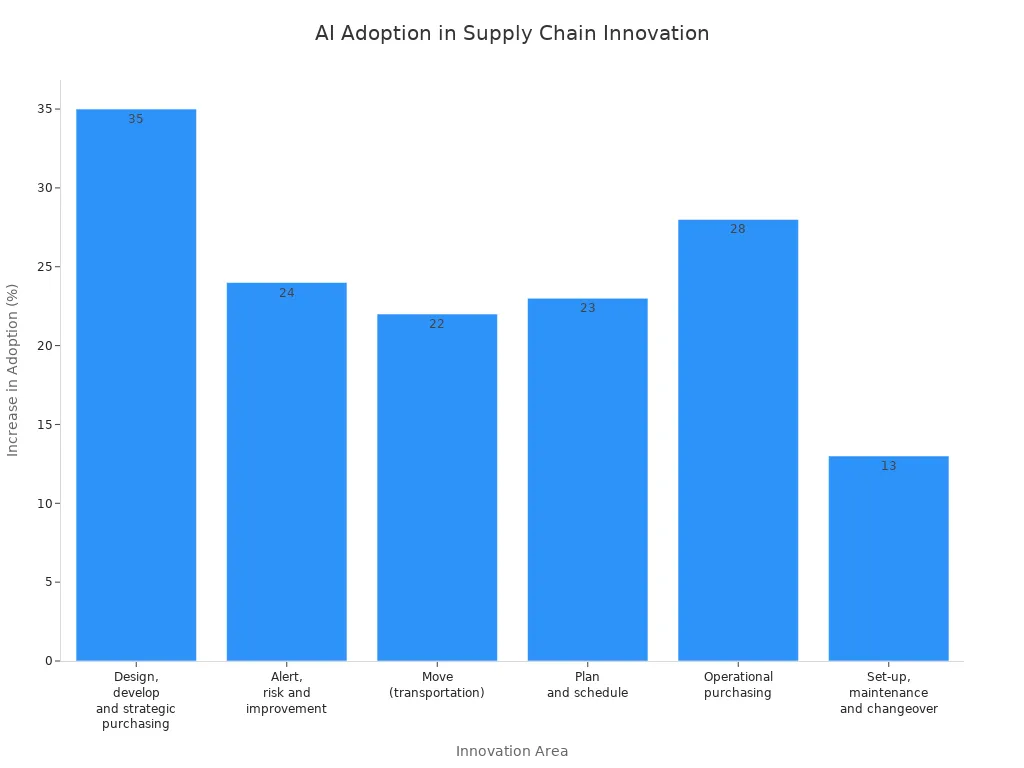
The adoption of AI-driven solutions continues to rise across several areas:
Area of Innovation | Increase in Adoption (%) |
|---|---|
Design, develop and strategic purchasing | 35% |
Alert, risk and improvement | 24% |
Move (transportation) | 22% |
Plan and schedule | 23% |
Operational purchasing | 28% |
Set-up, maintenance and changeover | 13% |
Autonomous AI agents also use advanced analytics for risk identification and mitigation. Generative AI improves supplier selection and contract management. These advances help companies respond faster to market changes and improve delivery performance.
Hyper-Efficient Supply Chains
The integration of autonomous AI agents in supply chains leads to hyper-efficient operations. These agents enable real-time communication and automate tasks such as demand forecasting, procurement, logistics, and inventory management. Companies benefit from lower costs and better responsiveness to shifting market needs. For example, AI agents can adjust inventory levels based on sales trends, which reduces unsold inventory and storage expenses.
Looking ahead, JUSDA and JusLink will continue to drive innovation by adopting emerging technologies. The use of AI-driven control towers, blockchain, and IoT will set new standards for efficiency and competitiveness. Companies that focus on research, collaboration, and agile practices will adapt quickly and deliver greater value in the autonomous supply chain era.
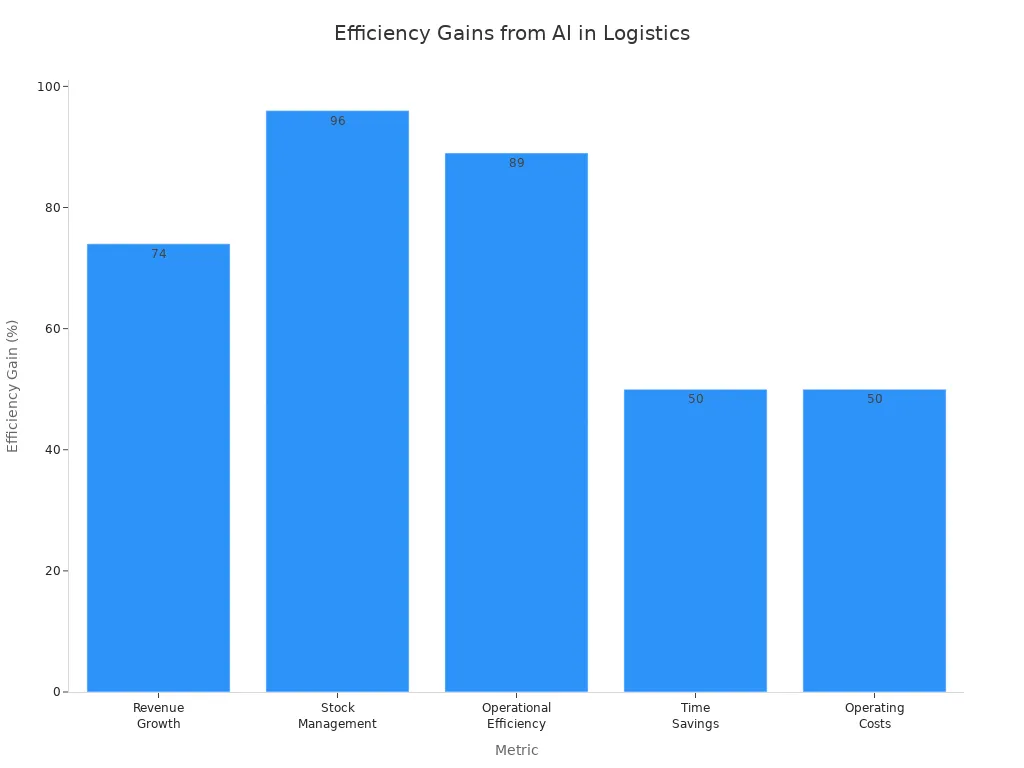
JUSDA’s adoption of autonomous AI agents has transformed logistics operations, delivering measurable gains in efficiency and inventory management. Companies report up to 50% reductions in operating costs and staffing needs, with 96% fewer out-of-stock issues.
Metric | Reported Efficiency Gain |
|---|---|
Revenue Growth | 74% saw increased revenue within 3 months |
Stock Management | 96% reduction in out-of-stock issues |
Operational Efficiency | 89% reduction in staffing needs |
Time Savings | Up to 50% less time spent on buyer tasks |
Operating Costs | Up to 50% reduction in expenses |
Industry experts recognize JUSDA’s leadership in integrating AI and predictive analytics for real-time delivery optimization. The future of intelligent supply chains will rely on advanced platforms and continuous innovation.
FAQ
What industries benefit most from JUSDA’s supply chain solutions?
JUSDA serves electronics, automotive, FMCG, medical health, new energy, heavy equipment, and bulk materials industries. Each sector receives tailored supply chain management and logistics services designed to improve efficiency and reduce costs.
How does JusLink improve inventory management?
JusLink uses real-time tracking and automated replenishment. The system monitors inventory levels, predicts demand, and triggers restocking. This approach helps companies avoid stockouts and reduce excess inventory.
What role do autonomous agents play in logistics optimization?
Autonomous agents analyze data, make decisions, and execute tasks across the supply chain. They support real-time collaboration, optimize routes, and manage inventory. These agents help companies respond quickly to changes and improve overall performance.
How does JUSDA ensure transparency in its operations?
JUSDA uses advanced management systems like eVMI and JusLink. These platforms provide real-time visibility into inventory and logistics. Clients can track shipments, monitor stock, and receive timely updates throughout the supply chain.
What makes JUSDA’s approach to AI unique?
JUSDA integrates AI with IoT, cloud computing, and big data analytics. This combination enables real-time decision-making, predictive analytics, and seamless coordination across global supply chains.
See Also
Exploring AI's Hidden Capabilities In Logistics Management
Transforming Future Logistics Through AI Supply Chain Solutions
Enhancing Supply Chain Efficiency With AI Innovations
Boosting Warehouse Productivity With Advanced Logistics Robotics
Understanding Robotic Automation's Role In Warehouse Efficiency