How Manufacturing Companies Can Find a Reliable Logistics and Supply Chain Service Provider in Europe

You face a tough challenge when searching for a reliable logistics and supply chain partner in Europe, especially as manufacturing companies require tailored solutions. A structured, criteria-driven approach helps you make better decisions. Multi-Criteria Decision Making lets you compare providers using important factors like business strength, service excellence, and sustainability. Advanced technology, strict compliance, and deep industry expertise play key roles in your selection process. JUSDA sets the standard for reliability and innovation in this space, catering specifically to the needs of manufacturing companies.
Key Takeaways
Evaluate logistics partners based on reliability, scalability, and cost-effectiveness to ensure smooth operations.
Utilize advanced technology like real-time tracking and predictive analytics to enhance visibility and decision-making.
Focus on compliance with European regulations to avoid delays and protect your business reputation.
Build strong partnerships through clear communication and shared goals for long-term success.
Regularly assess and optimize your logistics provider's performance to adapt to changing market demands.
Key Criteria for Manufacturing Companies
When you evaluate logistics and supply chain service providers in Europe, you need to focus on several key criteria. These factors help you identify partners who can support your growth, manage risks, and deliver consistent value. The table below summarizes the most commonly cited criteria by manufacturing companies when selecting a provider:
Reliability
You need a logistics partner who delivers on promises. High reliability in supply chains leads to reduced inventory costs and improved production schedules. If your provider fails to deliver on time, you risk significant financial losses. For example, manufacturers can lose $125,000 for every hour of unplanned downtime. JUSDA in Europe Market stands out with its advanced infrastructure and certifications, such as TAPA A and ISO, ensuring consistent, on-time performance. Reliable partners help you avoid costly disruptions and keep your operations running smoothly.
High reliability reduces inventory costs.
Reliable partners improve your production schedules.
Poor reliability can result in major financial losses.
Scalability
Your business needs change with market demand. Scalable logistics solutions allow you to adjust quickly during demand surges or slowdowns. Third-party logistics providers (3PLs) offer flexibility, letting you respond to market changes without overcommitting resources. For example, automation solutions like Autonomous Mobile Robots (AMRs) help companies adapt to fluctuating order volumes. JUSDA’s network and tailored services for manufacturing companies ensure you can scale up or down as needed, supporting your growth and resilience.
3PLs enable rapid response to demand surges.
Automation supports flexible operations.
Scalable solutions improve inventory management and cost control.
Cost-Effectiveness
You want a provider who helps you control costs while maintaining high service quality. Streamlining logistics operations reduces expenses and boosts efficiency. Timely deliveries improve customer satisfaction and minimize waste. Minimizing errors in logistics saves on labor and enhances your financial performance. JUSDA in Europe Market uses advanced technology and process optimization to deliver cost-effective solutions for manufacturing companies.
Evidence Description | Impact on Profitability |
|---|---|
Streamlining logistics operations | Reduces costs and enhances efficiency |
Ensuring timely delivery of goods | Improves customer satisfaction, reduces waste |
Minimizing errors in logistics | Saves on labor, enhances financial performance |
Technology
Modern supply chains rely on advanced technology. Leading logistics providers use AI, IoT, cloud computing, and blockchain to improve visibility, efficiency, and risk management. IoT-driven asset tracking and cloud-based management platforms are becoming industry standards. JUSDA’s JusLink intelligent supply chain platform integrates IoT, cloud computing, and big data, giving you real-time insights and predictive analytics. These tools help you optimize routes, manage risks, and make better decisions.
AI and predictive analytics support proactive risk management.
IoT enhances asset tracking and delivery accuracy.
Cloud platforms improve collaboration and data sharing.
Compliance
Operating in Europe means you must meet strict regulations. Compliance failures can stop your shipments, increase risks, and damage your reputation. JUSDA in Europe Market holds certifications like TAPA A, FM Global, and ISO, demonstrating a commitment to safety and regulatory standards. Specialized solutions, such as lithium-ion battery storage with advanced fire safety systems, ensure you meet even the toughest compliance requirements.
Compliance Challenge | Impact on Manufacturing Companies |
|---|---|
Shipping and distribution | Legal inability to ship products, affecting revenue streams. |
Risk-based verification | Increased operational risks and potential for financial penalties. |
Serial number status management | Damage to reputation and operational efficiency if not managed. |
Industry Experience
You benefit from working with a provider who understands your sector. Industry experience means your partner can anticipate challenges and offer tailored solutions. JUSDA serves a wide range of industries, including electronics, automotive, FMCG, and new energy. Their expertise allows them to design logistics strategies that fit your unique needs, whether you handle sensitive electronics or manage large-scale automotive supply chains.
Tip: Choose a provider with proven experience in your industry to ensure they understand your specific requirements.
Network Coverage
A strong logistics network ensures your goods move efficiently across Europe. Geographic concentration can increase vulnerability to disruptions, such as natural disasters or political instability. You need a provider with broad coverage and multiple routes to minimize risks. JUSDA’s strategic warehouse locations and extensive transport network give you access to major European markets and help you avoid bottlenecks at channel crossings, Alpine passes, and key ports.
“Geographic concentration amplifies supply chain vulnerability to regional disruptions. Natural disasters, political instability, and economic crises impact entire regions simultaneously, eliminating multiple suppliers or routes in single events.”
Manufacturing companies that select partners with robust network coverage gain greater resilience and flexibility, even during challenging times.
Essential Logistics Services

Transportation
You need reliable transportation to keep your supply chain moving. Manufacturing companies often use air, ocean, rail, and road transport to deliver goods across Europe. Each mode offers unique benefits for cost and speed. Air transport moves time-sensitive products quickly, while ocean shipping handles large volumes at lower costs. Rail transport balances speed and cost, especially for bulk goods in landlocked areas. Road transport provides flexibility and direct delivery for short distances.
Cost Characteristics | Speed Characteristics | |
|---|---|---|
Air | High variable costs, competitive for time-sensitive goods | Fastest mode, suitable for long distances in hours |
Ocean | Lowest variable costs for large volumes | Slowest mode, subject to delays |
Rail | Cost-effective for large volumes, moderate costs | Middle ground speed, efficient for landlocked areas |
Road | Competitive for short distances, flexible delivery | Fast for short distances, direct routes available |
JUSDA Europe offers all these transportation options, supporting sectors like electric vehicles, energy storage, and FMCG. You can choose the best mode for your needs and budget.
Inventory Management
Managing inventory well helps you save money and avoid shortages. You should track key performance indicators, such as forecast accuracy and in/out ratio, to spot problems early. These metrics help you work better with suppliers and reduce excess stock. Strategies like Just-in-Time (JIT), ABC analysis, and Economic Order Quantity (EOQ) make your inventory more efficient.
Strategy | Description | Benefits |
|---|---|---|
Just-in-Time (JIT) | Inventory arrives only when needed for production. | Reduces holding costs and minimizes excess stock. |
ABC Analysis | Categorizes inventory by importance and value. | Focuses resources on high-value items. |
Economic Order Quantity (EOQ) | Calculates the best order size to lower total costs. | Balances ordering and holding costs. |
JUSDA Europe uses advanced warehousing and cloud technology to help you manage inventory in real time.
Value-Added Services
You gain extra benefits from value-added logistics services. These include labeling, packaging, insurance, quality assurance, customs solutions, and purchase order management. Such services improve product presentation, protect your goods, and ensure compliance with regulations.
Labeling and packaging
Insurance
Quality assurance
Customs and trade solutions
Purchase order management
JUSDA Europe provides these services, making your supply chain smoother and more secure.
Real-Time Tracking
Real-time tracking gives you full visibility of your shipments. You can spot problems early and fix them before they grow. This technology helps you manage inventory better, make faster decisions, and reduce risks. You also meet demands for transparency and sustainability.
Tip: Use real-time tracking to improve efficiency and keep your customers informed.
JUSDA’s JusLink platform offers advanced tracking and monitoring, supporting your operations with up-to-date information.
Assess Providers
Due Diligence
You should always start with a thorough due diligence process when evaluating logistics partners. This step protects your business from compliance risks and supply chain disruptions. You need to gather accurate data about the provider’s operations, shipment details, and supply chain locations. Assess potential risks, such as non-compliance with European regulations or issues in the country of origin. After identifying risks, you must take steps to reduce them. Finally, submit a Due Diligence Statement to confirm compliance with the latest European Union rules.
Step | Description |
|---|---|
Information Collection | Gather verifiable data about the product and its supply chain, including shipment info and geolocations. |
Risk Assessment | Assess the product for risks of non-compliance, focusing on deforestation and legality in the origin country. |
Risk Mitigation | Implement measures to reduce identified risks to a negligible level, tailored to the specific situation. |
DDS Submission | Finalize and submit a Due Diligence Statement confirming compliance with EUDR requirements. |
JUSDA’s digital platforms and AI-driven solutions help you streamline these steps, making compliance easier and more transparent.
References & Case Studies
You gain valuable insights by reviewing references and case studies from similar sectors. These stories show you best practices in logistics management and highlight the importance of strong supplier relationships. You also learn how technology boosts efficiency and supports sustainability. By studying different European supply chains, you can shape your own logistics strategy.
Insights from similar manufacturing sectors reveal best practices in logistics management.
Companies can learn effective logistics strategies and the significance of supplier relationships.
Technology utilization for enhanced efficiency and sustainability is emphasized.
Practices from various European supply chains can guide organizations in shaping their logistics strategies.
JUSDA’s customer stories, such as their work with global manufacturers, demonstrate how digital platforms and risk management tools deliver real-world results.
Site Visits
You should visit provider sites to see their operations firsthand. During these visits, focus on several key factors:
Key Factor | Description |
|---|---|
Market Intelligence | Understanding global forces like tariffs and labor shortages that affect logistics decisions. |
Labor Market Challenges | Recognizing workforce gaps and evolving skill requirements that impact site selection. |
Sustainability | Prioritizing environmental goals such as reducing emissions and integrating renewable energy. |
Technological Innovation | Utilizing advanced modeling tools to analyze logistics factors cohesively and effectively. |
JUSDA’s advanced facilities and commitment to sustainability set a high standard for what you should expect during these visits.
Communication
Clear and open communication builds trust between you and your logistics provider. When you share information and expectations, you create a strong partnership. Transparent communication also helps you protect your brand and stand out in a competitive market.
Transparent communication fosters trust and accountability between logistics providers and manufacturing companies.
It enhances collaboration, which is crucial for maintaining strong long-term partnerships.
A culture of transparency protects brand integrity and positions companies favorably in a competitive marketplace.
JUSDA’s approach to transparency and collaboration makes them a model for long-term success.
European Compliance
Regulations
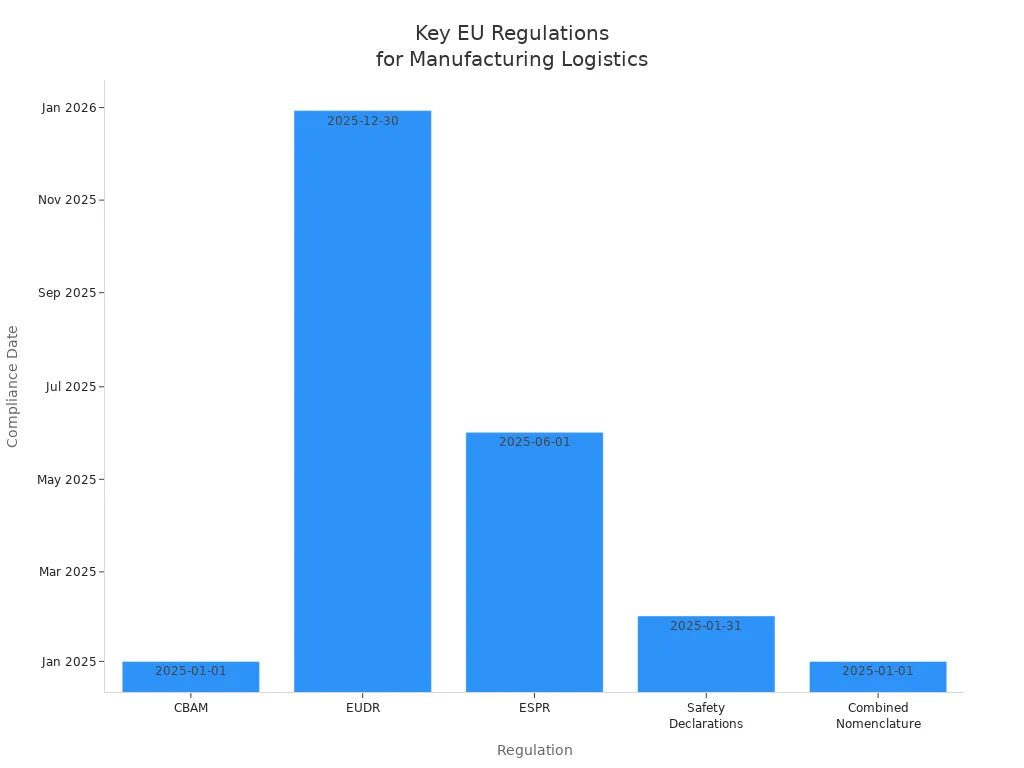
You must follow strict European regulations to keep your supply chain running smoothly. These rules protect the environment, ensure product safety, and support fair trade. If you ignore them, you risk fines and shipment delays. The table below highlights some of the most important regulations that affect your logistics operations:
Regulation | Description | Compliance Date |
|---|---|---|
Carbon Border Adjustment Mechanism (CBAM) | Imposes a price on carbon-intensive imports to the EU. | 1 January 2025 |
European Union Deforestation Regulation (EUDR) | Ensures products do not contribute to deforestation. | 30 December 2025 for large companies |
Ecodesign for Sustainable Products Regulation (ESPR) | Sets ecodesign requirements for physical goods. | First half of 2025 for working plan |
Safety and Security Declarations for EU Imports into the UK | Requires safety declarations for goods imported from the EU. | 31 January 2025 |
European Union Combined Nomenclature | Updates customs classification for goods. | 1 January 2025 |
JUSDA in Europe Market holds certifications like TAPA A, FM Global, and ISO, which show a strong commitment to meeting these regulations. You can trust their expertise to help you stay compliant, especially when handling sensitive goods like lithium-ion batteries. Their specialized storage facilities use advanced fire safety systems, setting a high standard for safety and compliance.
Customs
Customs procedures shape how quickly and efficiently your goods move across borders. You need a partner who understands the Union Customs Code (UCC) and uses digital tools to speed up clearance. JUSDA’s customs expertise in 26 EU countries helps you avoid delays and keep your supply chain efficient.
Aspect | Description |
|---|---|
Union Customs Code (UCC) | Aims to simplify customs processes and enhance compliance. |
Electronic Communication | Promotes digital interactions between customs authorities and traders. |
Risk Management | Improves the assessment of risks associated with customs operations. |
Authorized Economic Operator (AEO) | A quality mark indicating secure and efficient customs controls. |
Centralized Clearance | Allows for customs clearance across the EU, enhancing efficiency. |
Streamlined operations through simplified customs processes.
Enhanced compliance with new regulations.
Greater efficiency and transparency in trade.
Some challenges due to different timelines in each country.
Data Security
You must protect your data to build trust and avoid legal trouble. European laws like the General Data Protection Regulation (GDPR) require you to handle personal data carefully. JUSDA’s ISO 27001 certification shows they take information security seriously.
Data sovereignty laws keep personal data under local protection.
GDPR applies to all companies handling EU residents’ data.
ISO 27001 helps manage and protect sensitive information.
Regular reviews of security policies keep your data safe.
Employees learn to spot and prevent security risks.
Tip: Choose a logistics partner with strong data security standards to protect your business and your customers.
Final Decision
Weigh Options
You need a clear process to compare logistics and supply chain providers. Focus on more than just cost. Reliability, speed, and quality matter most for long-term success. Strong partnerships help you improve processes and reduce costs over time. Use technology to manage routes and inventory efficiently. Regular discussions with your partners help address issues and celebrate wins. Set clear expectations for key performance indicators like on-time delivery and quality.
Method | Description |
|---|---|
Evaluating Partners and Vendors | Focus on reliability, speed, and quality rather than just cost. Strong partnerships can lead to better long-term value. |
Optimizing Route Planning | Use transport software to manage routes efficiently, considering various factors like speed limits and tolls. |
Utilizing Technology | Implement technology for inventory management and compliance to streamline operations and reduce costs. |
Tip: Build strong relationships with your supply chain partners. This approach leads to better results and smoother operations.
Negotiate Contracts
When you negotiate contracts, look at more than price. Check the provider’s experience, financial stability, and track record. Make sure they offer the services and technology you need. Confirm they follow all legal and regulatory requirements. Align your goals with your provider’s objectives. Clearly outline service levels, pricing, and performance metrics. Set up risk-sharing agreements to support a long-term partnership.
Criteria | Description |
|---|---|
Experience | Number of years in the logistics industry. |
Financial Stability | Financial health and stability of the vendor. |
Track Record | Previous successful contracts and client feedback. |
Capability | Range of services and technological expertise. |
Compliance | Adherence to legal and regulatory requirements. |
Note: Effective relationship management starts after signing the contract. Keep communication open and review performance regularly. This practice helps both sides grow and innovate.
Ongoing Evaluation
You must keep evaluating your provider’s performance. Start by assessing and selecting reliable suppliers. Conduct regular audits and compliance checks. Use data-driven strategies to improve quality and readiness. Manage risks and ensure you meet all regulations. Expand your supplier network to stay flexible. Benchmark costs and performance to drive smart decisions.
Audit suppliers and check compliance.
Optimize performance using data.
Manage risks and maintain compliance.
Use global procurement strategies.
Diversify sourcing for flexibility.
Benchmark costs and performance.
JUSDA uses ongoing performance metrics and continuous improvement to deliver customer satisfaction. You can use a checklist to track your provider’s results and ensure they meet your needs.
To select a reliable logistics partner in Europe, follow these steps:
Assess scalability for changing demand.
Consider cost-effectiveness to improve your budget.
Look for value-added services that support your operations.
Check technology for real-time tracking and analytics.
Align your provider’s strengths with your business needs, compliance, and innovation. Strong partnerships built on trust and transparency drive better results. Use this checklist to review your current partners:
Enable data sharing across teams.
Integrate digital tools with partners.
Track performance and reward improvement.
Use technology for smarter decisions.
JUSDA sets a high standard for reliability and advanced solutions. Take time to assess your supply chain partners using these criteria.
FAQ
What should you look for in a logistics partner’s certifications?
You should check for certifications like TAPA A, ISO 9001, and FM Global.
Tip: These show the provider meets high standards for safety, quality, and compliance.
How does real-time tracking help your supply chain?
Real-time tracking lets you see where your goods are at any moment.
You can spot delays fast.
You can update your customers quickly.
Why is network coverage important for your business?
Strong network coverage means your goods move faster and safer across Europe.
Note: Wide coverage helps you avoid delays from local disruptions.
How can you ensure your provider meets European compliance rules?
Ask for proof of compliance, such as certifications and audit reports.
Review their safety records.
Check if they follow GDPR for data protection.
See Also
Mastering Lean Logistics To Achieve Manufacturing Excellence
Enhancing Supply Chain Strategies For High-Tech Manufacturing
Comprehensive Insights Into Leading Global Logistics Firms
Transforming Logistics Through Innovative Supply Chain Practices
Addressing Global Supply Chain Growth Challenges Effectively