Nearshoring and Friendshoring Redefine Global Logistics: Building the Next Generation of Resilient Supply Chains


Nearshoring and friendshoring are reshaping global logistics by driving resilient and agile supply chains. Companies now face shifting tariffs and a digital revolution that demand rapid adaptation. Many organizations have realized measurable gains by embracing these changes:
A technology equipment manufacturer reported a 2% to 3% annual revenue boost and avoided 2% in extra costs.
A chemical company cut warehousing and logistics costs by over 5% and reduced inventory by more than 15%, achieving 15% growth.
A household products company increased net sales by 3% and lowered operational costs by more than 2%.
Statistic Description | Value |
|---|---|
Percentage of US manufacturing executives relocating supply chains to politically aligned countries | |
Estimated annual additional exports for Mexico from nearshoring | US$35 billion |
Foreign Direct Investment (FDI) into Mexico in 1H25 | US$19 billion |
Increase in industrial real estate demand in Northern Mexico in 2024 | 52% |
JUSDA leads supply chain innovation with intelligent solutions for global logistics. Forward-thinking businesses can strengthen their networks by adopting these strategies and digital technologies.
Key Takeaways
Nearshoring and friendshoring help companies reduce costs and improve delivery times by relocating operations closer to customers.
Digital technologies, like JUSDA’s JusLink AI, enhance supply chain visibility and decision-making, allowing businesses to respond quickly to changes.
Diversifying suppliers across friendly nations strengthens supply chains and reduces risks from geopolitical tensions and trade disruptions.
Companies can achieve greater agility and resilience by adopting nearshoring strategies, which allow for faster responses to market demands.
Investing in regional hubs and digital solutions positions organizations to remain competitive in a rapidly changing global market.
Nearshoring and Friendshoring Explained
What Is Nearshoring?
Nearshoring describes the practice of relocating offshored business activities to a nearby foreign country. Companies often choose this strategy to benefit from more accommodating customs procedures and tariffs available under regional free trade agreements. Nearshoring allows organizations to streamline logistics, reduce transportation times, and improve supply chain responsiveness. JUSDA supports nearshoring with its extensive network of warehouses and service points across Asia, North America, and Europe. This global infrastructure enables businesses to optimize inventory management and distribution in regions close to their manufacturing bases.
What Is Friendshoring?
Friendshoring refers to the relocation of supply chain operations to partner nations that share economic or geopolitical ties. Organizations select friendshoring to strengthen relationships with countries that offer political stability and reliable trade partnerships. This approach helps companies mitigate risks associated with global disruptions and regulatory changes. JUSDA’s presence in over 155 service points worldwide provides clients with access to trusted logistics partners in key markets. The company’s collaborative approach ensures secure and efficient movement of goods between allied nations.
Key Differences
Term | Definition |
|---|---|
Nearshoring | Relocating offshored activities to a nearby foreign country. |
Friendshoring | Relocating to a partner nation with economic or geopolitical ties. |
Nearshoring focuses on geographic proximity to improve efficiency and reduce lead times.
Friendshoring emphasizes strategic alliances and political alignment to enhance supply chain security.
JUSDA’s global footprint empowers clients to leverage both strategies. The company’s integrated logistics solutions support businesses seeking agility and resilience in their supply chains.
Drivers of Change in Global Logistics
Tariffs and Trade Uncertainty
Tariffs have become a major force in shaping global supply chains. Companies face higher costs and operational uncertainty when tariffs increase. Many organizations must adjust sourcing strategies, shift production locations, or renegotiate contracts. These changes often disrupt established supplier relationships and require new investments in compliance management.
The study outlines a theoretical framework for understanding how increases in tariffs and uncertainty about tariffs affect importer and exporter behaviors, categorizing costs firms must navigate in response to tariffs.
Tariffs increase the cost of goods, leading to financial and operational uncertainties.
Companies may need to adjust sourcing strategies, shift production, or renegotiate contracts, resulting in delays and higher expenses.
Supplier relationships may be disrupted, requiring investment in compliance.
An estimated 60% of U.S. companies experienced logistics cost increases of 10% to 15% due to tariffs in the past year.
A smartphone manufacturer importing Chinese components now faces a 25% tariff, adding millions to annual production costs.
The 2025 tariff proposals could raise the immediate tariff burden from 2.2% to as high as 17.0%. This shift threatens widespread disruptions across key U.S. industries.
JUSDA’s JusLink AI platform helps companies simulate tariff impacts and coordinate responses across departments. Automated solutions for tariff management improve financial outcomes and operational agility.
Digitalization and Technology Adoption
Digitalization has transformed supply chain operations. Companies now use advanced technologies to gain end-to-end visibility and improve accuracy. Data-driven decision-making allows organizations to respond quickly to market changes.
A recent survey by Eide Bailly indicated that 45% of mid-market manufacturers and distributors have improved their supply chain visibility in the last year. This improvement leads to better planning and faster response times.
Big Data Analytics and Cloud Computing optimize supply chain costs and improve responsiveness. JUSDA’s JusLink AI solution provides real-time monitoring, predictive analytics, and risk management. The platform integrates IoT, cloud computing, and big data to enhance collaboration and transparency.
Geopolitical and Regulatory Shifts
Geopolitical tensions and regulatory changes drive companies to rethink their supply chain strategies. The COVID-19 pandemic and conflicts such as the situation in Ukraine exposed vulnerabilities in global supply chains. Rising labor costs in traditional outsourcing regions have reduced the benefits of offshoring.
Cost factors
Quality control
Intellectual property protection
Customer proximity
Supply chain disruptions
Geopolitical uncertainty
Rising labor costs
Customer expectations
Many organizations now adopt nearshoring and friendshoring to address these challenges. JUSDA’s global network and digital platforms support companies in building resilient supply chains that can adapt to regulatory shifts and geopolitical risks.
Benefits of Nearshoring for Supply Chains
Agility and Shorter Lead Times
Nearshoring brings production closer to end markets. Companies gain the ability to respond quickly to changes in demand and market conditions. Shorter transportation routes reduce delivery times and improve supply chain visibility. High-tech OEMs that move operations to the U.S. or Mexico benefit from faster iteration cycles and stronger intellectual property protection. They also experience improved communication with suppliers and partners.
Case Study | Description |
|---|---|
Nearshoring and Regional Manufacturing | Companies that bring manufacturing closer to their end markets mitigate tariff risks, maintain cost control, and improve adaptability and resilience in a volatile trade environment. AI and automation enhance operational efficiency, shorten lead times, and are more responsive to market demands. |
High-Tech OEMs Reconsidering Offshore Manufacturing | Nearshoring to the U.S. or Mexico allows companies to mitigate tariff risks, shorten lead times, enhance supply chain visibility, improve communication, strengthen IP protection, and accelerate iteration cycles. |
OEM Supply Chain 2025 | A hybrid approach can cut lead times, buffer against disruptions, and optimize costs tailored to specific needs. |
JUSDA’s global warehouse network supports this agility. With facilities in China, Vietnam, the United States, Mexico, and other regions, JUSDA enables businesses to store inventory closer to their customers. The company’s advanced management systems, such as JusLink and eVMI, provide real-time inventory tracking and control. This infrastructure allows organizations to react quickly to market shifts and reduce the risk of stockouts or delays.
Risk Mitigation and Resilience
Nearshoring reduces dependency on distant suppliers. Companies can respond faster to disruptions, such as political instability or natural disasters. Proximity to suppliers and customers minimizes risks from unforeseen events. JUSDA’s technology and network enhance supply chain resilience by providing real-time monitoring and predictive analytics through the JusLink AI platform. This platform helps businesses identify potential risks early and take proactive measures.
JUSDA’s extensive presence across Asia, North America, and Europe allows clients to diversify their supply chains. The company’s warehousing solutions in key markets, including bonded and general storage, support flexible logistics strategies. JUSDA’s JUSDASR service further strengthens resilience by offering cross-border logistics, first-mile, and last-mile delivery, as well as dropshipping capabilities. These services ensure that goods reach their destinations efficiently, even during disruptions.
Sustainability and Regionalization
Nearshoring contributes to sustainability by shortening supply chains. Companies reduce the carbon footprint associated with long-distance shipping. Regional production enhances supply chain resilience and supports sustainable practices. Proximity to markets allows for quicker response to changes in consumer preferences, which reduces waste and inefficiencies.
Sustainability Benefit | Description |
|---|---|
Shorter Supply Chains | Nearshoring reduces the carbon footprint associated with long-distance shipping, contributing to sustainability. |
Supply Chain Resilience | Regional production enhances supply chain resilience, which is crucial for sustainable practices. |
Agility in Response | Proximity to markets allows for quicker response times to changes in consumer preferences, reducing waste and inefficiencies. |
Over 42% of multinational companies now implement nearshoring as part of their strategies, up from 27% in 2022.
Nearshoring enables companies to adapt product offerings quickly in response to market data.
JUSDA’s clean room facilities and compliance with environmental health and safety standards further support sustainability goals. The company’s regional warehouses in Vietnam, the United States, and Mexico help clients reduce transportation distances and environmental impact.
JUSDA’s Warehousing and JUSDASR Solutions
JUSDA’s warehousing solutions provide a foundation for successful nearshoring strategies. The company operates over 2.5 million square meters of warehouse space worldwide, including specialized facilities in China, Vietnam, the United States, and Mexico. JUSDA Vietnam offers general, bonded, and distribution center storage, supported by advanced inventory management systems like JusLink and eVMI. These systems ensure transparency, control, and efficiency in inventory management.
JUSDASR delivers cross-border logistics services tailored for e-commerce merchants and manufacturers. With strategic warehouse locations in the United States, JUSDASR enables quick distribution and cost savings. The service includes dropshipping, first-mile logistics, and last-mile delivery through partnerships with major carriers. JUSDASR supports specialized storage for high-power energy storage products and provides reliable, compliant delivery.
JUSDA’s technology and network empower clients to build resilient, agile, and sustainable supply chains. The integration of real-time data, predictive analytics, and a global logistics network positions JUSDA as a trusted partner for companies pursuing nearshoring strategies.
Friendshoring for Secure Logistics Networks
Supplier Diversification
Supplier diversification stands at the core of friendshoring strategies. Companies now seek to reduce reliance on any single country by expanding their supplier base across multiple friendly nations. This approach helps organizations build more resilient logistics networks and respond quickly to disruptions.
Many corporations diversify suppliers to avoid overdependence on one region.
Major retailers and manufacturers shift sourcing from China to countries like Vietnam and Mexico.
A highly diversified supply chain can halve the GDP impact of a major supplier shutdown, according to IMF research.
36% of shippers embrace friendshoring, while 32% create parallel supply chains to strengthen resilience.
JUSDA’s global network supports this diversification. With warehouses and service points in regions such as Vietnam, Mexico, the United States, and Europe, JUSDA enables clients to access a broad range of suppliers and logistics partners.
Political and Economic Stability
Political and economic stability play a vital role in the success of friendshoring. Reliable supply chains depend on stable environments. Companies must assess political uncertainties and regulatory conditions to minimize risks. Instability can threaten business operations, so evaluating these factors is crucial when choosing friendshoring locations.
Friendshoring marks a strategic shift. Organizations move away from distant or unstable regions to create adaptable supply chains that withstand disruptions. A recent Capgemini survey shows that 73% of global executives expect friendshoring to impact their operations within three years. Experts predict that 38% of manufacturing capacity will shift to geopolitically aligned markets.
JUSDA’s Global Collaboration
JUSDA’s partnerships and global presence demonstrate friendshoring in action. The company collaborates with trusted partners in key markets, ensuring secure and efficient logistics. JUSDA’s network of over 155 service points and extensive warehousing in Asia, North America, and Europe allows clients to build supply chains anchored in stable, friendly regions.
JUSDA’s commitment to innovation and collaboration empowers businesses to navigate global uncertainties and achieve long-term supply chain security.
Overcoming Challenges in Nearshoring and Friendshoring
Cost and Capacity Considerations
Companies face several obstacles when transitioning to nearshoring and friendshoring. Substantial investment costs, extended timelines, and infrastructure deficiencies often slow progress. Labor shortages and higher wages in regions like the United States add complexity. Regulatory and compliance requirements also create hurdles for organizations seeking to relocate operations.
Challenge Type | Description |
|---|---|
Substantial Investment Costs | Upfront capital for new facilities and technology can reach hundreds of millions of dollars. |
Extended Timelines | Projects may require years from planning to production. |
Infrastructure Deficiencies | Limited transportation and energy resources hinder efficiency in some regions. |
Labor Availability and Costs | Skilled labor shortages and higher wages increase operational expenses. |
Regulatory and Compliance Complexities | Navigating local laws and standards can delay implementation. |
Implementation and Change Management
Successful nearshoring and friendshoring require careful planning and execution. Organizations often follow these best practices:
Identify friendly markets using criteria such as political stability and trade agreements.
Diversify operations across multiple allied countries to avoid new bottlenecks.
Digitally enable the transition with AI tools and control towers for real-time monitoring.
Collaborate with governments to access grants and tax incentives.
Localize compliance and culture by investing in local leadership and infrastructure.
These steps help companies accelerate integration and reduce friction during the transition.
Leveraging Technology for Success
Digital solutions play a critical role in overcoming operational challenges. JUSDA’s JusLink AI platform empowers companies to maximize predictive analytics, utilize real-time data, and implement scenario modeling. These capabilities improve demand forecasting, risk detection, and decision-making.
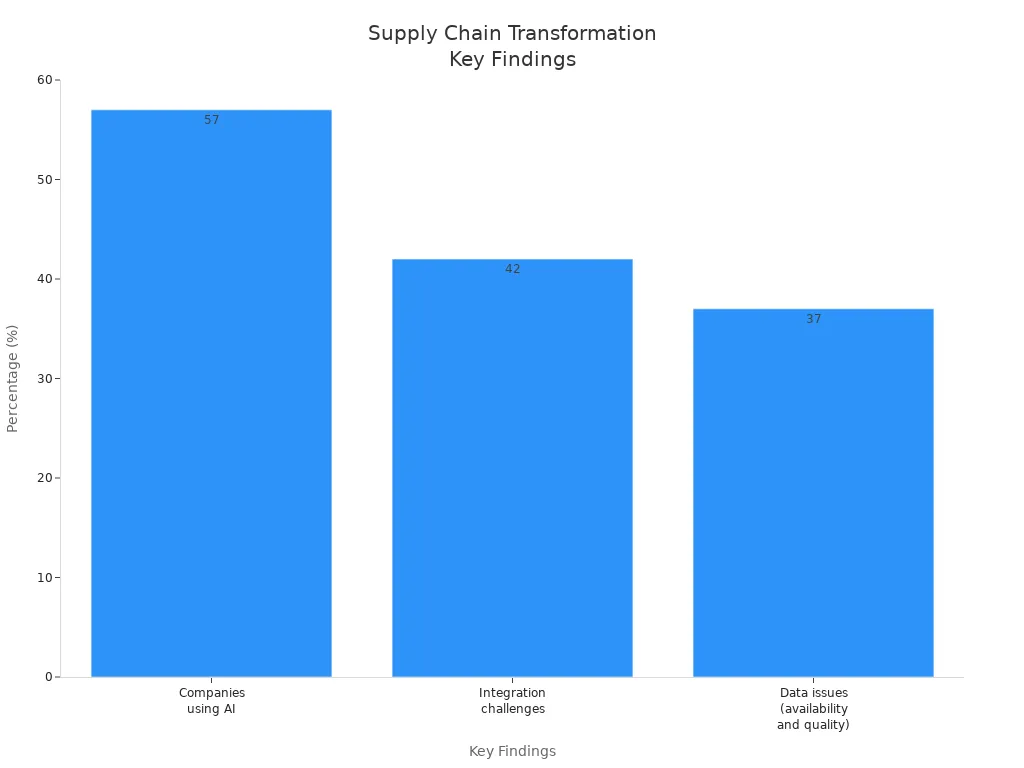
57% of companies use AI in operations to enhance supply chain performance.
Integration challenges affect 42% of organizations.
Data quality and availability remain concerns for 37% of businesses.
JUSDA’s JusLink AI solution improves communication between distribution centers and truck drivers, optimizing space utilization and reducing inefficiencies. Companies gain better visibility, allowing them to respond quickly to disruptions and maintain resilient supply chains.
Steps to Implement Nearshoring and Friendshoring
Assessing Supply Chain Vulnerabilities
Organizations must evaluate their supply chain risks before shifting operations. A structured approach helps identify and address vulnerabilities.
Identify risk using SWOT analysis, FMEA, and ISO 31000 guidelines.
Assess risk by evaluating the likelihood and impact, focusing on supplier-related risks and third-party assurances.
Integrate risk management into overall supply chain strategy, involving cross-functional stakeholders.
Mitigate risk through diversification, redundancy, and strategic partnerships.
Monitor and review supply chain performance, adjusting risk management strategies as needed.
Regular assessment ensures companies remain prepared for disruptions and maintain supply chain stability.
Selecting Strategic Locations
Choosing the right location is critical for successful nearshoring and friendshoring. Companies should consider several criteria:
Criteria | Description |
|---|---|
Cost Efficiency | Shorter shipping distances reduce costs. |
Supply Chain Resilience | Spreading production across nearby countries reduces risks. |
Speed and Agility | Nearshoring allows for quicker market access and faster response to changes. |
Customer Location | Proximity to customers improves delivery times and satisfaction. |
Regulatory Factors | Compliance with local laws and trade agreements influences operational decisions. |
JUSDA’s global warehouse network supports strategic location selection, offering facilities in regions such as China, Vietnam, the United States, and Mexico.
Building Digital-First Operations
Modern supply chains require digital-first operations for efficiency and visibility. Key components include:
Component | Description |
|---|---|
Core Systems | Integration of ERP, WMS, and TMS for seamless operations. |
Automation Platforms | Utilization of AI and machine learning to enhance workflows and processes. |
Data Systems | Implementation of cloud services and business intelligence tools for unified operational visibility. |
Communication & Collaboration | Use of integrated systems to ensure smooth information flow across all levels of the organization. |
Assessment: Evaluate the current state of digital transformation.
Strategy development: Create a strategy based on the assessment.
Implementation: Deploy technologies and transform processes.
Monitoring and optimization: Track performance and make adjustments.
Continuous improvement: Recognize that transformation is ongoing.
JUSDA’s JusLink AI solution provides real-time monitoring, predictive analytics, and risk management, supporting digital-first supply chain operations.
Collaborating with Partners Like JUSDA
Collaboration with experienced partners accelerates the transition to nearshoring and friendshoring. JUSDA offers logistics expertise and supply chain management knowledge, facilitating smoother transitions. Their regional market knowledge helps reduce risks associated with geopolitical tensions. Companies benefit from JUSDA’s extensive network, advanced technology, and strategic alliances, which safeguard against supply chain disruptions.
Working with JUSDA enables organizations to access high-demand products, maintain security in domestic production, and build resilient supply chains.
The Future of Resilient Supply Chains

Trends in Digital Logistics
Supply chains continue to evolve as companies adopt new digital technologies. Artificial intelligence (AI) now plays a key role in controlling data and automating decision-making. Automation streamlines procurement and inventory management, while real-time analytics enable monitoring and control for greater resilience. Sustainability initiatives have become central, with organizations integrating eco-friendly practices and circular supply chains to meet regulatory demands and consumer expectations.
Modern supply chains also benefit from blockchain technology, which enhances trust and reduces fraud risks. Advanced robotics streamline operations and adapt to new tasks. The integration of Internet of Things (IoT) devices provides real-time data, improving visibility and allowing proactive issue resolution. Enhanced supply chain visibility through analytics supports risk management and operational efficiency. Companies increasingly use 3D printing for on-demand production, which reduces lead times and supports agile manufacturing.
Sustainability is now a core part of logistics strategies. Companies focus on reducing emissions and responsible sourcing, aligning with both regulations and consumer preferences.
Strategic Recommendations
Building intelligent, resilient supply chains requires a strategic approach. Organizations should integrate technology such as AI, machine learning, and digital twins for smarter risk prediction and real-time monitoring. Governance alignment ensures that technology supports company policies and resilience goals. Collaboration remains essential, with open data standards and the inclusion of small suppliers in planning.
Recommendation | Description |
|---|---|
Integration of Technology | Use AI, machine learning, and digital twins for risk prediction and monitoring. |
Governance Alignment | Align technology with company policies for effective resilience. |
Collaboration | Adopt open data standards and include small suppliers in planning. |
Organizational Flexibility | Encourage employee participation to improve responsiveness. |
Companies should leverage AI for data analysis and demand forecasting to improve production management. Targeted coordination mechanisms help different supply chain segments work together. Market responsiveness benefits downstream enterprises, while resource integration strengthens upstream operations.
The enhancement of supply chain resilience relies not only on technology but also on collaborative development among all types of enterprises.
Organizations now shift towards friendshoring and nearshoring to reduce risks from geopolitical tensions and trade disruptions. Diversifying suppliers and localizing operations increases stability and prepares supply chains for future challenges.
Nearshoring and friendshoring continue to redefine global logistics by building resilient supply chains. Companies invest in regional hubs to reduce long-distance dependencies and improve supply security. Digitalization automates processes and enhances visibility, while supplier diversity and strategic partnerships ensure steady product flow. JUSDA demonstrates a commitment to innovation and global supply chain excellence. Organizations should evaluate their logistics strategies to remain agile and competitive in a changing market.
Nearshoring reduces transportation costs and delivery times.
Digitalization and strong supplier relationships drive supply chain excellence.

JUSDA Solutions
To provide you with professional solutions and quotations.
FAQ
What is nearshoring, and how does JUSDA support it?
Nearshoring means moving business operations to a nearby country. JUSDA supports nearshoring with a global warehouse network, advanced inventory management systems, and regional expertise. This approach helps companies reduce lead times and improve supply chain responsiveness.
How does JUSDA’s JusLink AI solution enhance supply chain resilience?
JusLink AI provides real-time monitoring, predictive analytics, and risk management. Companies use these features to identify risks early, optimize inventory, and make data-driven decisions. JusLink AI integrates IoT, cloud computing, and big data for better collaboration and transparency.
What industries benefit from JUSDA’s supply chain solutions?
JUSDA serves industries such as electronic manufacturing, automotive, FMCG, new energy, medical health, heavy equipment, and bulk materials. The company tailors its logistics and supply chain services to meet the unique needs of each sector.
What value-added services does JUSDA’s warehousing offer?
JUSDA’s warehousing provides picking, packing, labeling, kitting, repacking, and software upgrades. The company uses advanced systems like eVMI and JusLink for real-time inventory tracking, ensuring transparency and control for clients.
How does JUSDASR help with cross-border logistics?
JUSDASR offers cross-border logistics solutions, including warehousing, first-mile logistics, and last-mile delivery. The service features strategic warehouse locations, dropshipping, and partnerships with major carriers for efficient and reliable delivery.
See Also
Transforming Supply Chain Management With Cloud Technology
Innovative Supply Chain Solutions Transforming Logistics Today
The Future of Logistics: AI in Supply Chain Management
Addressing Global Supply Chain Growth Challenges Effectively