Partnerships as the way forward for air cargo in a changing world


Global disruptions continue to reshape air cargo operations. Companies face surging demand, fluctuating volumes, and new market pressures.
Year-to-date air cargo volumes are about 12% higher than last year.
Asia-Pacific airlines recorded an 8.3% increase in demand in May.
E-commerce and supply chain disruptions drive the need for faster, smarter logistics.
A recent industry report shows that dedicated freighter routes now link major manufacturing hubs to consumption centers. The cold chain segment may reach USD 65 billion by 2035, fueled by biotech and pharmaceutical needs. Strategic partnerships and technology adoption empower companies to meet these challenges, unlocking efficiency and resilience in a rapidly changing world.
Key Takeaways
Strategic partnerships are essential for air cargo companies to adapt to global disruptions and meet rising customer demands.
Collaboration allows companies to expand their networks, share resources, and improve operational efficiency, leading to cost savings and better service.
Compliance with international regulations is crucial; partnerships can help navigate complex rules and avoid costly mistakes.
Investing in technology, such as AI and smart warehousing, enhances visibility and efficiency in air cargo operations.
Building trust and open communication with partners fosters long-term relationships that drive success in the air cargo industry.
Air cargo industry shifts
Trade and regulatory changes
Global trade and regulatory policies continue to shape the air cargo industry. Companies face new rules such as changes to the de minimis threshold, which have led to falling shipment volumes and excess capacity. Logistics providers must now meet stricter international data requirements, increasing the complexity of compliance. Trade wars and tariffs raise costs and shift manufacturing hubs, which alters freight routes. Regional conflicts and military tensions restrict airspace and drive up fuel costs, making cargo flights more expensive. Sanctions and export controls limit the movement of certain goods, disrupting schedules.
U.S. Customs and Border Protection enforces compliance more strictly, impacting operational efficiency. Companies must focus on risk assessment and implement strong internal compliance programs to avoid illicit conduct.
Supply chain disruptions
Supply chain disruptions have become a standard occurrence in the air cargo sector. Organizations must use both short-term emergency actions and long-term resilience strategies to maintain continuity. Survey results show that supply chain disruptions are the top strategic concern for logistics and procurement executives worldwide.
Global supply chain risks reduce inventory efficiency.
Air transport offers unique strategies for mitigating disruptions, such as modal flexibility.
Traditional tendering approaches are becoming obsolete due to volatility in the freight landscape.
E-commerce growth
E-commerce continues to drive demand for air cargo services. The global e-commerce market is expected to exceed $8.09 trillion by 2027, growing at an average rate of 7.2% per year. Cross-border e-commerce logistics reached $97.85 billion in 2023, with a projected growth rate of 25.4% from 2024 to 2030.
"E-commerce is reshaping the air cargo sector into a more time-critical, high-frequency, and technology-driven business. It is not only adding to overall cargo volumes but also changing the very nature of how airlines, airports, and logistics providers operate."
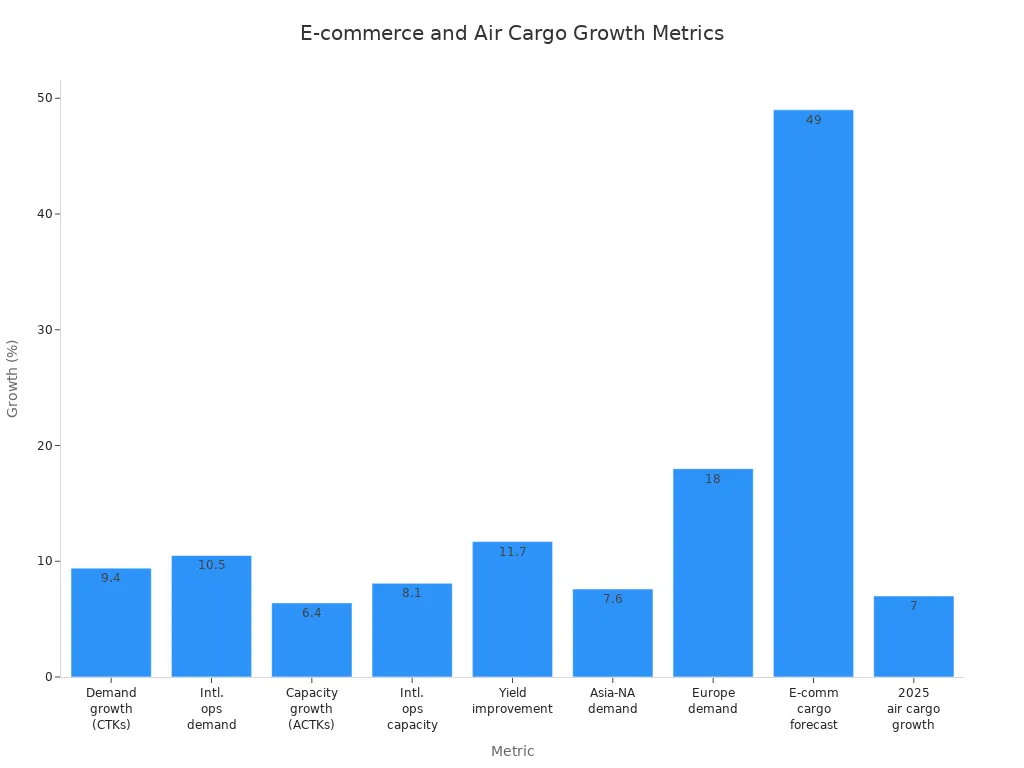
Metric | Value |
|---|---|
Demand growth (CTKs) | 9.4% increase in September 2024 compared to September 2023 |
International operations demand growth | 10.5% increase |
Capacity growth (ACTKs) | 6.4% increase |
International operations capacity growth | 8.1% increase |
Yield improvement | 11.7% on 2023, 50% above 2019 |
Asia-North America demand growth | 7.6% increase |
Europe demand growth | 18% increase |
E-commerce cargo volume growth forecast | 49% increase |
Expected air cargo growth in 2025 | 7% increase |
The power of partnerships
Strategic partnerships have become a cornerstone for success in the air cargo industry. Companies now rely on alliances to overcome challenges, improve efficiency, and create new opportunities. These partnerships help organizations adapt to rapid changes and meet growing customer expectations.
Expanding network reach
Partnerships allow companies to extend their global reach and connect with new markets. When two or more organizations work together, they can combine their strengths and resources. This approach helps them serve more customers and offer better services.
Qatar Airways and Cainiao formed a partnership to boost global connectivity and capacity for air cargo.
Their collaboration enabled Cainiao to double its weekly charter flights on important routes, which improved service flexibility.
This alliance meets the rising demand for fast and reliable international logistics, especially in e-commerce.
JUSDA also demonstrates the value of network expansion. With over 155 service points worldwide and a warehouse area exceeding 2.5 million square meters, JUSDA supports clients across multiple regions. Its partnerships help customers access efficient logistics solutions in Asia, North America, Europe, and beyond.
Sharing resources
Resource sharing is another key benefit of partnerships in air cargo. Companies can pool their assets, technology, and expertise to achieve common goals. This cooperation leads to cost savings, better service quality, and increased innovation.
SHEIN and Lufthansa Cargo work together to use sustainable aviation fuel (SAF), which improves air cargo performance.
Both companies share data and collaborate to boost operational efficiency and environmental results.
Their agreement includes SAF-based offsetting solutions and highlights the importance of joint learning and shared methods for sustainability.
JUSDA’s partnerships with industry leaders show how resource sharing works in practice. By integrating advanced management systems like JusLink and eVMI, JUSDA enables real-time inventory tracking and transparency. Clients benefit from value-added services such as picking, packing, and labeling, which streamline operations and reduce costs.
Navigating compliance
Compliance with international regulations remains a major challenge for air cargo companies. Partnerships help organizations manage complex rules and avoid costly mistakes. Working with experienced partners provides access to specialized knowledge and tailored solutions.
Cotton On partnered with an integrated logistics provider to gain visibility throughout the supply chain, which is vital for managing compliance.
Tailored solutions allowed better planning for cargo deliveries and helped navigate compliance limitations.
Air freight partnerships enabled quick responses to market demands, ensuring compliance with time-sensitive regulations.
JUSDA supports clients in navigating compliance by offering comprehensive foreign trade services, customs clearance, and trade compliance support. Its multilingual teams and close relationships with customs authorities help businesses meet regulatory requirements in different regions.
Partnerships in air cargo create a foundation for growth, resilience, and innovation. Companies that collaborate can expand their networks, share valuable resources, and navigate the complex world of compliance with greater confidence.
Technology and digital transformation
AI and real-time data
Artificial intelligence is changing how companies manage air cargo logistics. AI algorithms analyze historical shipping data to forecast cargo volumes. This helps companies plan capacity and manage rates. AI systems also use real-time data to recommend efficient flight paths, which reduces fuel use and operational costs. Many organizations automate routine tasks and optimize workflows with AI, improving efficiency by up to 20%. IoT sensors powered by AI provide real-time tracking, increasing accuracy compared to traditional methods. These technologies help companies reduce errors and speed up cargo processing.
AI-driven route optimization can lower fuel consumption and decrease flight delays. Companies use AI to inspect and categorize cargo, which improves handling and tracking.
Smart warehousing
Smart warehousing uses advanced technology to streamline operations and improve security. Predictive analytics help forecast cargo demand and optimize flight schedules. Blockchain technology creates secure records for shipment tracking and regulatory compliance. Real-time monitoring systems detect delays or temperature changes early, protecting sensitive goods. Automated billing platforms reduce manual errors and improve financial management. JUSDA’s warehouses use systems like eVMI and JusLink for real-time inventory tracking. These tools give clients transparency and control over their inventory.
Smart Warehousing Features | Benefits |
|---|---|
Predictive analytics | Better scheduling |
Blockchain tracking | Secure compliance |
Real-time monitoring | Early problem detection |
Automated billing | Fewer errors |
JUSDA’s digital solutions
JUSDA leads digital transformation in air cargo partnerships. The JusLink AI solution provides supply chain trend analysis, freight rate prediction, and sales demand forecasting. JusLink’s risk control tower monitors risks in real time and sends early warnings. The intelligent supply chain assistant, JusElsa, uses natural language processing to help users interact with the system. These digital tools empower companies with visibility, efficiency, and risk management. JUSDA’s platform integrates IoT, cloud computing, and big data, allowing clients to monitor every part of their supply chain.
Digital transformation improves operational efficiency, transparency, and compliance. Early adopters gain a competitive edge by building resilient and efficient operations.
Real-world partnership examples
Global air cargo alliances
Global alliances in the air cargo sector show how collaboration drives efficiency and market expansion. Companies like Qatar Airways Cargo and Cainiao have doubled weekly charter flights on key trade routes. This move improves delivery speed for cross-border e-commerce and gives shippers more flexibility. Atlas Air and Etihad Cargo work together to expand their reach and offer specialized services. Korean Air partners with Swissport to invest in modern cargo terminals and advanced tracking technology. These partnerships help businesses connect to global markets and handle increased volumes.
Strategic expansion and investment in infrastructure allow companies to scale up and improve service quality. Technology adoption streamlines operations and boosts reliability for global businesses.
Partnership | Impact on Operations | Market Expansion |
|---|---|---|
Qatar Airways & Cainiao | Faster delivery, more flights | Supports Chinese exporters in Europe |
Atlas Air & Etihad Cargo | Specialized services | Wider global reach |
Korean Air & Swissport | Modern terminals, tracking | Connects to new markets |
JUSDA and automotive logistics
JUSDA’s JusLink solution provides real-time monitoring and risk management. This approach helps companies respond quickly to market changes and maintain just-in-time production. The partnership supports Chinese automotive exporters as they expand into Southeast Asia and other regions.
JUSDA’s lean supply chain management reduces costs and improves efficiency.
Digital tools enable dynamic management and full visibility across global supply chains.
Collaboration fosters innovation and sustainable growth in the automotive industry.
E-commerce and cross-border logistics
Partnerships play a vital role in e-commerce and cross-border logistics. JUSDA’s JUSDASR service empowers merchants with efficient warehousing and last-mile delivery. Strategic warehouse locations near major ports and airports in the US enable quick distribution. Direct accounts with FedEx and UPS ensure reliable delivery for global customers.
Partnerships leverage complementary strengths to enhance global e-commerce logistics.
Service quality and delivery times improve, which is critical for air cargo’s role in e-commerce.
Connectivity and reliability increase for businesses and consumers worldwide.
Cainiao’s e-commerce insights combined with Qatar Airways Cargo’s global network stimulate economic growth and support international expansion.
Building effective partnerships
Identifying the right partners
Selecting the right partners forms the foundation of successful air cargo collaborations. Companies look for partners with a strong global network, reliable shipping services, and advanced technology. Compliance with regulations also plays a key role in avoiding legal issues and fines. The following table outlines the most effective criteria for partner selection:
Criteria | Description |
|---|---|
Worldwide Reach | A strong global network is essential for delivering goods to various markets effectively. |
Reliable Global Shipping Services | Trustworthiness is crucial to avoid negative impacts on the business's financial performance. |
Compliance with Regulations | Adhering to shipping rules and customs requirements is vital to avoid legal issues and fines. |
Technology and Tracking | Access to the latest technology enhances efficiency and improves overall logistics processes. |
JUSDA demonstrates these qualities through its extensive global network, advanced digital solutions, and commitment to regulatory compliance.
Trust and communication
Trust and communication drive the success of air cargo partnerships. Companies build trust over time by maintaining strong relationships and sharing information openly. Trust-based governance reduces negotiation costs and minimizes conflict. Partners who believe in the continuity of their relationship cooperate more effectively and share information freely.
Trust increases with the duration of the relationship.
Beliefs about the continuity of the relationship are essential for trust formation.
Trust-based governance leads to reduced negotiation costs, minimized conflict, enhanced information sharing, and improved cooperation.
JUSDA fosters trust by integrating transparent systems like JusLink and eVMI, which enable real-time data sharing and collaboration.
Measuring success
Measuring partnership success helps companies improve performance and maintain strong relationships. Key metrics include on-time performance, cargo utilization, documentation accuracy, and customer satisfaction. The table below highlights common metrics used in the air cargo industry:
Metric | Description |
|---|---|
On-Time Performance (OTP) | Measures if shipments depart and arrive as scheduled. Delays impact customer trust and supply chains. |
Cargo Uplift & Load Factor | Tracks how much available space is actually used. Higher utilization leads to better revenue. |
Documentation Accuracy | Reflects operational discipline; errors can delay clearance. |
Cargo Damage / Claims Ratio | Percentage of shipments reported as damaged or lost, tied to service quality. |
Handling Time (TAT) | Time taken from cargo acceptance to delivery; faster TAT provides a competitive advantage. |
Revenue per Kilo / Yield | Measures profitability of each shipment, crucial for balancing costs with demand. |
Customer Satisfaction (NPS) | Customer feedback reveals service gaps and relationship strength. |
JUSDA uses these metrics to monitor performance, optimize operations, and strengthen partnerships across its global network.
Action steps for air cargo stakeholders
Initiating collaboration
Stakeholders in the air cargo industry begin successful partnerships by identifying mutual goals and selecting partners with proven expertise. Companies often look for organizations with strong global networks and advanced digital solutions. They prioritize partners who understand local markets and possess experience in aerospace logistics. Collaboration starts with open communication and clear expectations. Stakeholders use digital platforms like JusLink to share real-time data and coordinate shipments. This approach builds trust and sets the foundation for long-term cooperation.
Tip: Companies should establish transparent processes and leverage technology to streamline initial collaboration steps.
Overcoming barriers
Barriers to partnership can slow progress and reduce efficiency. Air cargo stakeholders overcome these challenges by adopting several effective strategies:
Partner with global aerospace logistics providers who understand local regulations.
Leverage industry clusters to navigate new market rules.
Utilize real-time tracking systems and GPS tools for optimized routing.
Collaborate with third-party logistics providers for expert route planning.
Invest in advanced security measures, including cargo insurance and safety protocols.
Rely on experienced customs brokers to manage trade barriers and customs regulations.
Use currency hedging tools and negotiate contracts in a single currency to reduce currency risks.
JUSDA supports these efforts by offering comprehensive foreign trade services, customs clearance, and advanced inventory management systems. These solutions help companies address regulatory, operational, and financial challenges.
Ensuring resilience
Resilience remains a top priority for air cargo stakeholders. The IATA highlights the importance of safety, security, digitalization, and sustainability in maintaining global supply chain strength. Companies build resilience by forming close, long-lasting relationships with operator partners. These partnerships allow organizations to share advantages with customers and adapt quickly to disruptions. JUSDA’s approach includes dual sourcing, building localized supplier bases, and ensuring real-time shipment visibility. Support from freight partners helps maintain precise delivery schedules and enhances overall supply chain stability.
Note: Continuous investment in technology and strong partnerships ensures that companies can respond to market changes and maintain reliable operations.
Partnerships and technology shape the future of air cargo. Companies now use real-time dashboards, AI, and data analytics to improve communication and efficiency.
IT service providers help airlines and freight forwarders make better decisions.
Real-time data from IoT sensors gives faster responses to customer needs.
Trend | Impact on Air Cargo Partnerships |
|---|---|
E-commerce growth | Drives demand for quick delivery |
Changing trade agreements | Requires flexible supply chains |
Focus on resilience | Strengthens supply chain continuity |
Stakeholders should build strong alliances and invest in digital tools. Adaptability and innovation will remain essential as the industry evolves.
FAQ
What industries does JUSDA support with air cargo partnerships?
JUSDA serves electronic manufacturing, automotive, FMCG, new energy, medical health, heavy equipment, and bulk materials. The company tailors supply chain solutions to meet the unique needs of each industry.
How does JUSDA’s JusLink AI solution improve supply chain visibility?
JusLink uses AI, IoT, and big data to provide real-time monitoring, trend analysis, and risk alerts. Clients gain full visibility across all supply chain nodes, which helps them manage inventory and respond to disruptions quickly.
What compliance support does JUSDA offer for international air cargo?
JUSDA provides comprehensive foreign trade services, customs clearance, and trade compliance support. Multilingual teams and strong relationships with customs authorities help businesses meet regulatory requirements in different regions.
What value-added services do JUSDA’s warehouses provide?
JUSDA’s warehouses offer picking, packing, labeling, kitting, repacking, and software upgrades. Advanced systems like eVMI and JusLink enable real-time inventory tracking and control, which improves transparency and efficiency.
See Also
Navigating Tomorrow's Logistics Through Digital Innovations
Transforming Future Logistics with Artificial Intelligence
Exploring Innovations in Sea Freight Logistics for 2024
Revealing New Strategies for Cross-Border Supplier Connections
Addressing Global Supply Chain Growth Challenges Effectively