From Fragility to Flexibility: How 2025’s Semiconductor Supply Chain is Powering a Resilient AI Future

The semiconductor supply chain in 2025 demonstrates remarkable growth and adaptability, with global sales expected to hit $637 billion and a projected industry value of $697 billion. Rapid advances in generative AI chips drive this expansion, while businesses seek resilience and flexibility to meet new challenges. Solutions like JUSDA’s JusLink platform deliver real-time updates, smart inventory control, and full process visibility. Companies now rely on intelligent risk management to safeguard operations and ensure compliance, making the supply chain;semiconductor ecosystem stronger and more responsive than ever.
Key Takeaways
The semiconductor supply chain is evolving rapidly, with a focus on flexibility and resilience to meet new challenges.
Companies are adopting geographic diversification to reduce risks from geopolitical tensions and localized disruptions.
AI and digital transformation tools, like JUSDA’s JusLink platform, enhance real-time visibility and risk management in supply chains.
Investing in workforce development is crucial to address the projected shortage of skilled professionals in the semiconductor industry.
Sustainability initiatives are becoming essential, with companies prioritizing ethical sourcing and reducing their environmental impact.
Semiconductor Supply Chain Evolution

2025 Transformation
The semiconductor supply chain in 2025 stands at a turning point. Companies have shifted their strategies to address new risks and opportunities. The industry now faces increased geopolitical pressures, with tariffs and territorialism shaping business decisions. Executives have responded by prioritizing geographic diversity and resiliency. They recognize the need to adapt quickly to disruptions and new competitors.
A clear overview of these changes appears in the following table:
Key Change | Description |
|---|---|
Geopolitical Impact | Territorialism and tariffs are now major concerns, especially for large companies. |
Supply Chain Resiliency | Increasing geographic diversity is prioritized to enhance resilience against disruptions. |
New Competition | A significant rise in concern over new competitors entering the semiconductor market. |
Talent Risk | Continues to be a top issue, tied with tariffs, affecting industry growth. |
Inventory Management | Executives are more optimistic about balancing supply and demand due to emerging technologies. |
Companies now face significant tariff announcements that may disrupt the supply chain. For example, a 25% tariff on Canada and Mexico and a 10% tariff on China have raised concerns among chip companies about the global impact. To address these risks, leaders have adopted new inventory strategies. The industry is moving from just-in-time inventory to buffered inventory models. This shift helps companies remain flexible and reduces vulnerabilities.
Digital transformation plays a central role in this evolution. Tools such as lead time analysis and availability snapshots support better planning and transparency. JUSDA’s JusLink platform exemplifies this shift. It provides real-time updates, smart inventory control, and full process visibility. These features help companies manage risks and maintain efficiency across the global supply chain.
Technological advancements also drive the 2025 transformation. The industry has seen rapid progress in several areas:
Artificial intelligence in high-bandwidth memory supports real-time processing for complex applications.
Advanced packaging technologies, such as chip-on-wafer-on-substrate, maintain performance as traditional scaling approaches reach their limits.
Efficient power components, including silicon carbide and gallium nitride, meet the growing needs of AI in data centers.
Sustainability in manufacturing has become a priority, with innovations aimed at reducing carbon footprints.
Leaders now view supply chain flexibility as a top strategic priority. Digital transformation and generative AI implementation are critical for future growth. Generative AI chip development is outperforming the broader industry, setting new standards for performance and efficiency.
AI Demands
Artificial intelligence has become a driving force in the semiconductor supply chain. Companies must meet the demands of AI applications, which require high-performance chips and reliable logistics. The need for energy-efficient chip designs has grown, supporting the rapid expansion of AI workloads.
One of the largest makers of chips adopted AI in its risk management, and it was able to anticipate and address the consequences of one of its principal suppliers going down during the pandemic.
AI-driven requirements have transformed supply chain management. Companies like Intel use AI to anticipate demand shifts. This approach reduces overstocking and shortages, which can stall production cycles. AI enhances demand forecasting and optimizes logistics, making the supply chain more responsive.
JUSDA’s JusLink platform leverages AI, IoT, and big data to deliver real-time visibility and intelligent risk management. These capabilities help companies respond quickly to changes in demand and supply. The platform’s smart replenishment and risk control features ensure that inventory levels match market needs.
The semiconductor industry now uses buffered inventory strategies to enhance flexibility. Lead time analysis and availability snapshots provide better planning and transparency. These tools support the growing complexity of AI-driven supply chains.
Recent Disruptions
Vulnerabilities Exposed
Recent years have revealed critical weaknesses in the global supply chain for semiconductors. Several factors have contributed to these vulnerabilities:
Investments in U.S. semiconductor manufacturing remain insufficient, leaving the country dependent on foreign production, especially from China.
China continues to invest heavily in foundational chip production, increasing risks for U.S. manufacturers.
The U.S. must develop a comprehensive strategy to boost domestic production of foundational semiconductors to address these risks.
Disruptions have led to significant backlogs and delays across industries. The following table highlights how different scenarios have impacted production and delivery timelines:
Scenario | Description | Impact on Backlog |
|---|---|---|
1 | Plant shutdowns lead to backlog increase in automotive plants. | Significant backlog increase due to chip scarcity. |
2 | Restoration of automotive production reduces backlog. | Backlog builds again due to high demand for electronics chips. |
3 | Changing product mix towards high-end models. | Lower backlog for automotive, but increases for other sectors. |
4 | Restoration of production across sectors with additional chip capacity. | Backlog reduced for all sectors. |
These disruptions have shown that a single point of failure can ripple through the entire supply chain, affecting multiple industries.
Lessons Learned
Industry leaders have gained valuable insights from recent disruptions. The table below summarizes key lessons:
Lesson | Description |
|---|---|
Nature of Supply-Driven Shortages | Supply-driven shortages can result from manufacturing disruptions, geopolitical forces, or natural disasters. |
Importance of Strategic Resilience | Companies must build resilience into their supply chains to better navigate future disruptions. |
Additional takeaways include:
Major supply chain disruptions do not have quick fixes, highlighting the complexity of the semiconductor industry.
Future disruptions remain likely, as many products depend on shared manufacturing capacities.
Executives now recognize the growing threat of climate change and extreme weather events. Over half of surveyed CEOs and senior decision-makers identified these environmental factors as major risks to operational continuity. Companies must prioritize resilience and adaptability to secure their position in the evolving semiconductor landscape.
Diversification Strategies
Geographic Spread
Geographic diversification has become a cornerstone for building resilient semiconductor supply chains. Companies now distribute their manufacturing and sourcing activities across multiple regions. This approach helps reduce the risk of localized disruptions, such as natural disasters or political instability, affecting the entire operation. By spreading production facilities globally, organizations can ensure that a single event does not halt their output.
Many leading semiconductor manufacturers have adopted friend-shoring strategies. They align their operations with allied nations to avoid geopolitical risks. For example, TSMC has expanded its presence in Arizona and Europe, while SMIC has established foundries in Vietnam, Malaysia, and Germany. These moves reflect a broader industry trend toward restructuring operations to withstand export controls and global tensions.
Geographic diversification helps companies mitigate risks from localized disruptions. By spreading production across various regions, they reduce the chances of multiple sites being affected at the same time.
This shift not only enhances resilience but also supports compliance with regional regulations. Companies can adapt more quickly to changing trade policies and market demands.
Technology Approaches
Technology-driven diversification strategies play a vital role in strengthening the semiconductor supply chain. Organizations invest in new technologies to create more robust and flexible frameworks. The adoption of digital twin technology allows companies to simulate different scenarios and identify vulnerabilities before they become critical issues.
A variety of approaches are shaping the industry:
Approach | Current Status | Expected Change |
|---|---|---|
Domestic Sourcing | 40% | 47% |
Nearshoring | N/A | +4% |
US Investments | 59% | 74% |
Supplier Base Diversification | N/A | 74% exploring |
Companies also focus on diversifying their supplier base. By sourcing critical materials from multiple vendors, they reduce dependence on any single supplier. This strategy is especially important as 67% of semiconductor supply chains face challenges due to limited availability of essential materials. Digital transformation platforms, such as JUSDA’s JusLink, support these efforts by providing real-time visibility and intelligent risk management.
For example, TSMC, Robert Bosch, Infineon, and NXP Semiconductors have formed a joint venture in Germany. This partnership aims to provide advanced semiconductor manufacturing services within the European Union, further strengthening regional supply chain resilience.
Stockpiling rare inputs, establishing backup suppliers, and modularizing production capacity are additional strategies that companies use to build resilience. These measures ensure continuity even during unexpected disruptions.
Talent Pool
The evolution of the global talent pool is crucial for the semiconductor industry’s future. Explosive demand for technologies like AI and IoT has intensified the need for skilled professionals. Companies face a projected shortage of over one million engineers worldwide by 2030. The demand extends to technicians, skilled tradespeople, and leadership roles.
Role Type | Projected Shortage by 2030 | Skills Required |
|---|---|---|
Engineers | Over 1 million globally | Electrical, Design, Process, Test, Materials Science, Embedded Software, etc. |
Technicians | 39% in the U.S. | Fabrication Line Operators, Maintenance Technicians |
Skilled Tradespeople | N/A | Electricians, Pipefitters, Welders, Carpenters |
Leadership Roles | N/A | Second-line and third-line leaders |
Digital Skills | N/A | Cloud computing, AI, analytics, robotics, data analytics |
Several factors contribute to this talent gap. Geopolitical initiatives are reshoring semiconductor manufacturing, which increases the need for local skilled labor. An aging workforce leads to a significant gap as many employees approach retirement. Rapid technological change requires new skills that traditional education systems struggle to provide. Competition from other technology sectors further complicates recruitment.
To address these challenges, companies invest in workforce development and training programs. They also seek partnerships with educational institutions to build a pipeline of talent equipped with digital and technical skills. This focus on talent ensures that the supply chain; semiconductor ecosystem remains innovative and resilient in the face of ongoing change.
Digital Supply Chain Transformation

AI and Automation
AI and automation have become essential in the digital transformation of the supply chain; semiconductor industry. Companies now use AI systems to oversee manufacturing workflows and make real-time adjustments. These systems help boost operational efficiency and reduce costs. Predictive maintenance, powered by AI, uses sensor data to forecast equipment failures and schedule timely repairs. This approach minimizes downtime and keeps production lines running smoothly.
JUSDA’s JusLink platform stands out as a leader in this space. The platform offers scalable and customizable tools for semiconductor companies. It automates quality inspection and supply chain management, streamlining the entire manufacturing value chain. JusLink’s intelligent replenishment system adjusts inventory dynamically based on real-time data, ensuring timely restocking and cost savings. These features help companies respond quickly to market demand and maintain balanced inventory levels.
Real-Time Visibility
Real-time visibility is a cornerstone of modern supply chain management. Organizations rely on up-to-date knowledge about inventory and operations to improve performance and reduce errors. JusLink enhances visibility by providing real-time data on inventory, shipments, and supply chain risks. The platform’s Control Tower Intelligent Risk Management system integrates external data sources to identify potential disruptions, enabling proactive measures.
Recent surveys show that 93% of companies using supply chain technologies report improved efficiency and cost reduction. Many organizations now use predictive analytics and AI to make strategic decisions. JusLink’s unified interface fosters collaboration among stakeholders, improving communication and shared goals. Companies investing in real-time tracking technologies gain operational resilience and a competitive edge.
JUSDA’s advanced warehouse solutions further support digital transformation. These solutions use IoT and big data to provide real-time inventory tracking and control. This transparency helps companies optimize logistics, reduce costs, and ensure product quality.
Risk Management
Predictive Analytics
Risk management in the semiconductor supply chain relies on predictive analytics to anticipate and address potential disruptions. Companies use advanced tools to monitor trends, forecast demand, and identify vulnerabilities before they escalate. These solutions help organizations make informed decisions and maintain operational stability.
Some of the most effective predictive analytics tools include:
Supply Wisdom: Delivers real-time intelligence, AI-driven risk alerts, and continuous supplier monitoring.
IBM Watson Supply Chain: Uses artificial intelligence to predict and mitigate supply chain disruptions.
SAP Integrated Business Planning: Offers predictive modeling and forecasting for inventory and demand management.
Tableau & Power BI: Provide data visualization that helps managers analyze trends and predict risks.
Microsoft Azure AI & Google Cloud AI: Offer cloud-based, AI-driven predictive analytics for supply chain optimization.
JUSDA’s JusLink platform also leverages AI and big data to provide real-time visibility and intelligent risk management. These capabilities enable companies to respond quickly to changes and minimize the impact of unexpected events.
Predictive analytics empowers supply chain leaders to stay ahead of risks and maintain business continuity.
Redundancy
Redundancy strategies play a crucial role in strengthening the semiconductor supply chain against disruptions. Organizations implement multiple layers of protection to ensure continuous operations even when challenges arise.
Key redundancy strategies include:
Diversification of Suppliers: Sourcing from multiple suppliers in different regions reduces dependency on any single source.
Multi-Sourcing: Procuring the same components from several suppliers ensures alternatives are available.
Inventory Buffer: Maintaining strategic inventory reserves for critical parts helps absorb shocks.
Alternative Transportation Routes: Using various routes and carriers increases resilience against transport disruptions.
Dual Sourcing: Engaging both primary and backup suppliers for essential components.
Regional Manufacturing Facilities: Establishing production lines in different areas mitigates localized risks.
Supplier Collaboration and Risk Assessment: Working closely with suppliers to identify and address vulnerabilities.
Advanced Technology and Automation: Leveraging technology for better visibility and faster decision-making.
Strategic Partnerships and Alliances: Forming alliances to access additional resources and expertise.
Continuous Monitoring and Scenario Planning: Implementing systems to detect and respond to potential disruptions proactively.
JUSDA’s global network and digital platforms support these redundancy strategies, helping companies build robust and flexible supply chains.
Sustainability
Green Initiatives
Semiconductor supply chain leaders have made sustainability a core priority. They focus on reducing emissions, optimizing resource use, and assessing environmental impact. Companies track progress using clear sustainability metrics:
Emissions reduction
Resource consumption
Environmental impact assessments
Many organizations optimize processes and improve material efficiency. They work to lower emissions, reduce chemical use, and minimize water consumption. The industry also pursues environmental, social, and governance goals to lessen its footprint.
A comparison of successful green initiatives among leading companies appears below:
Company | Initiative | Impact |
|---|---|---|
TSMC | Incorporating green hydrogen, replacing 15% of hydrogen use | Reduced CO₂ emissions by over 20,000 tons annually |
Samsung | Sourcing 10% of hydrogen from renewables, aiming for 50% by 2030 | N/A |
Intel | Partnering with renewable energy providers in Ireland | 12% reduction in emissions in pilot phase |
NVIDIA | Using hydrogen-powered trucks | 30% reduction in transportation emissions |
Renesas Electronics | Utilizing hydrogen fuel cell forklifts | 25% reduction in energy-related emissions |
Companies that adopt these initiatives set new standards for environmental responsibility in the semiconductor sector.
Ethical Sourcing
Ethical sourcing remains a complex challenge in the semiconductor supply chain. Multiple stakeholders play important roles:
Stakeholder | Role in Ethical Sourcing Practices |
|---|---|
Regulators | Enforce compliance and due diligence standards |
Investors | Demand responsible sourcing from companies |
Downstream Customers | Expect transparency and ethical practices in supply chains |
RMI | Provides guidance and tools for due diligence in sourcing |
Many companies meet only minimum reporting standards. Complex supply chains make transparency difficult. A large percentage of companies cannot trace the source of their minerals.
To address these issues, organizations:
Actively source from suppliers with responsible mining practices.
Ensure supply chain transparency to uphold ethical labor standards.
Implement OECD Due Diligence guidance to assess risks.
Ethical sourcing builds trust and supports long-term sustainability in the semiconductor industry.
Investment and Collaboration
Public-Private Efforts
Public and private sectors have joined forces to strengthen the semiconductor supply chain. Major investments support new manufacturing facilities, research, and workforce development. These efforts help create a stable foundation for future growth and innovation.
Investment Source | Amount | Impact |
|---|---|---|
CHIPS and Science Act | Incentives for semiconductor fabs and $13 billion for research and workforce development | |
Department of Commerce Grants | $32.54 billion | Funding for 32 companies across 48 projects |
Intel Grant | Up to $3 billion | Support for the Secure Enclave program for national security microelectronics |
Samsung Electronics | $6.4 billion | New chipmaking campus in Texas |
Polar Semiconductor | $120 million | Doubling U.S. production capacity in Minnesota |
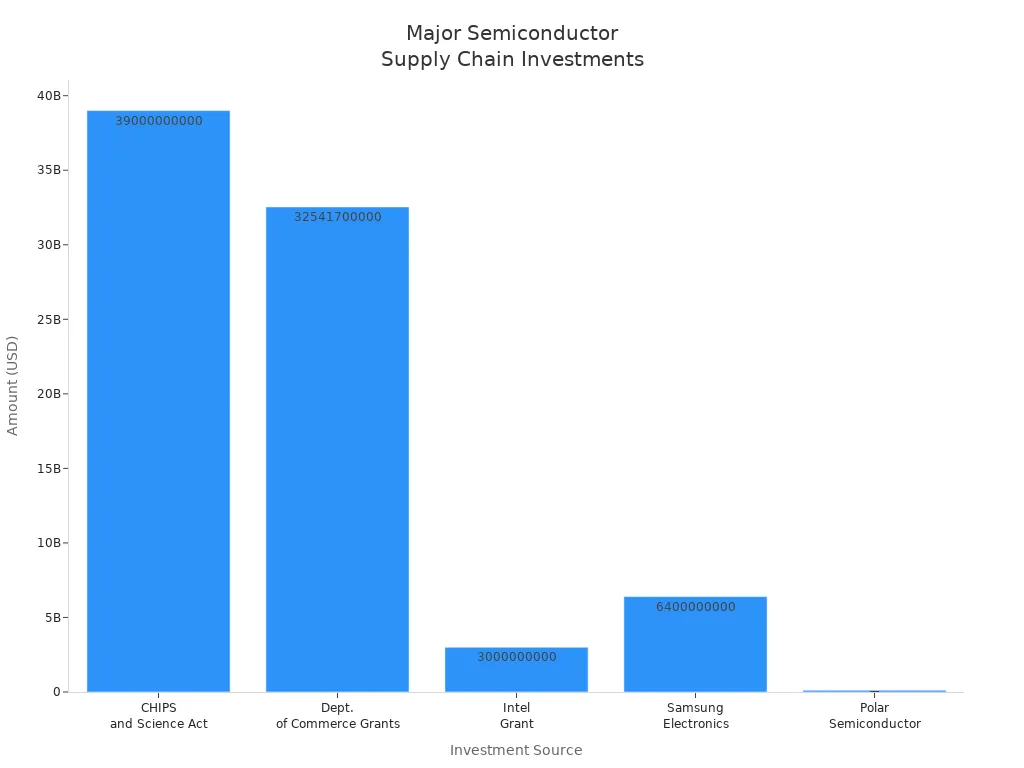
These investments have a broad impact. Over 500,000 American jobs have been created and supported. The semiconductor ecosystem now includes 69,000 facility jobs, 122,000 construction jobs, and 335,000 additional jobs throughout the U.S. economy. This collaboration between government and industry ensures that the supply chain remains robust and adaptable.
Industry Alliances
Industry alliances play a vital role in driving innovation and reducing risks in the semiconductor supply chain. Companies and governments work together to address challenges and share resources.
Investment screening and subsidies help de-risk supply chains.
Collaboration among countries maintains supply chain stability.
Management of dual-use technologies enhances resilience.
Alliances also use advanced technologies like artificial intelligence to improve operational efficiency. Data-driven insights help identify vulnerabilities before disruptions occur. Proactive measures allow companies to find new suppliers or solutions, saving costs and maintaining quality.
Governments manage supply chains through export controls and tariffs. International cooperation helps mitigate risks from geopolitical tensions. Collective action among allies ensures that the semiconductor supply chain remains resilient and secure.
Case Studies: JUSDA and Global Supply Chain Success
Manufacturing Expansion
JUSDA has played a vital role in supporting global manufacturers as they expand operations across borders. The company’s extensive network includes over 155 service points and more than 2.5 million square meters of warehouse space worldwide. Manufacturers relocating production to Southeast Asia and other regions have relied on JUSDA’s advanced warehousing and logistics solutions. These services include general storage, bonded warehouses, and finished goods distribution centers. JUSDA’s warehouse management systems, such as eVMI and JusLink, provide real-time inventory tracking and transparency. This approach reduces manual handling and improves efficiency for manufacturers facing complex international supply chains.
A leading Chinese manufacturer, for example, partnered with JUSDA to overcome challenges in global procurement and customs management. By integrating JUSDA’s Supply Chain Management Collaboration Platform, the manufacturer achieved end-to-end lifecycle management and real-time visibility. This partnership enabled cost-effective expansion and standardized operations across multiple regions.
AI-Driven Solutions
JUSDA’s JusLink platform delivers AI-driven solutions that transform supply chain outcomes for global manufacturers. The platform integrates IoT, cloud computing, and big data to enhance collaboration and risk management. Companies using JusLink benefit from:
Enhanced supplier collaboration, which leads to improved logistics and risk management.
Optimized route planning, helping businesses save up to 20% on fuel costs.
Higher revenue growth, with companies investing in AI reporting 61% better results than competitors.
Integration of supply chain functions, reducing manual workloads and boosting operational efficiency.
Improved risk prediction, as real-time data analysis allows proactive responses to disruptions.
JUSDA’s AI-powered tools, such as JusElsa, support conversational interactions for shipment tracking, risk assessment, and data queries. These features help manufacturers maintain control and agility in the supply chain; semiconductor sector. JUSDA’s customer stories show that digital transformation and intelligent solutions drive resilience and success in today’s global market.
Future Outlook
Trends Ahead
The semiconductor supply chain will continue to evolve as new trends emerge. Companies see rising demand for chips, especially those supporting AI, cloud computing, and edge devices. The industry faces several key developments:
AI and cloud computing drive chip demand, with edge computing and IoT products gaining traction.
Labor shortages impact production timelines, creating a strong need for skilled workers in manufacturing.
Geopolitical tensions, including conflicts and trade disputes, disrupt supply chains and increase uncertainty.
Environmental challenges, such as water scarcity, affect manufacturing operations and resource planning.
The ongoing surge in AI model development increases the need for specialized components like GPUs and SSDs.
The complexity of semiconductor manufacturing leads to longer lead times and higher costs.
Inventory rebalancing may not resolve supply chain constraints in the near future.
The sector also faces a growing shortage of skilled labor. This shortage could limit production capacity and raise costs as companies work to stabilize after recent market shifts.
Stakeholder Actions
Stakeholders must take decisive steps to ensure continued resilience in the semiconductor supply chain. Several actions stand out:
Prioritize sustainable manufacturing and recycling initiatives to reduce environmental impact.
Use advanced analytics and AI for dynamic demand forecasting.
Diversify suppliers and logistics partners to build flexible supply chains.
Partner with reliable distributors to manage disruptions effectively.
Establish real-time monitoring systems for early detection and response to issues.
Launch market-driven incentive programs to encourage manufacturing diversification.
Promote global trade and international collaboration in research and development.
Invest in STEM education and workforce development to address labor shortages.
Create stable frameworks for semiconductor trade controls.
By embracing these strategies, stakeholders can strengthen the supply chain, support innovation, and prepare for future challenges.
The semiconductor supply chain grows stronger through digital transformation and strategic planning. JUSDA’s JusLink and advanced warehouse services help companies achieve real-time visibility and risk management. Ongoing innovation, investment, and collaboration remain essential.
Governments and firms assess vulnerabilities and invest in advanced manufacturing.
International groups share risk assessments and support crisis response.
Leading companies build new facilities in key regions.
Stakeholders who embrace intelligent solutions will shape a resilient future for AI and global supply chains.

JUSDA Solutions
To provide you with professional solutions and quotations.
FAQ
What types of warehousing services does JUSDA offer?
JUSDA provides general storage, bonded warehouses, distribution centers, and finished goods storage. The company also offers clean room facilities that meet strict environmental health and safety standards.
How does JUSDA ensure real-time inventory transparency?
JUSDA uses advanced management systems like eVMI and JusLink. These platforms enable real-time inventory tracking and control, giving clients full visibility into their supply chain operations.
What value-added services are available in JUSDA warehouses?
JUSDA offers picking, packing, labeling, kitting, switch doc, repacking, software upgrades, and rework services. These options help clients optimize warehouse operations and improve efficiency.
How does JusLink support supply chain risk management?
JusLink integrates AI, IoT, and big data to provide real-time risk monitoring and early warnings. The platform’s Control Tower Intelligent Risk Management system helps companies respond quickly to disruptions.
Which industries benefit from JUSDA’s supply chain solutions?
JUSDA serves electronic manufacturing, 3C home appliances, FMCG, automotive, new energy, medical health, heavy equipment, and bulk materials. The company tailors solutions to meet each industry’s unique needs.
See Also
Discovering AI's Role in Shaping Future Supply Chains
Transforming Logistics for Tomorrow with AI Innovations
The Shift in Supply Chains Driven by IoT Technology
Embracing Technology for a Modern Supply Chain Approach
Sustainable Supply Chains: The Impact of Robotics Innovations