Driving ROI: How Emerging AGV and AMR Trends Are Accelerating Warehouse Automation

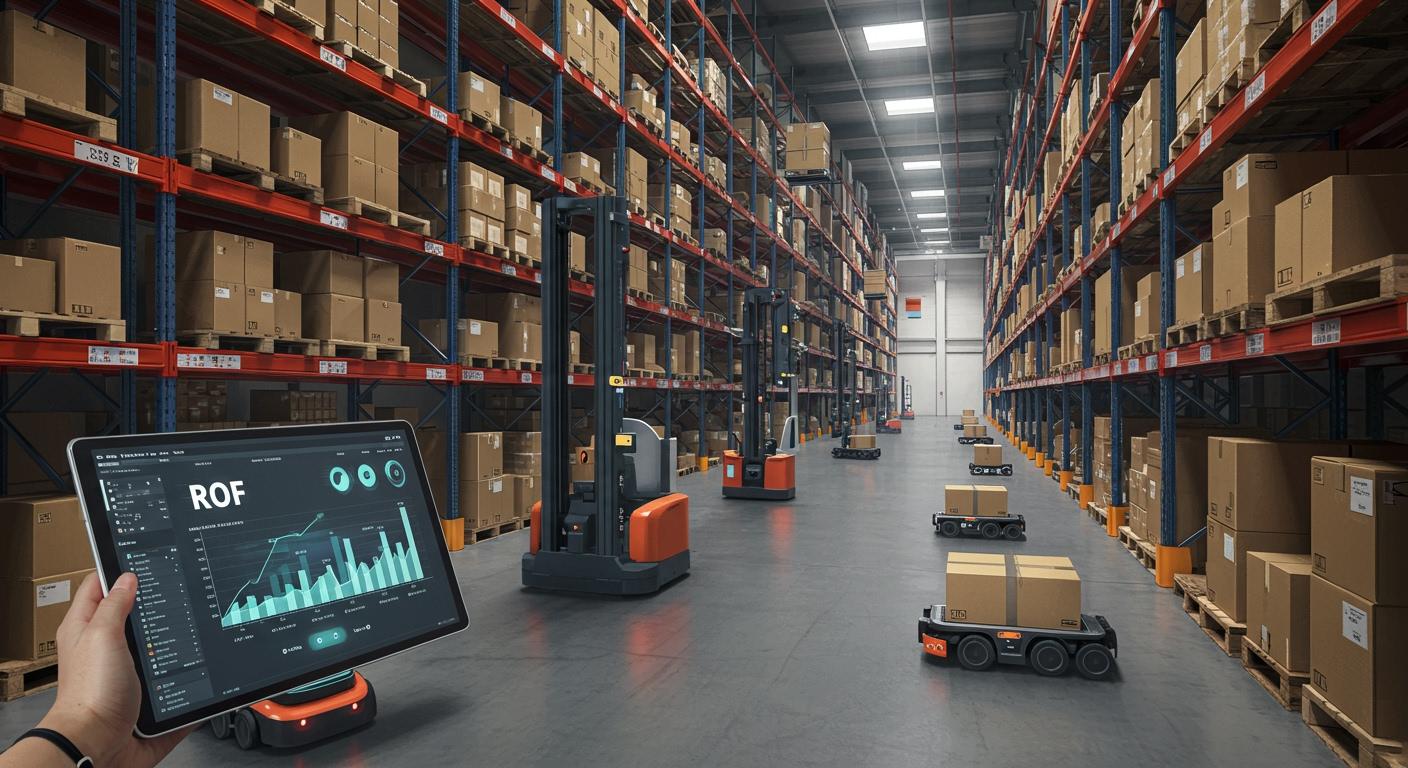
AGV and AMR innovations are rapidly transforming warehouse automation, delivering measurable gains across global supply chains. Companies in electronics, automotive, and FMCG now face urgent pressure to integrate intelligent automation for efficiency and cost reduction.
Metric | Value |
|---|---|
Reduction in picking time | |
Improvement in fulfillment accuracy | 94% to 99.7% |
Order handling speed per robot | 250 items per hour |
AI-driven solutions boost quality, flexibility, and safety, making advanced automation a strategic advantage for industry leaders.
Key Takeaways
AGVs and AMRs significantly boost warehouse efficiency, reducing picking time by up to 55% and improving fulfillment accuracy to nearly 99.7%.
Implementing automation can lower labor costs by up to 70%, allowing companies to reallocate resources to more complex tasks.
AI integration enhances the performance of AGVs and AMRs, optimizing routes and improving obstacle avoidance for better operational efficiency.
Flexible automation solutions can increase warehouse capacity by 54% without the need for physical expansion, maximizing space utilization.
Companies often see a return on investment within 6 to 18 months after adopting AGVs and AMRs, making automation a financially sound choice.
AGVs, AMRs, and Warehouse Automation
What Are AGVs and AMRs?
Automated Guided Vehicles (AGVs) and Autonomous Mobile Robots (AMRs) are two types of robotic systems that play a central role in warehouse automation. AGVs follow fixed routes using magnetic strips or laser guidance. AMRs, on the other hand, use advanced sensors like LiDAR and cameras, along with artificial intelligence, to navigate dynamic environments.
The table below highlights the main differences between AGVs and AMRs:
Feature | AGVs | AMRs |
|---|---|---|
Navigation | Follows predefined paths | Uses AI-based, real-time navigation |
Flexibility | Limited to structured settings | Adapts to dynamic environments |
Sensors & Guidance | Magnetic strips, laser guidance | LiDAR, cameras, machine learning |
Obstacle Avoidance | Stops and waits | Detects and maneuvers around obstacles |
Setup Requirements | Needs guidance infrastructure | Minimal setup, adapts to surroundings |
Cost & Scalability | Lower initial cost, less scalable | Higher initial cost, more scalable |
Applications | Repetitive deliveries | Dynamic environments |
AGVs work best in predictable, repetitive tasks. AMRs excel in fast-changing warehouse environments where flexibility is key.
How They Enable Warehouse Automation
AGVs and AMRs drive warehouse automation by taking over repetitive and physically demanding tasks. These robots move materials, pick orders, and transport goods across the facility. Their ability to operate 24/7 without breaks leads to higher efficiency and productivity.
Labor costs can drop by as much as 70% when using AMRs.
Both AGVs and AMRs help reduce workplace injuries by handling heavy loads and repetitive movements.
Companies can scale their robotic workforce during peak seasons, avoiding the challenges of hiring and training temporary staff.
AGVs and AMRs also streamline workflow processes. They optimize travel paths, reduce idle time, and minimize human errors. The initial investment in these technologies may be high, but the long-term savings are significant. By maximizing throughput and reducing downtime, warehouse automation becomes a powerful tool for cost control and operational excellence.
Trends Shaping Warehouse Automation
AI and Data Integration
Artificial intelligence and data integration have become essential drivers in warehouse automation. Companies now use AI to optimize routes and improve obstacle avoidance for AGVs and AMRs. Machine learning enables robots to learn from previous operations, which increases efficiency over time. Machine vision supports object recognition, helping robots navigate and complete tasks with greater accuracy. AI-driven automation is expected to reduce logistics costs by 25% by 2025. Digital twins also play a key role, allowing businesses to test different warehouse layouts virtually. This approach leads to better resource use, shorter travel times, and maximized storage space.
Tip: Integrating cloud computing with AI provides real-time data insights, supporting faster and more informed decision-making.
Flexible and Scalable Solutions
Warehouse automation solutions must adapt to changing business needs. Flexible systems allow companies to scale operations quickly during peak periods. Automated systems reduce the need for wide aisles, freeing up to 90% of usable space. These solutions can boost warehouse capacity by 54% without requiring expansion. Labor costs, which account for 50-70% of total operating expenses, decrease as automation takes over repetitive tasks. Automated picking systems manage up to 550 lines per hour, and training time for new automation tools drops to just 1-2 days. Inventory accuracy rates climb above 99%, and most customers achieve ROI within 6 to 18 months.
Evidence Type | Statistic/Claim |
|---|---|
Space Efficiency | Freeing up to 90% of usable space |
Warehouse Capacity | Boost warehouse capacity by 54% |
Labor Cost Reduction | Labor costs make up 50-70% of total costs |
Picking Efficiency | Up to 550 lines per hour |
Training Time | 1-2 days for automation |
Inventory Accuracy | Over 99% |
ROI Payback Period | 6 to 18 months |
Human-Robot Collaboration
Human-robot collaboration shapes the future of warehouse automation. Robots handle repetitive and hazardous tasks, which allows human workers to focus on quality checks and complex packaging. This partnership increases productivity and improves safety by reducing workplace injuries. Automation minimizes human error, while employees oversee exceptions and manage unique situations. In distribution centers, AMRs bring shelves to workers, speeding up order fulfillment and raising accuracy. Addressing safety concerns remains important for maintaining trust and maximizing the benefits of collaboration.
Higher productivity: Robots manage repetitive tasks, freeing workers for more complex activities.
Improved safety: Robots take on heavy lifting and hazardous jobs, lowering injury risks.
Greater accuracy: Automation reduces errors, while humans supervise and handle exceptions.
JUSDA’s Role in Warehouse Automation
Smart Warehousing Solutions
JUSDA stands out as a global leader in warehouse automation by delivering smart warehousing solutions tailored to diverse industries. The company operates over 155 service points worldwide and manages more than 2.5 million square meters of warehouse space. JUSDA’s facilities support a wide range of needs, including general storage, bonded warehouses, distribution centers, and finished goods storage.
JUSDA Vietnam, for example, offers 110,000 square meters of storage across seven locations. These warehouses use advanced management systems like eVMI and JusLink for real-time inventory tracking. Clients benefit from value-added services such as picking, packing, labeling, kitting, and repacking. Clean room facilities meet strict environmental standards, supporting industries like electronics and automotive.
JUSDA’s multilingual staff and close relationships with customs authorities help streamline logistics for international clients.
JUSDA’s warehousing solutions focus on transparency, efficiency, and customer satisfaction. Real-time data sharing and strategic collaboration between suppliers and buyers enhance supply chain management. The company’s global network ensures reliable support for businesses seeking to optimize their logistics operations.
JusLink and AI-Driven Efficiency
JusLink, JUSDA’s intelligent supply chain platform, integrates IoT, cloud computing, and big data to drive efficiency in warehouse automation. The platform provides real-time collaboration and information sharing across the supply chain. JusLink’s AI solution includes features such as supply chain trend analysis, freight rate prediction, sales demand forecasting, and replenishment strategies.
The Risk Control Tower monitors supply chain risks and provides early warnings. JusElsa, an intelligent assistant powered by advanced language models, enables seamless human-computer interaction for tasks like shipment tracking and exception handling. These tools help companies reduce inventory costs, improve decision-making, and maintain supply chain stability.
JUSDA’s commitment to innovation and technology ensures that clients achieve greater visibility, accuracy, and operational control. The company’s solutions empower businesses to streamline processes and maximize the value of warehouse automation.
ROI in Warehouse Automation
Cost Savings and Productivity
Warehouse automation delivers measurable cost savings and productivity gains for global supply chains. AGVs and AMRs automate repetitive tasks, reducing labor costs and increasing throughput. Companies see significant improvements in operational efficiency when they deploy these technologies. JUSDA’s advanced management systems, such as JusLink and eVMI, support real-time inventory tracking and process optimization across its global warehouse network.
Metric | AMRs | AGVs |
|---|---|---|
15-30% | 5-15% | |
Labor cost reduction | 40-60% | 20-35% |
Picking accuracy | 99.9% | 98.5% |
Inventory discrepancies | -65% | -40% |
Product damage reduction | -80% | -50% |
Uptime | 98% | 92% |
Potential FDA violations avoided | $2.3M | N/A |
Additional productive hours gained | 500 hours annually | N/A |
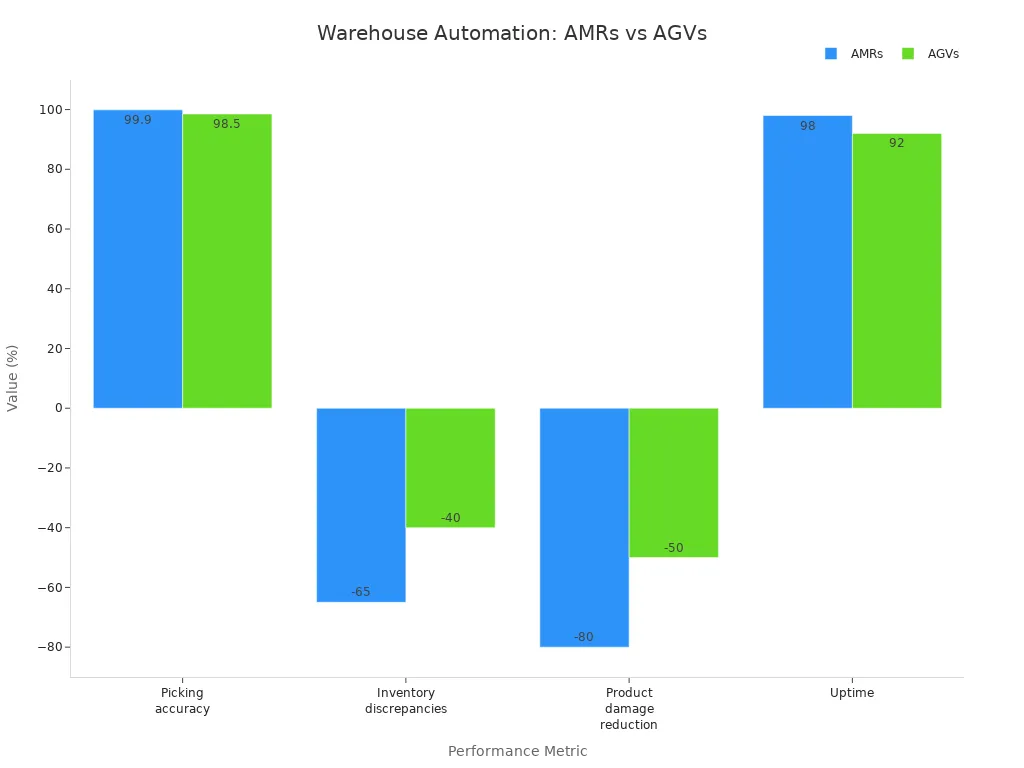
JUSDA’s automation solutions help clients reclaim hundreds of productive hours each year. AMRs fill gaps created by labor shortages and automate physically demanding tasks. Employees can focus on higher-value activities, while robots handle material transport and order picking. This shift leads to fewer workplace injuries and higher overall productivity.
AMRs provide flexible and scalable solutions for modern warehouses.
They adapt to changes in layout or workflow without costly modifications.
Automation increases throughput and maintains efficiency during peak seasons.
Half of users integrate AGVs and AMRs with Warehouse Management Systems, and many connect with ERP or MES platforms.
Accuracy and Inventory Control
Accurate inventory management is essential for maximizing ROI in warehouse automation. AMRs equipped with scanning technology enhance inventory counting and tracking. Real-time visibility of stock levels reduces discrepancies and improves order accuracy. JUSDA’s global network leverages advanced systems to deliver transparency and control for clients in electronics, automotive, and FMCG sectors.
AMRs improve inventory accuracy through automated scanning and tracking.
Real-time data sharing supports better decision-making and reduces manual errors.
Automation leads to fewer write-offs from misplaced or expired inventory.
Companies experience fewer stockouts and overstock situations.
Lower labor costs result from reduced manual processes.
Improved order accuracy increases customer retention.
The ROI of warehouse automation extends beyond cost savings. Efficiency, accuracy, and scalability contribute to enhanced customer satisfaction and long-term business growth.
Businesses adopting automated inventory management often report measurable ROI within months. Automation leads to enhanced operational efficiency, which is crucial for faster returns.
Scalability and Growth
Scalable automation systems support business growth and future expansion. AMRs can be deployed in a modular fashion, allowing gradual investment and proof of concept. Adding more AMRs does not require outsourcing installation or major infrastructure changes. Unlike AGVs, which need new environmental cues for adjustments, AMRs scale with minimal disruption.
Modular deployment enables companies to expand automation as needed.
Organizations handle more requests without proportional increases in headcount.
Automation allows teams to reclaim hours for strategic work, improving efficiency.
Employee satisfaction rises as automation reduces friction and manual workload.
Metric | Description |
|---|---|
Cost Savings | AI can save significant amounts, e.g., $12,500 a month on handling IT tickets. |
Productivity Gains | Automation allows teams to reclaim hours for strategic work, improving overall efficiency. |
Employee Satisfaction | Automation reduces friction, leading to higher employee engagement and satisfaction. |
Scalable Operations | Organizations can handle more requests without proportional increases in headcount. |
Revenue Potential | Faster onboarding and reduced bottlenecks lead to quicker productivity and increased profits. |
JUSDA’s global warehouse network and intelligent supply chain platforms empower clients to scale operations efficiently. Companies achieve faster onboarding, reduced bottlenecks, and increased profits. Automation supports long-term growth by enabling organizations to meet rising demand without sacrificing quality or control.
Real-World ROI Examples
JUSDA Customer Success Stories
JUSDA has helped global manufacturers achieve measurable improvements through advanced warehouse automation. One leading electronics manufacturer faced challenges with complex overseas supply chains and high inventory costs. JUSDA implemented its Supply Chain Management Collaboration Platform, powered by AI and cloud computing. This platform provided real-time transparency and streamlined operations. The manufacturer saw faster delivery schedules, improved inventory accuracy, and reduced manual handling. JUSDA’s integration of systems like ERP, TMS, and WMS allowed seamless data flow and better decision-making. As a result, the company expanded globally with lower costs and higher efficiency.
Another example comes from the automotive sector. JUSDA partnered with Foton Blue Ocean to enhance supply chain management. By using digital tools and the JusLink platform, both companies improved procurement coordination and reduced cross-border delays. The partnership led to more reliable deliveries and better risk management. These success stories show how JUSDA’s solutions drive ROI for clients in different industries.
AMR Deployments in Action
Smart Loading Hub’s AMR deployments highlight the impact of robotics on warehouse operations. Facilities that use AMRs report continuous productivity gains. AMRs operate without fatigue, which increases throughput and reduces the need for manual labor. The average unit cost for an AMR is around $30,000, and companies often see a quick return on investment. AMRs also help reduce workplace injuries by handling repetitive and heavy tasks.
The following table summarizes key performance metrics from recent AMR deployments:
Key Performance Metric | Description |
|---|---|
Productivity | AMRs can operate continuously, enhancing throughput without fatigue. |
Cost Efficiency | Average unit cost around $30,000 with quick ROI; reduces workplace injuries. |
Flexibility | Rapid reprogramming during peak seasons or product changes. |
Smarter Warehousing | Real-time data integration improves inventory accuracy and reduces stockouts. |
AMRs offer flexibility by allowing rapid adjustments during peak seasons or product changes. Real-time data integration supports smarter warehousing, improving inventory accuracy and reducing stockouts. Companies that adopt AMRs experience fewer bottlenecks and greater operational control. These examples demonstrate how warehouse automation delivers strong ROI and supports business growth.
Implementation Challenges
Integration and Change Management
Integrating AGVs and AMRs into existing warehouse systems presents several challenges. Companies often encounter compatibility issues when connecting new automation with current warehouse management systems. Employees need training to adapt to new workflows that involve robotics. Sometimes, warehouses require layout modifications to accommodate the movement and operation of AMRs.
Employees must learn new processes and adapt to automation.
Infrastructure adjustments may be necessary for smooth robot navigation.
Organizational change management also plays a critical role. Teams may resist new technology, so leaders must understand concerns and provide practical strategies. Performance analytics help guide decisions and allow companies to adapt their approach. Fostering a culture of innovation encourages acceptance of automation.
Change must be championed from the top. When leadership demonstrates commitment, it sets a powerful example. Cultivate a culture that embraces continuous improvement, where feedback is valued, and every team member feels part of the transformation journey.
Developing comprehensive training programs tailored to different roles ensures that employees gain the skills needed for success. Recognizing milestones and celebrating achievements helps build morale and sustain momentum throughout the transition.
Cost Justification
Justifying the investment in AGVs and AMRs requires clear communication of financial and operational benefits. Companies use several methods to demonstrate value to stakeholders:
Method | Description |
|---|---|
Quantifies profitability by comparing net financial benefits to total investment cost. | |
Labor Savings | Significant reduction in workforce costs by replacing multiple operators with automation. |
Increased Throughput | Automation allows for continuous operation, increasing production capacity and potential revenue. |
Improved Quality | Automation reduces defects and waste, enhancing product quality and minimizing rework costs. |
Enhanced Safety | Reduces workplace injuries and associated costs by automating dangerous tasks. |
Space Optimization | Increases storage capacity, potentially reducing the need for additional warehousing. |
Stakeholders often look for measurable outcomes such as labor savings, increased throughput, and improved quality. Automation also enhances safety and optimizes space, which further supports the business case for investment. By presenting these benefits with clear data, companies can build strong support for warehouse automation initiatives.
Maximizing ROI with JUSDA
Assessment and Planning
Companies that want to maximize ROI with JUSDA’s warehouse automation solutions should begin with a structured assessment and planning process. Teams define clear goals to align everyone and measure progress. They start with simple workflows before expanding to more complex tasks. This approach helps organizations build confidence and see early wins.
JUSDA recommends these main strategies for success:
Quick, low-friction deployment. Fast deployment depends on minimal infrastructure changes and experienced teams. This speeds up the return on investment.
Tailored applications. Matching the right automation solution to each task ensures the best results.
Operator adoption. Engaging employees and providing training supports smooth technology implementation.
The foundation of strong ROI rests on four pillars: space efficiency, labor productivity, inventory control, and data intelligence. These pillars drive savings and create compelling payback periods.
Integrating automation with existing systems improves coordination. Teams should scale strategically based on early successes. Real-time data from JUSDA’s platforms supports better decision-making and helps companies adapt quickly.
Partnering for Success
JUSDA works closely with clients to ensure every automation project delivers measurable value. The company’s experts guide businesses through each step, from initial assessment to full-scale deployment. They help clients identify the best-fit solutions for their unique needs.
Key steps for a successful partnership include:
Setting clear objectives and timelines.
Providing hands-on training for operators and managers.
Monitoring performance and making adjustments as needed.
Sharing best practices and lessons learned.
JUSDA’s collaborative approach builds trust and drives continuous improvement. Clients benefit from JUSDA’s global experience and advanced technology. Together, they achieve higher productivity, better inventory control, and sustainable growth through warehouse automation.
AGV and AMR trends drive financial benefits, efficiency, and scalability in warehouse automation. JUSDA’s solutions help companies achieve rapid ROI and operational excellence. The table below highlights key impacts:
Key Point | Description |
|---|---|
Financial Benefits | Flexible, scalable alternatives to traditional material handling |
Efficiency | Robots handle repetitive tasks, freeing staff for complex roles |
Scalability | Systems scale with demand, minimizing bottlenecks |
Rapid Adoption | Advancing robotics accelerates implementation |
Strategic planning, staff training, and real-time analytics ensure continuous improvement. Operators should assess readiness by mapping workflows, piloting automation, and integrating WMS. For further insights, explore resources on automation’s impact in global supply chains and logistics.

JUSDA Solutions
To provide you with professional solutions and quotations.
FAQ
What types of warehousing services does JUSDA offer?
JUSDA provides general storage, bonded warehouses, distribution centers, and finished goods storage. The company also offers clean room facilities that meet strict environmental standards.
How does JUSDA ensure inventory transparency and control?
JUSDA uses advanced management systems like eVMI and JusLink. These platforms enable real-time inventory tracking and data sharing, which improves transparency and control for clients.
What value-added services are available in JUSDA warehouses?
Clients benefit from picking, packing, labeling, kitting, switch doc, repacking, software upgrades, and rework services. These services optimize warehouse operations and support diverse industry needs.
How does JusLink’s AI Solution improve supply chain management?
JusLink’s AI Solution provides supply chain trend analysis, freight rate prediction, sales demand forecasting, and replenishment strategies. The platform also features a risk control tower and an intelligent assistant for efficient operations.
Are JUSDA’s facilities compliant with environmental health and safety standards?
JUSDA’s clean room facilities comply with stringent environmental health and safety standards set by major technology brands. The company prioritizes safety and quality in all warehouse operations.
See Also
Understanding Robotic Automation's Role in Warehouse Efficiency
Exploring Benefits of Automation in Modern Manufacturing Warehouses
Transforming Logistics with AI: The Future of Supply Chains
Boosting Warehouse Productivity Through Advanced Robotics Technology