U.S.-bound air cargo volumes reveal a clear shift in the global supply chain. Recent statistics show a 40% year-on-year surge from Southeast Asia in October, while shipments from China dropped by 2%. Several factors drive this change:
The China+1 manufacturing strategy redirecting production.
The ongoing U.S.-China trade war increasing export volumes from Southeast Asia.
These trends present new challenges and opportunities for U.S. importers and supply chain leaders seeking resilience and efficiency.
Key Takeaways
Southeast Asia’s air cargo volumes to the U.S. surged by 40% year-on-year, while China’s volumes dipped by 2%. This shift highlights the growing importance of Southeast Asia in global supply chains.
The ‘China + 1’ strategy is gaining traction among U.S. importers. Companies are diversifying their sourcing to reduce risks associated with geopolitical tensions and tariffs.
E-commerce growth is a major driver of air cargo demand. U.S. importers should optimize their logistics to capitalize on this trend and improve efficiency.
Rising tariffs and operational costs in China are pushing businesses to seek alternatives in Southeast Asia. Companies must adapt their supply chain strategies to navigate these challenges.
Investing in advanced logistics solutions, like JUSDA‘s JusLink AI, can enhance visibility and decision-making, helping businesses respond effectively to market changes.
The U.S.-bound air cargo market has experienced notable changes in both demand and capacity over the past three years. E-commerce growth and regulatory changes have caused volumes to fluctuate. The end of the de minimis exemption has especially affected low-value shipments. In Q4 2023 and into 2024, low-value e-commerce goods drove double-digit growth in demand. However, the removal of the de minimis threshold may impact the 2025 peak season.
A quick look at recent trends:
Market volumes remain uncertain due to shifting trade flows and economic factors.
August 2023 saw a 5% year-over-year increase in demand, but global air cargo spot rates fell by 3% to $2.55 per kilogram.
Capacity continues to expand as passenger flights recover, which adds pressure on rates.
JUSDA’s market intelligence and Airgroup’s Freight Market Update both highlight these shifts, noting that increased capacity and muted demand have become defining features of the current market.
Rate Changes and Trade Lanes
The following table summarizes recent changes in rates and capacity for major trade lanes:
Trade lanes from China to the U.S. have seen a significant decline in volume, while Vietnam and Taiwan have experienced substantial increases. E-commerce shipments from China to the U.S. dropped by 34% in September, marking the fifth consecutive month of decline.
China vs. Southeast Asia Volumes
Vietnam stands out with a 62% year-over-year increase in air cargo volumes to the U.S., while China’s volumes have declined. The table below highlights these changes:
JUSDA’s market intelligence confirms that Southeast Asia’s share of U.S.-bound air cargo continues to rise, while China’s share declines. Airgroup’s Freight Market Update also points to these shifts, emphasizing the need for importers to adapt their supply chain strategies.
Drivers of the Sourcing Shift
Trade Policy and Tariffs
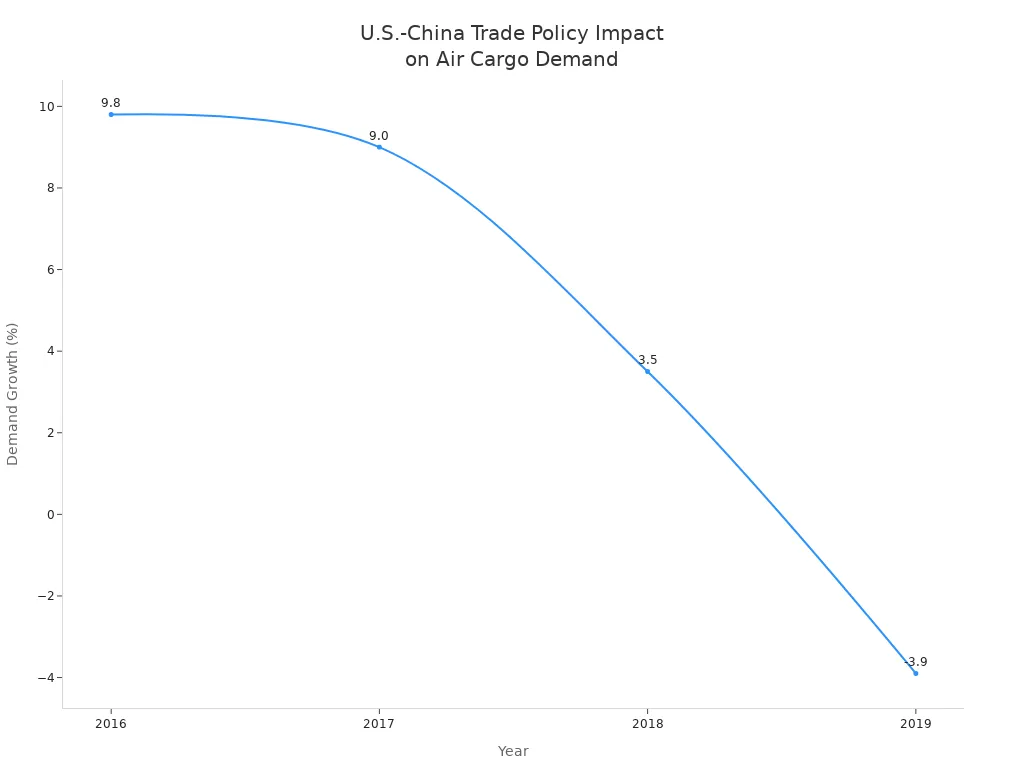
Trade tensions between the United States and China have reshaped global sourcing strategies. The introduction of new tariffs has increased costs for e-commerce platforms and affected the flow of goods. Changes to the de minimis exemption now impact low-value shipments from China, making logistics more complex and expensive. Companies such as Shein and Temu have responded by raising prices to offset these increased tariffs.
Recent tariff measures have reshaped the e-commerce landscape, especially for low-cost imports from China and Hong Kong. The removal of the de minimis exemption is expected to complicate logistics and increase costs, which may reduce air cargo volumes as companies adjust their pricing strategies.
Cost and Operational Pressures in China
Rising costs and operational challenges in China have added pressure to supply chains. Freight costs have increased significantly, affecting both contracts and spot bookings. Carriers now prioritize contracted volumes, reducing flexibility for shippers. Companies face additional charges, such as port fees and operational surcharges, that were previously absorbed. Schedule reliability has become a concern due to late booking windows and the risk of blank sailings. Chinese freight forwarders also experience pressure from escalating costs across various sectors, which impacts their profit margins.
These operational hurdles have made it more difficult for companies to maintain predictable and cost-effective logistics from China. As a result, many businesses are reevaluating their sourcing strategies and looking for alternatives in Southeast Asia.
Supply Chain Diversification Strategies
Many U.S. importers have adopted new strategies to manage risk and build resilience in their supply chains. The “China + 1” strategy has become popular, where companies maintain relationships in China while establishing backup production in other countries. This approach helps reduce exposure to geopolitical disruptions and supports business continuity.
A recent survey found that 73% of companies have modified their supply chain networks in the past two years, showing a strong trend toward diversification. Common strategies include:
Geographic diversification to minimize risk from regional disruptions.
Strengthening supplier qualification processes to ensure reliability.
Collaborating closely with suppliers to build stronger partnerships.
Leveraging technology for real-time decision-making and enhanced visibility.
The shift in sourcing from China to Southeast Asia is driven by interconnected factors such as geopolitical tensions, tariff pressures, and rising labor costs. Companies now diversify their supply chains to enhance resilience and reduce risks associated with dependence on a single market. Countries like Vietnam, India, and Bangladesh have emerged as attractive alternatives due to their economic openness and favorable trade agreements.
JUSDA supports these diversification efforts by providing advanced supply chain management solutions. With expertise in risk management and supply chain resilience, JUSDA helps businesses adapt to changing market conditions and maintain efficient operations.
Vietnam has emerged as a powerhouse in U.S.-bound air cargo. The country’s air cargo capacity on Vietnam-U.S. routes nearly doubled year-over-year as of August. Electronics exports have driven a 10% increase in air cargo shipments to the United States. JUSDA Vietnam plays a central role in this growth. The company offers a comprehensive suite of logistics services, including air, sea, and land freight, as well as the Vietnam-China-Europe Railway Express.
JUSDA Vietnam operates seven warehouses with a total area of 110,000 square meters. These facilities use advanced inventory management systems such as eVMI and Juslink, providing real-time stock tracking and transparency. The company’s self-owned customs team ensures smooth and efficient clearance processes. Multilingual capabilities in Chinese, English, and Vietnamese support seamless communication with clients. JUSDA Vietnam specializes in handling electronics, automobiles, and semiconductor raw materials, meeting the needs of diverse industries. Quick cargo handover times and strong relationships with customs authorities further enhance reliability.
Air cargo capacity on Vietnam-U.S. routes has nearly doubled year-over-year.
Vietnam’s air cargo to the U.S. increased by 10%, led by electronics exports.
JUSDA Vietnam provides advanced warehousing, customs, and logistics solutions.
Thailand, Malaysia, and Regional Growth
Thailand and Malaysia have also contributed to Southeast Asia’s expanding presence in the U.S.-bound air cargo market. Air cargo pricing from Thailand to the United States decreased by 8% year over year, making the route more attractive for shippers. While specific growth statistics for Malaysia are not available, both countries benefit from regional initiatives that support logistics and trade.
Competitive pricing from Thailand enhances market appeal.
Regional collaboration streamlines operations and improves efficiency.
Investments in digital transformation and infrastructure support sustained growth.
Infrastructure and Customs Advantages
Southeast Asia’s air cargo surge relies on robust infrastructure and efficient customs processes. Airports such as Liege offer unrestricted 24/7 operations, allowing for flexible scheduling and faster cargo flow. Streamlined customs procedures reduce delays and improve efficiency in cargo handling. Digital infrastructure, including AI-powered tools and platforms, enhances operational reliability and supports better logistics management.
Improvement Type
Description
24/7 Operations
Liege Airport offers unrestricted operations around the clock, enhancing cargo flow.
Simplified Customs
Streamlined customs procedures reduce delays and improve efficiency in cargo handling.
Digital Infrastructure
AI-powered tools and digital platforms enhance operational reliability and manage logistics better.
Southeast Asian carriers value the strong infrastructure at key airports. The absence of night flight restrictions allows for more flexible scheduling. Seamless customs procedures contribute to reduced delivery lead times, supporting the region’s growing share in U.S.-bound air cargo.
Note: Regional initiatives such as digital transformation, infrastructure investments, and specialized services for high-value cargo segments further strengthen Southeast Asia’s position in the global air cargo market.
Implications for U.S. Importers and Supply Chains
Managing Risk and Disruption
U.S. importers face a complex risk landscape when sourcing from Asia. Tariff-driven cost pressures elevate credit risk exposure, especially for companies that rely on exports to the U.S. Countries such as Vietnam and Thailand remain vulnerable due to their dependence on U.S. markets. Increased regulatory measures can lead to higher costs and operational bottlenecks. According to Ankit Tambe, rising tariffs drive up input costs, compress margins, and create cash flow pressures, which increases default risk for businesses. The following table highlights the main risk factors:
Risk Factor
Percentage of Imports at Risk
Tariffs
23%
Increased Costs
N/A
Supply Chain Disruptions
N/A
Importers must address these risks to maintain stable operations. Proactive risk management and supply chain resilience have become essential for companies navigating today’s global trade environment.
Enhancing Visibility with JusLink AI
Visibility remains a top priority for supply chain leaders. JusLink’s AI solution from JUSDA provides advanced tools for real-time monitoring and risk control. The platform offers supply chain trend analysis, freight rate prediction, and sales demand forecasting. JusLink’s risk control tower delivers early warnings and real-time alerts, helping companies respond quickly to disruptions. The intelligent assistant, JusElsa, uses natural language processing to support decision-making and streamline communication. These features help importers reduce inventory costs, optimize procurement, and improve overall efficiency.
JusLink’s AI-driven platform empowers businesses to make informed decisions and maintain supply chain stability, even in volatile markets.
Strategic Sourcing and JUSDA in North America
Strategic sourcing now includes nearshoring and cross-border logistics solutions. JUSDA in North America supports companies that want to capitalize on manufacturing shifts and nearshoring trends. The service focuses on expanding logistics capabilities along the U.S. East Coast and the U.S.-Mexico border. JUSDA offers risk management for freight forwarding, especially for hazardous materials, and ensures compliance with safety regulations. The company’s quote management system and extensive carrier network provide transparency and efficiency for cross-border shipments. These solutions help U.S. importers adapt to changing trade patterns and maintain reliable air cargo flows.
Future Outlook and Recommendations
Air Cargo Sourcing Trends Ahead
U.S.-bound air cargo sourcing will continue to evolve as trade policies and supply chain strategies shift. Import volumes from Asia are expected to decline, with projections showing a 23.2% drop from mainland China. Southeast Asia, especially Singapore and Vietnam, will play a larger role as companies diversify their sourcing. The Asia Pacific air cargo market remains strong, driven by e-commerce and high-value sectors like semiconductors and pharmaceuticals.
The following table summarizes expert forecasts for Southeast Asia’s role in U.S.-bound airfreight:
Aspect
Details
Peak Season Demand
Strong demand expected through December and early January
Tariff Impact
Front-loading of cargo due to planned tariff increases
Capacity Constraints
Tightening across key trade lanes, extended booking lead times
Double Eleven shopping event to drive e-commerce demand
Strategic Adjustments
Airlines adjusting capacity and networks for peak season opportunities
Future Outlook
Longer traditional demand cycle due to Chinese New Year timing
Southeast Asia’s position as a logistics hub will strengthen as airlines and forwarders adjust networks to capture new opportunities. Importers will continue to balance air and ocean transport, seeking flexibility and resilience.
Action Steps for Supply Chain Leaders
Supply chain leaders must act decisively to adapt to these changes. The following steps can help companies build resilience and maintain efficiency:
Optimize air cargo routes to improve cost and transit times.
Enhance intermodal connectivity for smoother transitions between transport modes.
Leverage data analytics for better demand forecasting and trend prediction.
Diversify supplier bases and implement dual- or multi-sourcing strategies.
Consider reshoring or nearshoring to reduce exposure to global disruptions.
JUSDA stands ready as a strategic partner, offering advanced supply chain solutions, real-time visibility through JusLink AI, and robust logistics support in both Southeast Asia and North America. Companies that embrace these recommendations will position themselves for long-term success in a rapidly changing market.
The shift in U.S.-bound air cargo sourcing reflects changing trade policies, rising costs, and the growth of Southeast Asia. Companies now move from air cargo to containerized imports, and logistics providers enhance capabilities for increased container volumes. JUSDA’s advanced systems and tailored strategies deliver reliability and visibility. Businesses should diversify sourcing, monitor port congestion, and manage freight rate volatility to adapt and thrive.
What logistics services does JUSDA Vietnam provide?
JUSDA Vietnam offers air, sea, and land freight services. The company also operates the Vietnam-China-Europe Railway Express. Clients benefit from advanced warehousing, customs clearance, and value-added services like packing and inspection.
How does JusLink’s AI solution support supply chain management?
JusLink’s AI solution delivers real-time monitoring, trend analysis, and risk control. The platform helps companies forecast demand, predict freight rates, and manage disruptions with early warnings and intelligent assistance.
What industries does JUSDA serve in North America?
JUSDA in North America supports electronics, automotive, medical devices, and oil and gas industries. The company specializes in cross-border logistics, hazardous materials handling, and compliance with safety regulations.
How does JUSDA ensure efficient customs clearance in Vietnam?
JUSDA Vietnam uses a self-owned customs team and maintains strong relationships with customs authorities. The team handles documentation and clearance efficiently, reducing delays and ensuring smooth cargo movement.