JUSDA Strengthens Industry Leadership by Joining the Drafting of China’s New Logistics Service Contract Criteria
JUSDA Strengthens Industry Leadership by Joining the Drafting of China’s New Logistics Service Contract Criteria
Driving the Industry Toward a New Stage of High-Quality and Standardized Development
The newly released national standard GB/T 30333—2025 Criteria for the Logistics Service Contract, jointly issued by the State Administration for Market Regulation and the Standardization Administration of China, has officially come into effect. As a foundational regulatory document for logistics service contract management in China, the standard has undergone its first comprehensive upgrade in more than a decade.
Notably, Shenzhen Fertile Plan International Logistics Co., Ltd., a wholly-owned subsidiary of JUSDA, served as one of the core drafting organizations, contributing industry-leading expertise and operational insights to the development process and infusing the standard’s upgrade with “JUSDA Intelligence.”
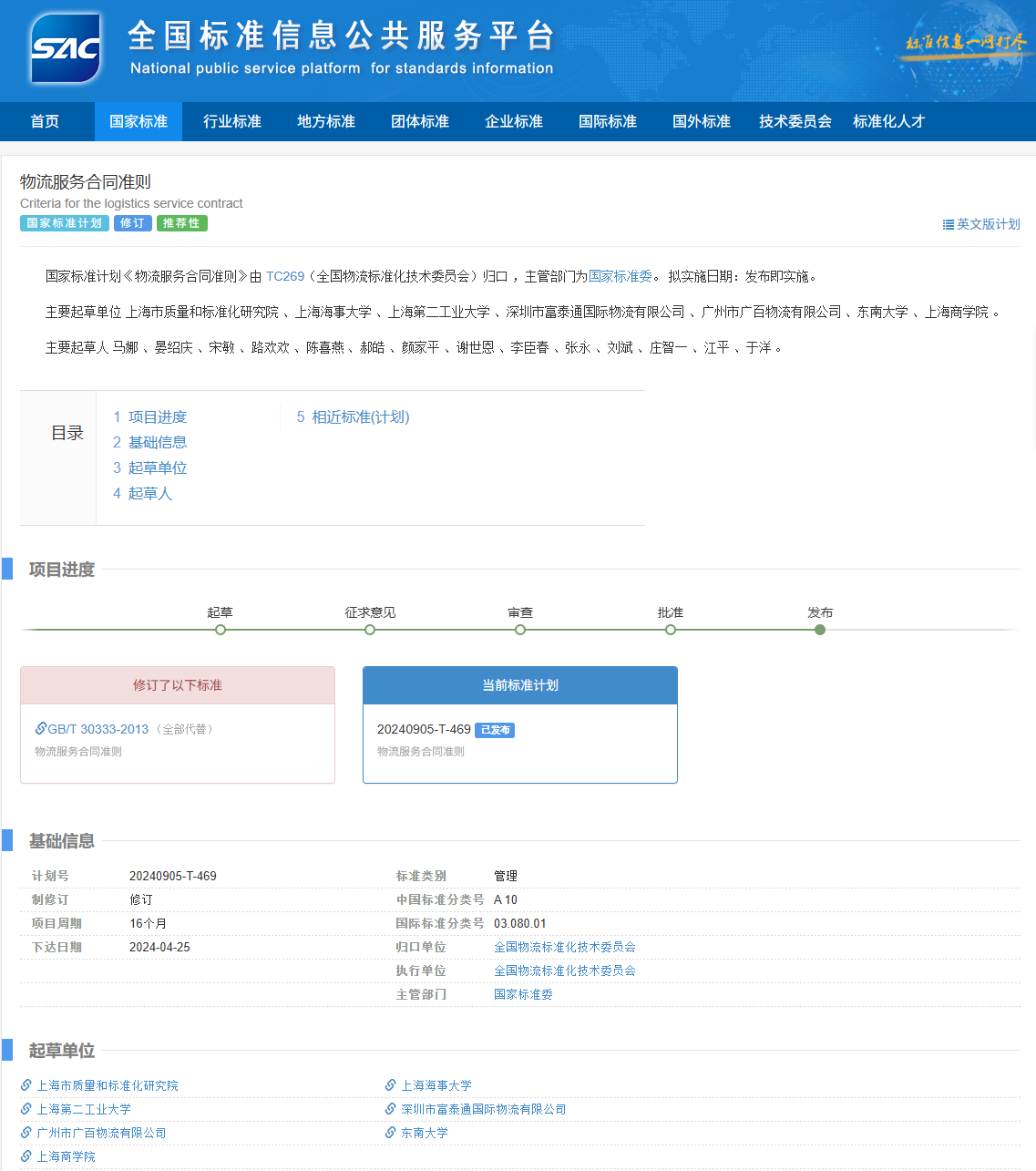
National Standard Released: Establishing a Strong Institutional Foundation for High-Quality Logistics Development
The 2025 edition of Criteria for the Logistics Service Contract marks a full-scale enhancement of the 2013 version. Built around the growing need for contract standardization under digitalization and globalized supply chain models, the new standard introduces upgrades in four major areas:
Optimized terminology system, better aligned with modern logistics scenarios
Clearer contract structure, covering preamble, main body, and closing provisions
Enhanced risk governance, adding rules for special goods, information security, and third-party performers
Greater contract operability, with clarified workflows, requirements, acceptance rules, and service specifications
Deep Participation: JUSDA Brings Professional Capabilities to National Standard Development
Leveraging extensive experience in international logistics, cross-border transportation, 3C electronics, and high-value goods management, JUSDA had substantial involvement in developing core sections of the standard, including terminology, contract structure, responsibility allocation, and risk governance.
Key contributions from JUSDA include:
Strengthening operability: Optimizing clauses on “performance responsibilities,” service processes, and operational requirements based on real-world logistics scenarios.
Enhancing risk management design: Introducing forward-looking recommendations related to hazardous materials, special-goods logistics, qualification requirements for third-party performers, and information security.
Refining compensation and valuation mechanisms: Supporting improvements in declared value policies, liability rules, claims procedures, and compensation limits to ensure clearer and fairer responsibility allocation.
JUSDA’s participation demonstrates the company’s professional commitment as an industry leader and its strategic vision in advancing the institutional development of the supply chain sector. It also further solidifies JUSDA’s leading position in logistics standardization.
Looking Ahead: JUSDA Continues to Drive Modernization of Global Manufacturing Supply Chains
JUSDA will continue to deepen its involvement in national standardization initiatives, advancing digital standards in key areas such as digital logistics, smart contracts, and data security. The company will contribute practical experience to strengthen the integration of standards, processes, and technologies while accelerating the build-out of cross-regional and cross-scenario standardization frameworks that support supply chain modernization.
JUSDA firmly believes that high-level standardization is a critical foundation for resilient and competitive global manufacturing supply chains. The company will work closely with industry partners to push China’s logistics service contract system toward greater transparency, standardization, and international alignment—contributing a more stable, reliable, and forward-looking “China power” to the global supply chain transformation.