JUSDA Wins the 2026 LOG Supply Chain & Logistics Tech Innovation – Digital Intelligence Innovation Award
JUSDA Wins the 2026 LOG Supply Chain & Logistics Tech Innovation – Digital Intelligence Innovation Award
Reshaping Global Supply Chains Through JusLink’s “Three-Flow Integration” Architecture
At the structural inflection point of 2026, global manufacturing is undergoing a paradigm shift—from “product export” to systemic “capacity globalization.” Amid escalating geopolitical fragmentation, trade policy volatility, and compliance complexity, supply chain resilience has decisively overtaken pure cost efficiency as the defining determinant of multinational competitiveness.
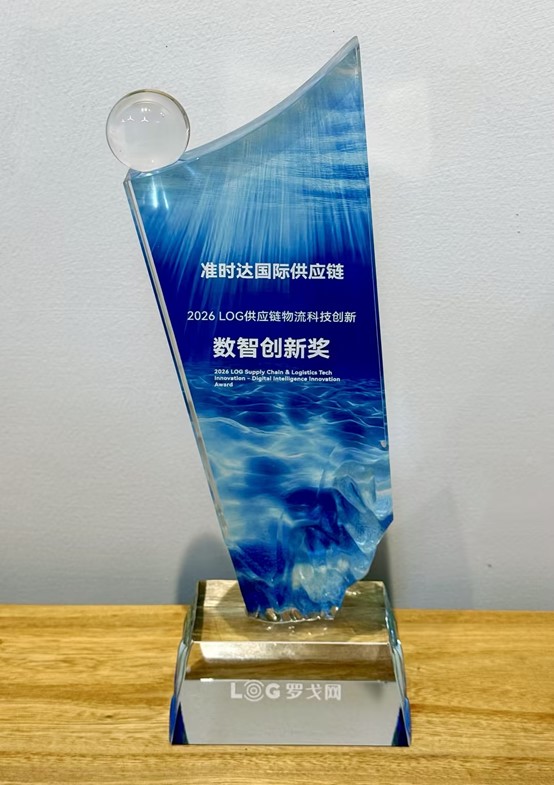
Against this backdrop, JUSDA has been honored with the 2026 LOG Supply Chain & Logistics Tech Innovation – Digital Intelligence Innovation Award, recognizing the architectural innovation of its AI-powered JusLink Smart Supply Chain Control Tower. This distinction signals more than technological excellence—it affirms a structural redefinition of global supply chain management logic.
From Scale Expansion to Value-Oriented Orchestration
In 2026, the logistics industry is completing a capability transition:
from a volume-driven traffic paradigm to a value-driven orchestration model emphasizing quality, operational efficiency, compliance integrity, and ecosystem integration.
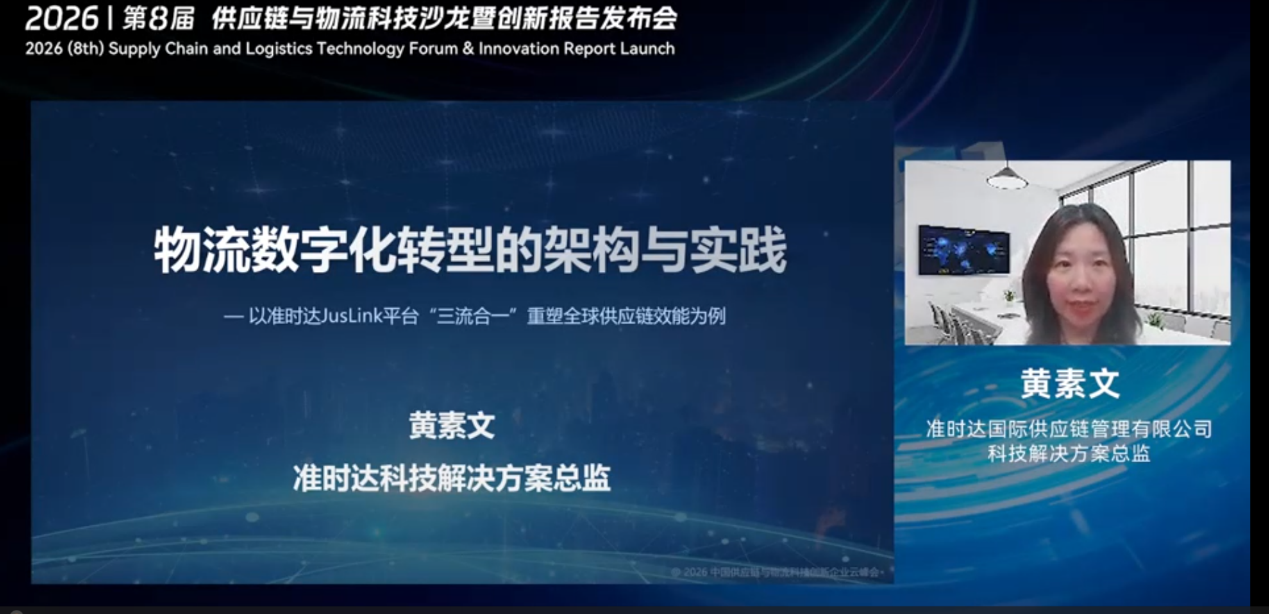
At the 8th China Supply Chain and Logistics Technology Innovation Enterprise Cloud Summit held on February 28, Christine Huang, Tech Solution Director at JUSDA, delivered a keynote titled The Architecture and Practice of Logistics Digital Transformation.
Her core thesis was unequivocal:
In an era defined by geopolitical volatility and regulatory divergence, competitive advantage no longer comes from incremental digital tools. It derives from deep architectural integration that transforms uncertainty into systemic certainty.
I. The Structural Shift: From JIT Efficiency to JIC Resilience
For over two decades, Just-In-Time (JIT) optimization dominated global manufacturing strategy. Zero-inventory logic, lean operations, and extreme cost compression shaped multinational supply networks.
That equilibrium has fractured.
As production capacity accelerates relocation to emerging hubs such as Vietnam, Mexico, and India, supply chains have expanded across greater geographic, regulatory, and political complexity. The compounding effect of tariff volatility, compliance divergence, port congestion, and regional risk exposure has exposed the fragility of cost-only optimization.
Global manufacturing is transitioning—often involuntarily—into a Just-In-Case (JIC) paradigm prioritizing:
Redundancy planning
Risk buffering
Multi-node resilience
Compliance foresight
Predictive orchestration
Enterprises expanding globally frequently encounter what can be defined as the “Two Highs, One Low” structural constraint:
High Complexity
Multi-tier supplier ecosystems, divergent customs regimes, tariff policy shifts, and cross-time-zone coordination significantly increase orchestration friction.
High Cost Volatility
Ocean freight rate fluctuations, demurrage and detention charges, and port congestion introduce nonlinear cost exposure beyond base transportation fees.
Low Visibility
Fragmented data flows create operational blind spots, reducing predictive control and forcing reactive remediation.
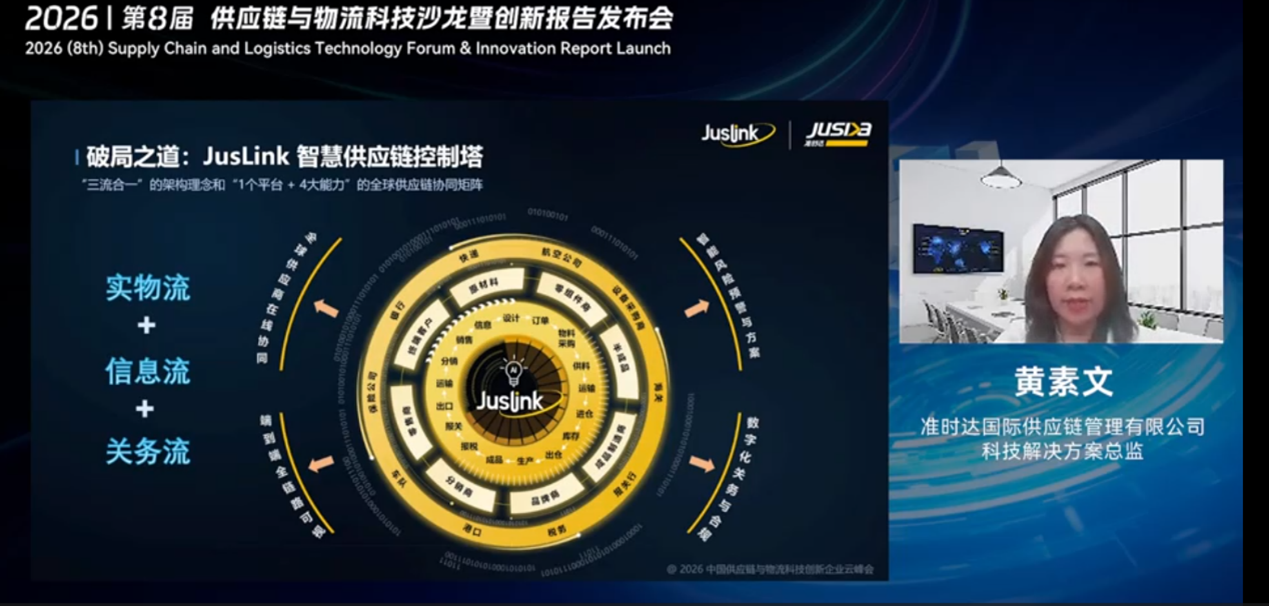
II. Architectural Innovation: JusLink’s “Three-Flow Integration” Framework
Born from over two decades of electronics manufacturing experience within Foxconn Technology Group, JUSDA understands the precision, synchronization, and compliance rigor required in complex multinational production networks.
Rather than layering disparate IT systems, JusLink reconstructs the foundational logic of global supply chain data through Three-Flow Integration:
1. Logistics Flow – Physical Certainty Engineering
JusLink leverages IoT telemetry, API-based system interoperability, and event-driven architecture to achieve Purchase Order (PO)-level granularity.
Instead of container-level macro tracking, the platform enables:
PO-level milestone tracking
Estimated Time of Arrival (ETA) recalibration
Node-based exception management
Real-time shipment status synchronization
Every material batch is mapped into the system with deterministic visibility:
Where it is. When it will arrive. What risk exposure it carries.
2. Information Flow – Cross-Border Data Synchronization
Multinational supply chains frequently involve dozens of suppliers, freight forwarders, customs brokers, and carriers.
JusLink enforces:
Second-level data synchronization
Structured EDI/API integration
Unified data standards across stakeholders
Automated document digitization
This replaces fragmented email chains and paper documentation with a single digital control plane, enabling frictionless transnational collaboration comparable to intra-office coordination.
3. Customs Flow – Embedded Compliance Intelligence
Customs clearance remains one of the highest-risk nodes in cross-border trade.
JusLink embeds:
Dynamic global tariff databases
Harmonized System (HS) code validation logic
Multi-jurisdiction regulatory rule engines
Pre-shipment compliance verification workflows
By shifting compliance validation upstream—before cargo departure—the system mitigates detention risk, customs delays, and regulatory non-conformance.
This is not post-event correction.
It is preventive compliance engineering.
III. From Firefighting to Predictive Defense: The 7-Day Advantage
True digital transformation is not an IT procurement project—it is a risk reconfiguration strategy.
Through PO-level end-to-end data penetration and predictive analytics modeling, JusLink can identify potential material shortage risks up to 7 days in advance.
Those 168 hours create:
Re-routing options
Alternate sourcing activation
Inventory rebalancing
Production rescheduling
Financial exposure mitigation
This transforms supply chain management from:
Reactive disruption handling → Proactive risk orchestration.
Quantifiable Impact
After full implementation for a multinational client, measurable performance improvements included:
On-Time Delivery (OTD) improved by 30%
Operational efficiency increased by 20%
Hidden inventory carrying costs reduced by 5%
In a margin-constrained manufacturing environment, a 5% reduction in hidden inventory costs directly enhances EBITDA performance. Logistics ceases to function as a cost center and evolves into a strategic value multiplier.
Digital Consistency as a Global Competitive Barrier
As global trade becomes increasingly fragmented, competitive differentiation will not stem solely from production scale or transportation capacity.
It will derive from digital consistency—the ability to maintain synchronized, transparent, and controllable operations across jurisdictions, partners, and regulatory systems.
JUSDA’s practice demonstrates a fundamental industry principle:
Resilience is not built by adding capacity.
It is built by integrating flows.
The transition from JIT to JIC is not temporary—it represents a structural rebalancing of global industrial logic. Enterprises that embed “Three-Flow Integration” into their operational DNA will not merely survive geopolitical volatility; they will convert it into competitive leverage.
In an era defined by uncertainty, certainty becomes the ultimate asset.
And certainty begins with architecture.