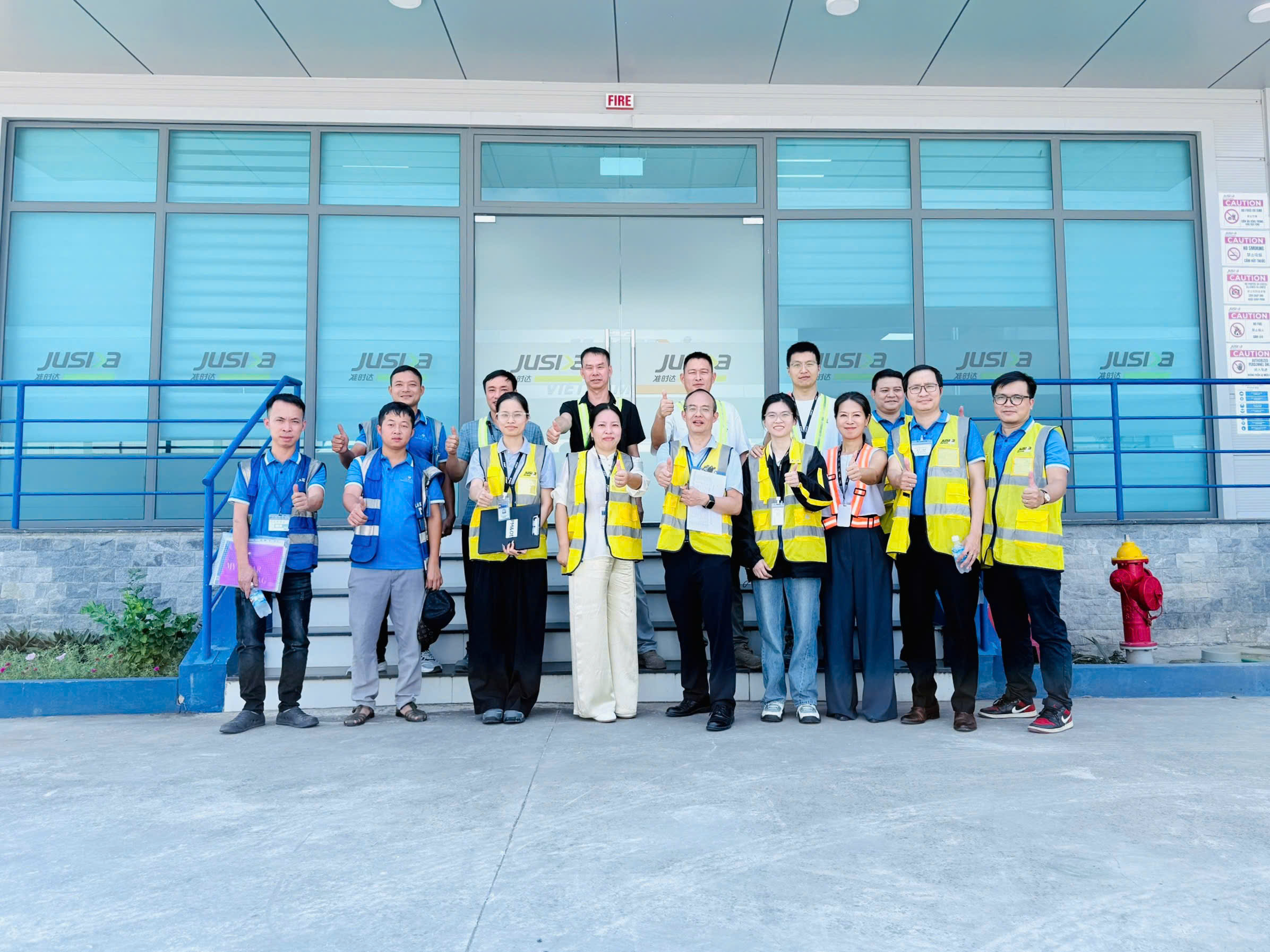
From September 14 to 24, SGS completed a series of on-site audits across four JUSDA warehouses in Vietnam, covering requirements related to C-TPAT, TAPA FSR, TAPA TSR and the ISO 9001:2015 Quality Management System.
For a global supply chain company, the value of certification goes far beyond obtaining a credential. Independent third-party audits provide an important way to validate how effectively an organization manages safety, quality, operational processes, risk and continuous improvement — and, ultimately, how reliably those capabilities translate into service for customers.
The completion of these audits marks another step in JUSDA’s efforts to strengthen operational consistency across its global network and enhance supply chain capabilities in overseas markets.
International standards are becoming a common language of trust
Global supply chains now span more countries, more partners and more operational touchpoints than ever before.
From warehousing and transportation to customs and final delivery, every additional handoff introduces greater complexity. As a result, customers are looking beyond network size, transit time and physical capacity when selecting long-term supply chain partners. They also want to know whether those partners operate with disciplined, consistent and well-established management systems.
TAPA standards focus on protecting high-value goods across warehousing and transportation environments. C-TPAT is centered on supply chain security in cross-border trade. ISO 9001 provides a structured framework for quality management, process control and continuous improvement.
Their areas of focus may differ, but they share a common objective: to move supply chain management away from reliance on individual experience and toward repeatable, process-driven execution.
For customers, certification means greater control and predictability
Supply chain management is, at its core, about managing complexity and uncertainty.
Whether supporting manufacturing, cross-border trade or global fulfillment, customers are not only concerned with the efficiency of individual nodes. They need confidence that the entire supply chain can operate consistently across multiple locations, partners and processes.
International standards help turn expectations around safety, quality, accountability, risk identification and incident response into clear management practices that can be executed, reviewed and traced.
For JUSDA, this means using disciplined operating mechanisms to reduce uncertainty and provide stronger support for business continuity and reliable delivery.
This is particularly important in industries such as electronics manufacturing and high technology, where supply chain performance is closely linked to production schedules, inventory planning and customer commitments. The deeper a supply chain partner is integrated into a customer’s operations, the more important consistency, control and reliability become.
From individual sites to global network capability
For a global supply chain company, the real challenge is not simply running one warehouse well.
It is ensuring that facilities across different countries, teams and operating environments can follow comparable management principles and service standards.
JUSDA has continued to advance international standards and management system development across multiple operating sites in China. The recent audits in Vietnam extend that approach further into its overseas network.
As JUSDA expands globally, what it delivers is not only warehousing infrastructure, transportation resources and digital platforms, but also a management model that can be applied consistently across regions.
Global scale is not defined only by how many locations a company operates. It is also defined by whether operational discipline can scale with the network.
When safety, quality, process control and risk management can be applied consistently across markets, a global network becomes more than a collection of locations. It becomes a more reliable and controllable operating system for customers.
Extending standards beyond internal operations
The value of international standards also extends beyond the boundaries of one company.
Modern supply chains connect customers, warehouses, carriers, suppliers and multiple service partners. Weakness at any point can affect the performance of the wider network.
That is why mature supply chain management depends on clear rules and shared expectations across participants.
When partners align on safety requirements, operating procedures, escalation processes and accountability, collaboration becomes more efficient and risk response becomes more effective.
During the audits, the SGS team recognized JUSDA’s progress in areas including management systems, operational execution, internal inspections and corrective-action mechanisms, while also identifying opportunities to further strengthen cross-functional coordination and collaboration with upstream and downstream partners.
This reflects a broader point: international standards are not simply tools for internal control. They also provide a common framework for building more disciplined and effective collaboration across the supply chain.
Certification is a milestone, not the finish line
An audit validates performance at a particular point in time. The greater test is whether the standards continue to shape day-to-day operations long after the audit is complete.
For JUSDA, the purpose of advancing international standards is not the certificate itself. It is to turn those standards into lasting, repeatable management capability — and to support consistent service quality and risk control across a global operating network.
Looking ahead, JUSDA will continue to integrate international standards into real operating environments, strengthen safety, quality, compliance and operational management across its global network, and further enhance the professionalism, consistency and scalability of its supply chain services.
A certificate validates a milestone. What sustains long-term global operations is a management system that continues to perform, improve and create greater predictability for customers.